
Abstract:
New York University mathematics professor Tristan Buckmaster announced three proofs on Tuesday, including a preliminary result that points to a major unsolved problem in theoretical mathematics. He also accused OpenAI of obtaining relevant progress information before its research was made public, and took advantage of its huge computing resources to publish a complete proof first.
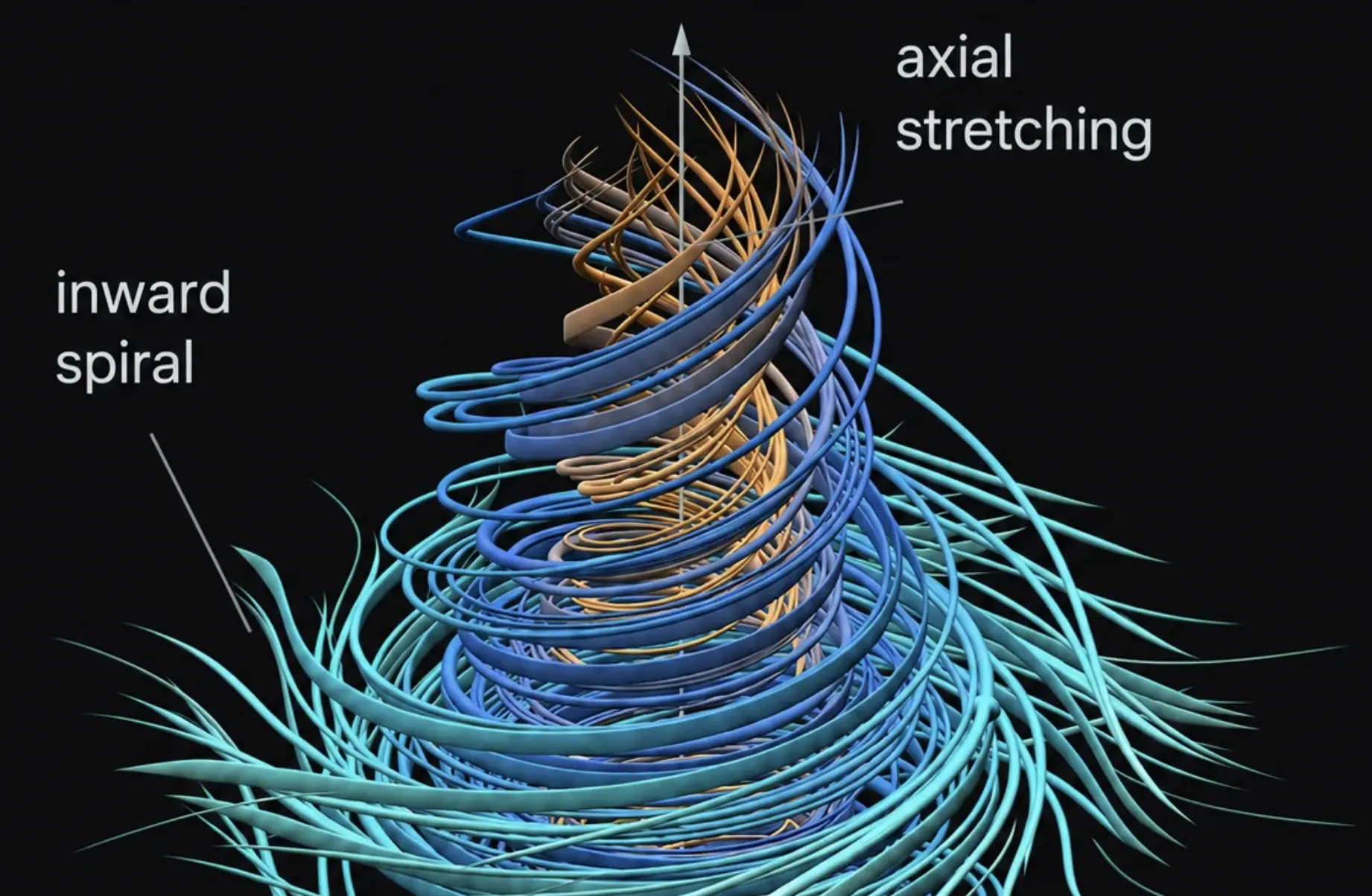
The Navier-Stokes existence and smoothness problems involved this time are one of the seven "Millennium Prize Problems" established by the Clay Mathematics Institute, with a reward of US$1 million. The Navier-Stokes equation is widely used in fluid mechanics, but theoretical research is still insufficient. OpenAI later published a complete proof of the Navier-Stokes existence and smoothness problem, and Buckmaster's discovery had previously taken steps towards this problem. According to OpenAI, this week-long work consumed a total of
300 billion output tokens
——If calculated based on current Astra rates, it is equivalent to22.5 million US dollars
calculation cost.OpenAI was accused of not starting the sprint until it was informed of the progress
"There's another part of the story that, to be honest, I very much wish I didn't have to care about," Buckmaster wrote in a statement. As he and Alpöge were completing their own research, he said, they learned that "information about our progress had been passed on to OpenAI." After they contacted OpenAI, the other party said they had obtained a complete proof of the core problem. But when asked when OpenAI started researching this problem and how much manpower it invested, the other party’s answers became increasingly vague."It turned out that an entire team was already working on the problem, using an incredible amount of computation... Ultimately, it was agreed upon that
the first tip came within a few days of the information about our work reaching OpenAI
. "Buckmaster said.If this statement is true, it means that the OpenAI team has believed that the research direction of Buckmaster and Alpöge is correct, and decided to use its huge advantages in computing resources to provide a formal proof first. OpenAI's announcement confirms much of the timeline, specifically noting that the latest attempt began on September 1, following rumors that "two millennium puzzles had been solved." The announcement also confirms ongoing conversations with Buckmaster and Alpöge.
Unique methods and signature disputes
Buckmaster said that while mathematicians have studied the problem extensively, the specific strategy he and his collaborators adopted was far from mainstream, leading him to wonder why OpenAI would adopt the same approach at the same time.
"The path to Clay's problem via smoothing forces, options c and d in Fefferman's statement, is the route pioneered by Luis and Diego, and the route Levent and I quietly chose to attack." Buckmaster wrote, "As far as I know, almost no one is working on this route. This is not a direction that can be reached by handing the problem statement to the model and taking a few days."
While Alpöge is employed by Anthropic, this research was not conducted on behalf of the company. Therefore, the two used a variety of models, mainly relying on OpenAI's Codex. Even so, Alpöge’s relationship with rival labs seems to have become a sore point for OpenAI. Buckmaster said OpenAI's Bubeck asked him to remove Alpöge's attribution from a proposed compromise.
When Buckmaster insisted on making the controversy public, Bubeck responded: "Why would you ruin your career?" Buckmaster said that after Buckmaster retorted, Bubeck said: "If you don't want me to be nice, I don't have to be nice."
Training data concerns and OpenAI’s response
Buckmaster is also concerned that because he uses Codex extensively when building projects, information about his work may be fueling OpenAI's own problem-solving efforts. OpenAI reserves the right to interactively train models using Codex, although users can opt out. If the OpenAI team uses a model based on Buckmaster's own Codex interactive training, it is possible for the model to "repeat" his work when faced with similar problems.
OpenAI downplayed the possibility of memory retrieval in its announcement: "We (researchers and agents) did not see any of their work in any way before they were released publicly — and in particular, did not have access to any specific user data in order to understand this problem." The announcement stated, "While unlikely, we cannot rule out that their use of de-identified data generated by our product helped improve our model. However, our proofs differ significantly, and even the precise results in the Euler case are different (forced vs. unforced)."
Regardless of the controversy, the matter is likely to reignite the ongoing debate about the role of AI in mathematical research, and OpenAI's specific motivations in it. Buckmaster seems to believe that the best response is to make as much research information as possible available to the public.
Related articles:
OpenAI’s unreleased internal AI model is said to solve the Navier-Stokes equation problem
Comments