
Abstract:
Next Thursday, Google will put an experimental satellite into orbit. The satellite has enough computing power to answer simple artificial intelligence query requests from space. Last month, in a laboratory in San Francisco, a team of technicians wearing protective clothing and hair nets conducted various tests on the refrigerator-sized satellite commissioned by Google, and repeatedly debugged and inspected it.
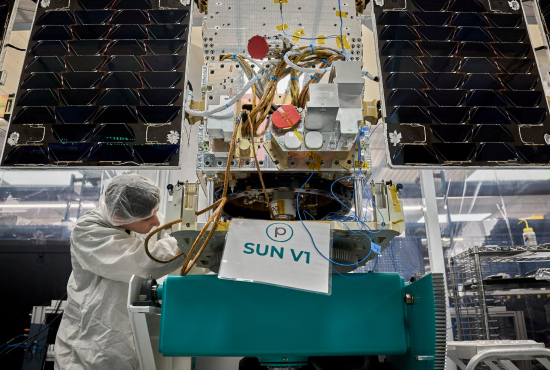
They first inspect the satellite's solar panels, which will be deployed in space and pointed at the sun. The satellite was then placed on the test bench and subjected to severe vibration testing to verify whether the internal chips were damaged during the lift-off process and whether the entire machine would disintegrate. Technicians carefully draw thin line marks on each screw to determine whether the screws have loosened during the vibration process.
The satellite successfully passed the vibration test, all screws remained tight and the chip was intact. James Manica, Google's senior vice president and head of research, called the test results "very good," but said he still had questions about the actual performance of the satellite after it was put into orbit.
This work is part of Project Suncatcher, an ambitious project by Google. The project aims to deploy artificial intelligence data centers into space and use solar energy to power them. On October 1, this satellite, produced in the San Francisco laboratory and named MVP by Google, will become the first step taken by the technology giant. The satellite will be launched into orbit on a SpaceX Falcon 9 rocket from Vandenberg Space Force Base near Santa Barbara, California.
Just a year ago, this idea seemed like a science fiction dream.
Elon Musk, Jeff Bezos, Sam Altman and others have expressed support for the orbital data center idea. But this idea faces many challenges, including the high cost of resisting space radiation and sending the equipment out of the atmosphere. As terrestrial data centers encounter public opposition and physical constraints, the appeal of deploying computing facilities above the earth is growing.
It should be noted that Google is not launching a complete data center this time, but just a pre-experimental prototype. MVP is equipped with four specialized chips called tensor processing units (TPUs), with computing power equivalent to a server in a ground data center. Satellite solar panels can only provide about 1 kilowatt of power to the chip, which is roughly the same as the power consumption of a hair dryer.
But this power is enough to help Google test hardware in the harsh environment of space. The satellite can handle simple AI queries and is designed to have a one-year operating life, but the satellite can orbit the Earth for up to six years. Eventually, it will return to the atmosphere and burn up under the influence of the Earth's gravity.
Manica said that Google’s expectations for this satellite are very cautious.
"Frankly speaking, we don't expect to be able to come up with a system that can be stably put into practical use in the next few years." He compared this task to Google's early self-driving car development process, "Don't forget, Google studied this for about 15 years before seeing the results. I think this project will follow a similar rhythm."
Brandon Lucia, a professor of electrical and computer engineering at Carnegie Mellon University, said that expanding from a single satellite to a large satellite cluster and building a giant distributed data center will take a long time and huge amounts of money.
“Once you enter the large-scale deployment stage, more engineering problems will arise,” he said. “This is uncharted territory.”
The Suncatcher project was proposed by Bryce Aguera y Alkas, a 51-year-old Google vice president and AI researcher who leads an intelligent technology research team. About three years ago, he attended a gathering of entrepreneurs and AI researchers. The core topic of the meeting was the rising energy consumption of AI systems. After attending the meeting, Aguera y Alkas determined that the data center must be moved to space to make full use of solar energy.
He said: "I have been thinking about this idea since I was a child. The idea of using stellar energy for calculations has long existed in science fiction works."
Agaila y Alkas quickly reported his idea to Manica. Manica was not optimistic at first, but agreed to conduct experiments to verify whether AI chips can be cooled in space and resist space radiation.
So in February 2025, Google sent the AI chip to the Crocker Nuclear Laboratory in Davis, California. A large particle accelerator in the laboratory (a cyclotron, whose magnets were used in similar devices in the Manhattan Project) irradiated the chip with a dose equivalent to the total radiation the chip would have received if exposed to space for five years.
Space radiation can cause bit flips. This type of fault will change the physical state of the circuit, turning 0 into 1 or 1 into 0 in the binary code, which can easily cause serious system failures. But the results of Google's cyclotron experiments are promising: In most cases, bit flipping problems can be fixed by restarting the chip.
In May 2025, Manica organized a meeting, in which Aguera y Alkas attended, reported to Google CEO Sundar Pichai, and applied to continue advancing the project. To his surprise, Google co-founder Sergey Brin also attended.
Brin and Pichai quickly approved the project. Agella Yi Alkas quoted Brin's original words: "Okay, this idea is feasible, let's discuss the implementation plan."
After receiving high-level approval, the Suncatcher plan accelerated. Google did not disclose the amount of investment in the project, but it expects that as satellite launch costs decline, the cost of orbital data centers will be roughly the same as that of ground data centers in the mid-2030s.
Google soon signed a contract with Planet Labs, a satellite imaging company it had invested in, and commissioned it to manufacture satellites equipped with AI chips. James Mason, chief space officer of Planet Labs, said that he and Brin had discussed the idea of space computing power for many years, but the idea was still vague at the time.
“At that time, this matter was still very far away.” Mason said, “At that time, large models had not yet emerged, and the demand for AI computing power had not yet entered the exponential growth stage.”
Planet Labs originally agreed to launch two satellites for Google in 2027. However, the Internet giant hopes to achieve orbit this year and is willing to take risks and shorten the construction period. Eric Stevens, director of systems engineering at Planet Labs, said that in order to speed up the progress, Google directly installed its self-developed chips into Planet Labs’ ready-made satellite platforms for testing.
The biggest technical difficulty lies in the heat dissipation of the AI chip: the chip generates a lot of heat when computing and processing information. Fans are commonly used on the ground to dissipate heat, but fans cannot work in the vacuum space environment. The Silicon Valley company therefore developed a heat dissipation solution that uses multiple layers of thermally conductive materials to dissipate heat into space.
The bottom layer is the Google AI chip, which is placed on the green motherboard; the upper layer is the thermal interface material, a light green paste-like sheet, similar in shape to a fruit roll, which connects the chip to the aluminum and copper heat dissipation layer to conduct heat away from the motherboard; the outermost layer is a radiation heat dissipation plate, which dissipates heat into space.
Travis Beers, senior director of product management for the Suncatcher program, said: The chip can run continuously in space for about 15 minutes at most, and then it must shut down for cooling. During this time, the chip can process short queries and support Google's Gemini large model to provide responses.
Google is already planning the next steps. It plans to launch a pair of satellites next year, and has also designed a cluster of more than 80 satellites. The satellites will fly in close formation, communicate with each other, and collaboratively process AI queries. Google is also in talks with designers to consider building a custom satellite the length of a football field.
Beers said: "If everything we do works perfectly after five years, it only means that we have not taken enough risks and learned only a limited amount. In the long run, if the project is truly successful, this matter will eventually become commonplace, and people will not think that the query they initiated to Gemini may be completed in space."
Comments