
Abstract:
A research team from the Korea Advanced Institute of Science and Technology (KAIST) and the Georgia Institute of Technology in the United States has developed a polyacrylonitrile (PAN) membrane that can pre-separate real crude oil at room temperature. The research was published in the journal Nature. Unlike traditional distillation, which first heats the crude oil to above 350 degrees Celsius and then condenses and fractionates it, this method does not require heating the crude oil first. The goal is to filter out some of the lighter components first and then hand them over to the existing distillation process for processing.
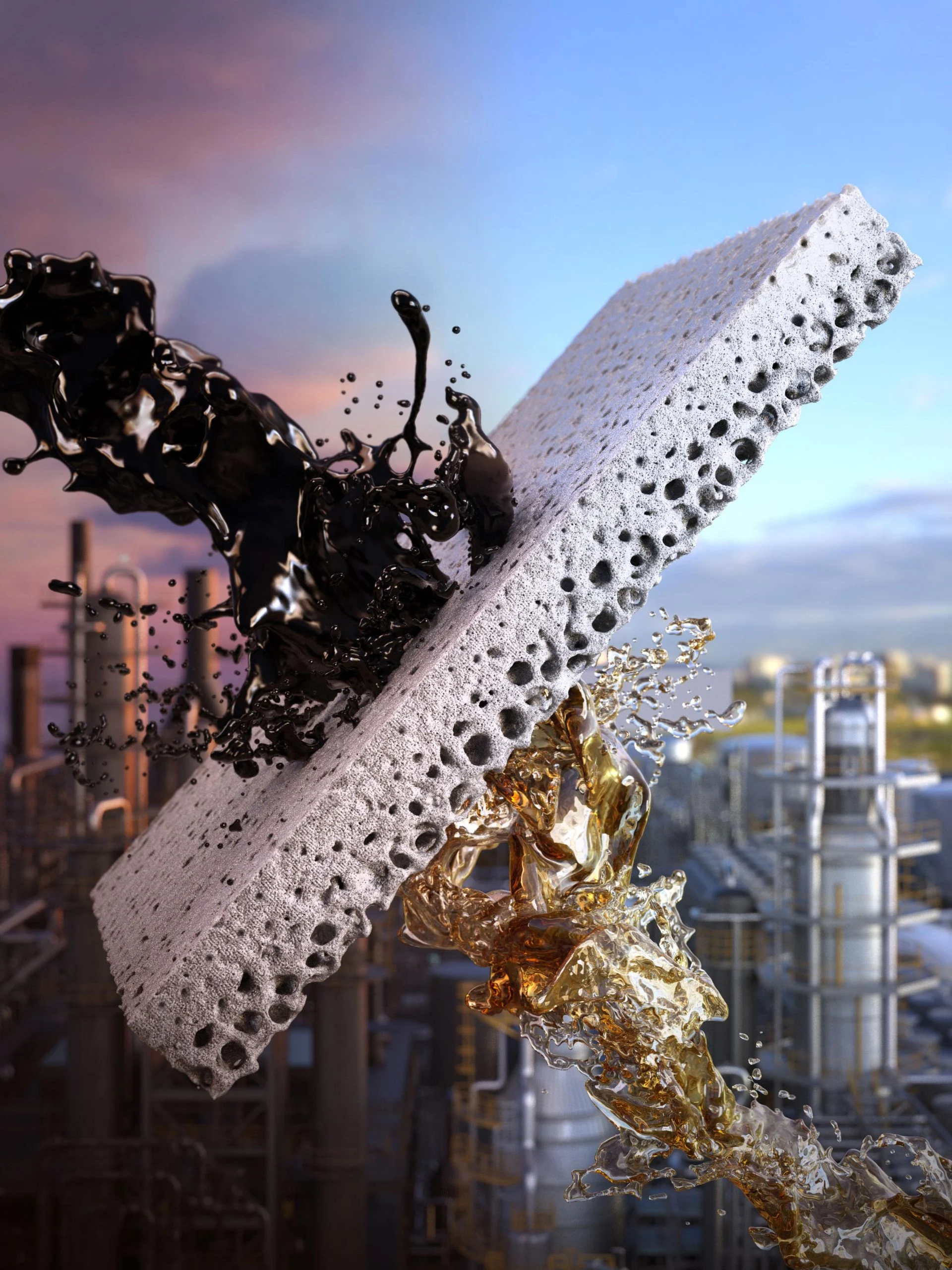
The key to this technology is the abnormal utilization of "membrane fouling". The researchers let crude oil flow through a porous PAN membrane commonly used in industrial filtration systems. The heavy hydrocarbons in the crude oil gradually deposited on the pore walls, narrowing the initial pores of about 15 nanometers to less than 2 nanometers, forming channels that can screen molecules. Lighter components such as naphtha, gasoline and kerosene pass through more easily, while heavier components are retained; when the deposition reaches a stable level, the separation channel remains stable. The research team used real crude oil provided by HD Hyundai Oilbank for testing.
In the tangential flow experiment, the crude oil permeability of the PAN membrane reached a maximum of 0.591 liters per square meter per hour per bar, exceeding the previously reported benchmark by 23 times; the selective separation performance was maintained continuously for four weeks. The “23 times” here refers to the comparison of the membrane permeability with the previous crude oil separation membrane benchmark, and does not mean that the processing capacity of the entire refinery has increased by 23 times.
The researchers also used process simulation evaluation to compare membrane pretreatment before and after adding traditional atmospheric distillation. The results showed that energy consumption may be reduced by 31.6%, carbon dioxide emissions may be reduced by 37.6%, cooling water consumption may be reduced by 20.7%, and the annualized total operating cost is estimated to be reduced by 36%. The cost analysis assumes that the membrane unit price is US$10 per square meter. If fully adopted in South Korea's refining and petrochemical industries, the research team estimates that it can reduce greenhouse gas emissions by about 10 million tons per year, equivalent to the emissions of about 4 million fuel vehicles.
These energy saving, emission reduction and cost figures are derived from process simulations and estimates and are not the results of commercial refinery field operations. The membrane currently demonstrates pre-separation before distillation. Researchers still need to promote large-area membrane components, long-term reliability and large-scale operation verification; if it is applied, existing refineries may be able to connect it as a modular filtration unit without completely replacing the distillation equipment. The team also proposed to explore uses such as waste plastic pyrolysis oil purification, battery manufacturing solvent recovery, biofuel purification and pharmaceutical purification in the future, but these are still potential applications.
Comments