
Abstract:
Scientists have successfully demonstrated for the first time a radio antenna consisting of a laser-generated plasma beam. This device does not require the common metal rods or mechanical telescopic structures of traditional antennas. Instead, it uses lasers to ionize the air to form a slender plasma channel, and then feeds radio signals through the electromagnetic field, allowing it to emit radio waves. Researchers say this technology is expected to be used in satellite communications, radar systems and space exploration equipment in the future.
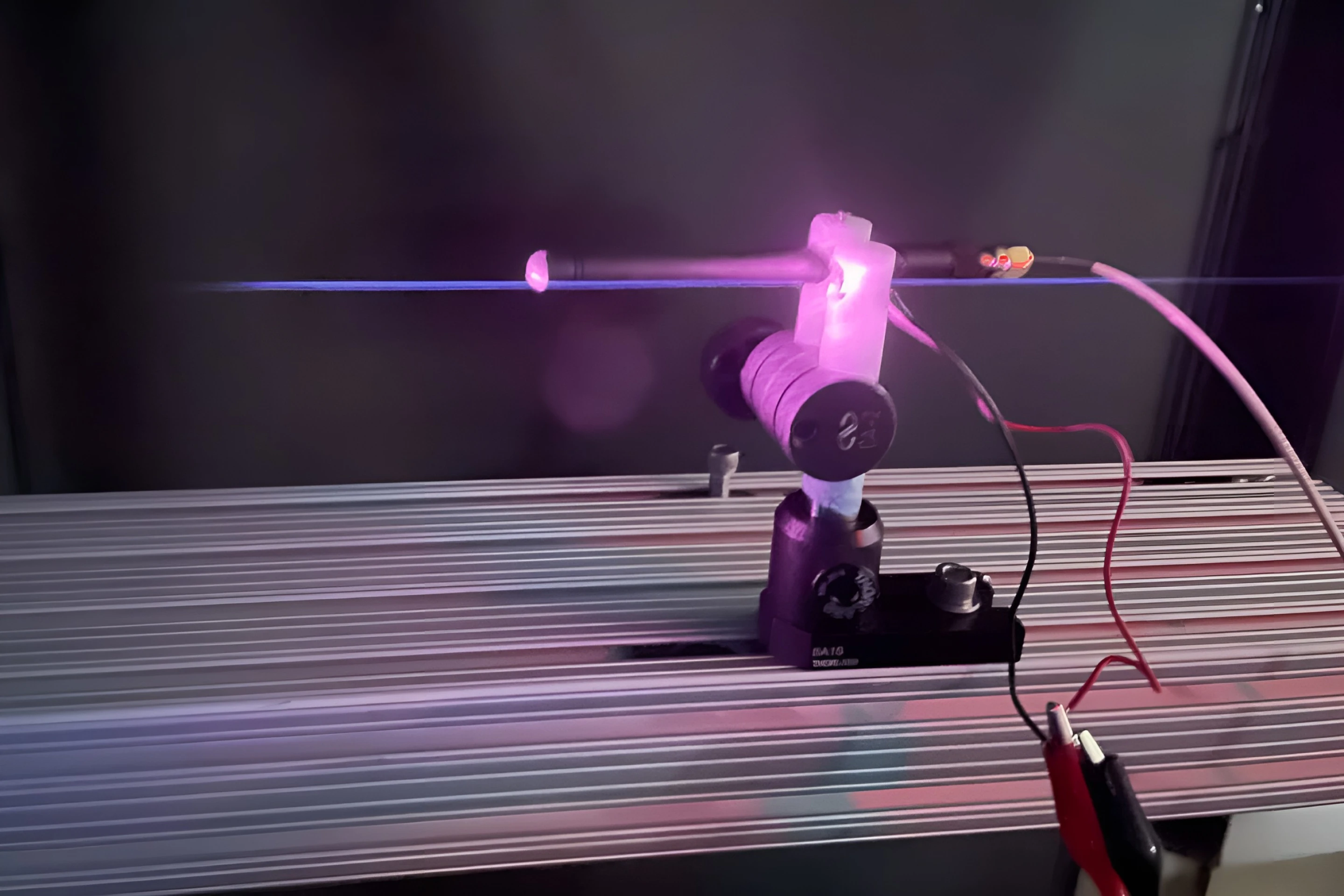
This research was conducted by a research team from North Carolina State University in the United States, and the related paper was published in "IEEE Transactions on Microwaves" on September 1, 2026. Researchers have demonstrated a technology called laser-induced plasmon filament antenna and experimentally confirmed for the first time that this laser-generated plasma channel can act as a real antenna to emit radio signals.
The physical size of a traditional antenna is closely related to its operating frequency. Typically, the length of an antenna affects the radio wave frequencies it can effectively transmit or receive. If the device needs to switch between different frequency bands, it is often necessary to use antennas of different sizes, or to adjust the antenna length with the help of a mechanical structure. For equipment such as satellites and aircraft that have strict requirements on weight, volume and structural complexity, this design may increase engineering difficulty.
Plasma antennas offer a different approach. Plasma is an ionized state of gas formed after being subjected to sufficient energy. It contains charged particles that can interact with electromagnetic fields. The researchers used a laser with a specific power and beam diameter to illuminate the air, ionizing air molecules in the laser path to form a slender plasma filament. By adjusting the laser parameters, researchers can control the properties of the plasma channel, including its length, thereby changing the operating conditions of the antenna.
However, creating a plasma channel is only the first step. The team also had to figure out how to feed radio signals into this channel. Because direct contact with the plasma using metal wires may change its structure, the researchers designed a contactless feed device.
The device uses a metal ring as a capacitive coupling structure. The laser passes through the metal ring, creating filaments of plasma inside the ring. After the radio frequency signal generator inputs a signal to the metal ring, the metal ring generates a corresponding electromagnetic field and transfers energy to the plasma filament through capacitive coupling, causing it to radiate radio waves. The entire process does not require metal parts to be in direct contact with the plasma.
In the experiment, the researchers let the plasma antenna emit radio signals at a frequency of 30MHz and placed a receiving antenna nearby for measurement. Experimental results show that compared with the control situation where the laser is blocked and no plasma antenna is formed, after enabling the plasma filament, the signal strength measured at the receiving end is increased to approximately 2.5 times, which is an increase of approximately 150%. This provides experimental evidence that laser-generated plasma filaments can serve as antennas.
The researchers believe that one of the most attractive features of this antenna is the ability to adjust the physical length of the antenna by changing laser parameters. In theory, this means that the device can change its operating frequency as needed without having to rely on complex mechanical telescoping devices. This flexibility could lead to new design space for systems that need to cover multiple radio frequency bands.
Another potential advantage is that the antenna direction can be controlled by the laser beam. The research team pointed out that as long as the propagation direction of the laser is changed, the direction of the plasma filament can be changed. This method may be used in the future to adjust the radar scanning direction, or to focus communication signals in more favorable directions to improve signal performance in specific directions.
Satellites and space exploration equipment are application areas of particular interest to researchers. Traditional satellite antennas often need to consider the deployment mechanism, structural weight and available space, while laser-generated antennas are expected to reduce some mechanical structure requirements. This adjustable design may also be valuable for space equipment that needs to switch between multiple frequency bands.
However, this does not mean that the technology can already be directly used for deep space communications. The research team pointed out that in the low-Earth orbit environment, there is still a thin atmosphere enough to form plasma, so it is feasible to use laser to generate plasma filaments. However, in an environment where the atmosphere is extremely thin or even close to a vacuum, how to generate and maintain appropriate plasma channels will become a problem that must be solved.
The researchers also do not claim that the antenna has complete two-way communication capabilities. What has been demonstrated so far is radio signal transmission, and it has not yet been experimentally verified whether it can work as a receiving antenna. Its emission efficiency, signal gain, working stability and performance in complex environments also require further study.
Paper co-author Paul Franzon, a professor at North Carolina State University, said that this technology provides a new way to customize the shape of the antenna without the need for a complex mechanical deployment mechanism. The research team believes that the current results are only the first step in technological development, but it proves that laser-induced plasma filaments can truly function as antennas, and subsequent work will focus on improving performance and exploring practical applications.
Overall, the significance of this research is not to have created a new device that can replace all traditional antennas, but to verify for the first time the feasibility of using lasers to temporarily manufacture antennas in the air. If issues such as energy consumption, signal gain, stability and actual environmental adaptability can be solved in the future, plasma beam antennas are expected to become a new choice for satellites, radars and other communication systems that require flexible adjustment of antenna shapes.
Comments