
Abstract:
While exploring the Mariana Trench, scientists discovered evidence of the deepest explosive undersea volcanic eruption ever recorded. The evidence comes from thin layers of volcanic rocks in the fore arc on the western side of the trench, an area that typically shows little young volcanic activity.
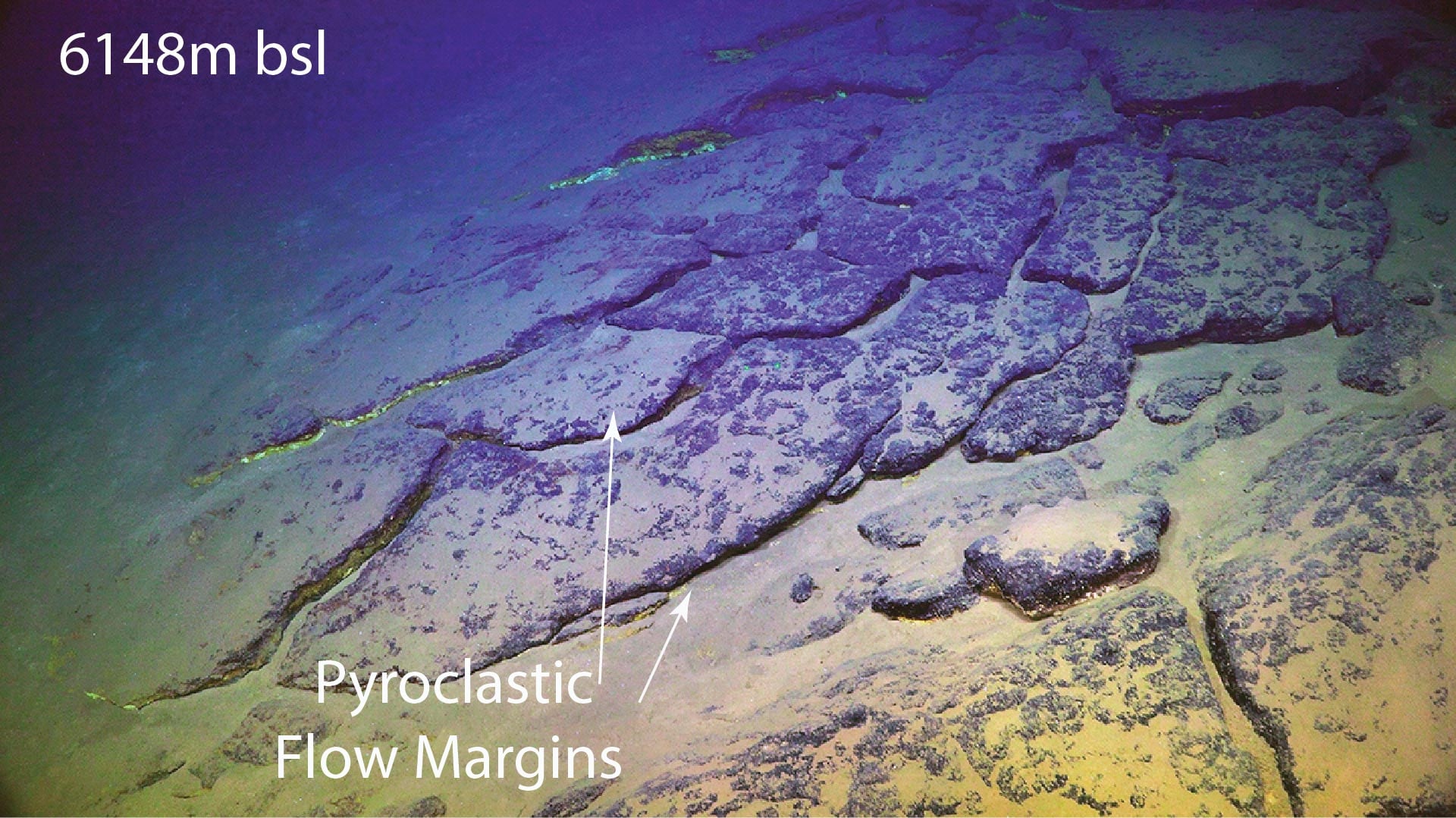
The Mariana Trench began to form about 52 million years ago, when the Pacific Plate began to subduct under the Philippine Sea Plate. At the end of 2024, researchers sent the remotely operated submersible "Jason/Medea" to investigate a 550-kilometer-long forearc area near Challenger Deep. Although the submersible can only dive to 6,500 meters, the seven dives it completed within a range of about 300 kilometers revealed significant differences between the east and west sides of the trench: the water is deeper and the trench walls are steeper on the east side, while unexpected volcanic sediments appear on the west side.
"Explosive volcanic activity near trenches is not common, so we were very surprised. This is the deepest pyroclastic rock ever recorded from the global ocean," said Dr. Robert Stern, lead author of the study, published in the journal Frontiers in Geoscience.
What makes this discovery particularly special is that the mantle beneath the forearc is usually not hot enough to melt, and young volcanic rocks are very rare. In addition, extreme seafloor pressure can limit the expansion of gases in the magma, changing eruption patterns. Stern explained that the pattern of volcanic eruptions at such depths is different from that on land or in shallow water environments; the explosive eruptions observed on land would not be as violent under high-pressure conditions because the gases in the magma cannot fully expand. Researchers are still studying this phenomenon and trying to understand the mechanisms.
The rocks also reveal that the forearc is being stretched in two different ways. Older rocks on the east side indicate that tectonic plates are being mechanically pulled apart; younger volcanic rocks on the west side indicate that magma is rising from the mantle and adding new material. The researchers believe that both processes may have occurred simultaneously, but more samples and radioactive dating are needed to confirm.
These findings also help explain why Challenger Deep is so deep. The tectonic plates here are relatively weakly connected, allowing the sinking Pacific plate to move more easily. Because the plate is relatively narrow and short, it is able to bend more sharply as it sinks, creating steeper trenches. The researchers also predict that the stretching forearc will widen existing subduction zones and could affect plate motion across the western Pacific. Stern said: "The sinking of oceanic plates in subduction zones provides most of the energy driving the movement of Earth's plates, so as this subduction zone widens, at least plate movement in the western Pacific will be affected."
Currently, the research team has not found the specific location of the volcanic eruption. However, the state of the recovered rocks provides clues about how far the volcanic material traveled. "We haven't pinpointed the eruption site yet," Stern said. "We know these high-temperature pyroclastic flows moved down the slope, but we don't think they moved very far. They retain enough heat to reweld into fairly hard rock; if the pyroclastic flows traveled a long distance, that heat would be lost."
Researchers hope to return to the area and explore deeper into the trench. The Challenger Deep is nearly 11,000 meters deep, which is still beyond the capabilities of the equipment used in this expedition. Stern added: "We want to study more of the Challenger Deep forearc area and go deeper. We cannot study the seafloor between 6,500 meters and 11,000 meters, which is the depth of Challenger Deep. Currently only Chinese scientists and some wealthy entrepreneurs have the research tools to reach the bottom of Challenger Deep."
This research was funded by the National Science Foundation, and the paper was published on September 24, 2026.
Comments