
Abstract:
The Sony PlayStation 5 was originally designed as a console for video games, but an open source development project is trying to find another use for this gaming device: running local artificial intelligence large language models. By cracking the system limitations of PS5, the developers transplanted the open source inference engine llama.cpp to the console and further used its GPU to run large models. The latest demonstration shows that a cracked ordinary PS5 can already run the Qwen 3.8 model with 27 billion parameters. Using low-bit quantization, the text generation speed reaches about 20 Tokens per second.
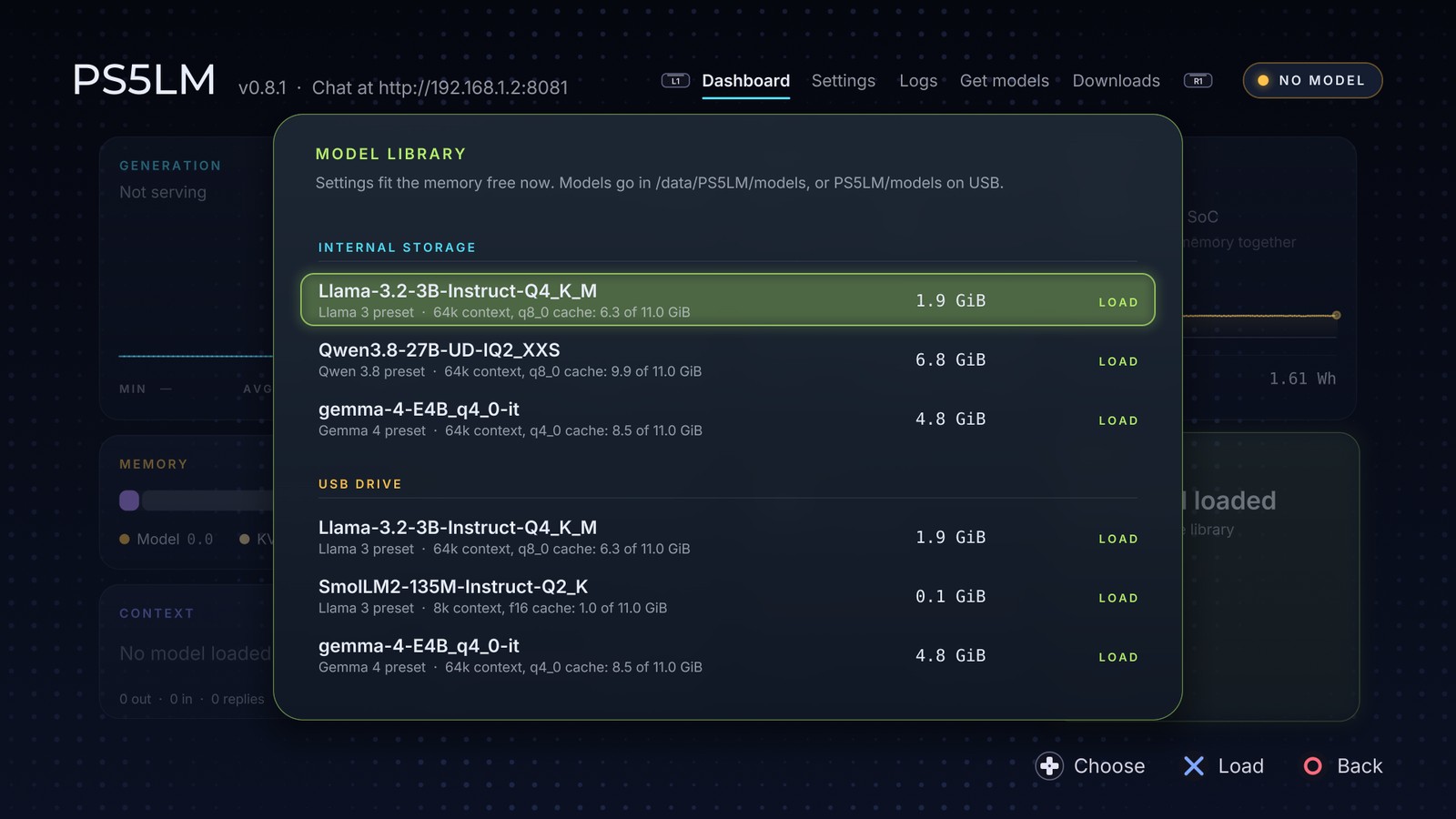
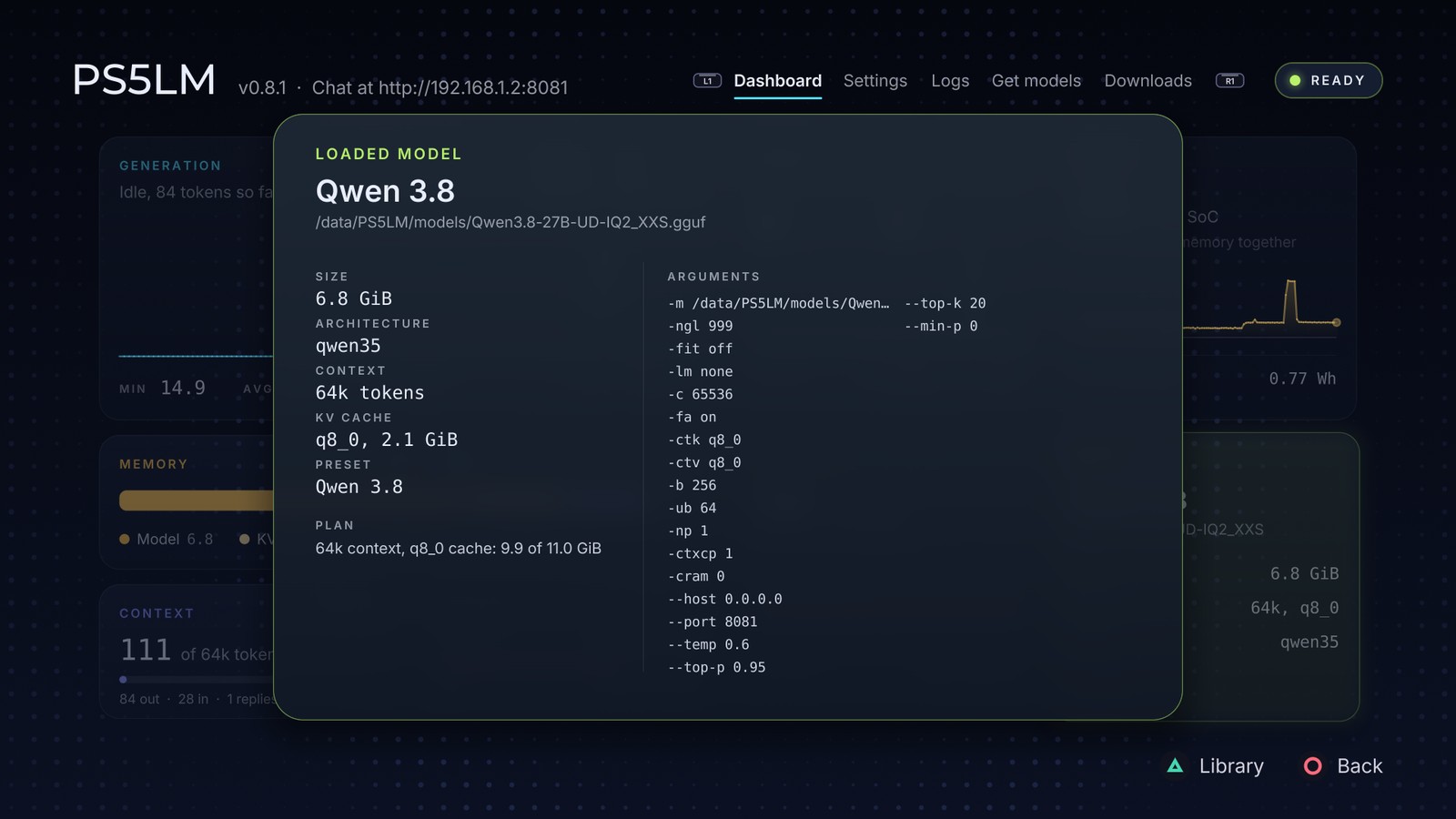
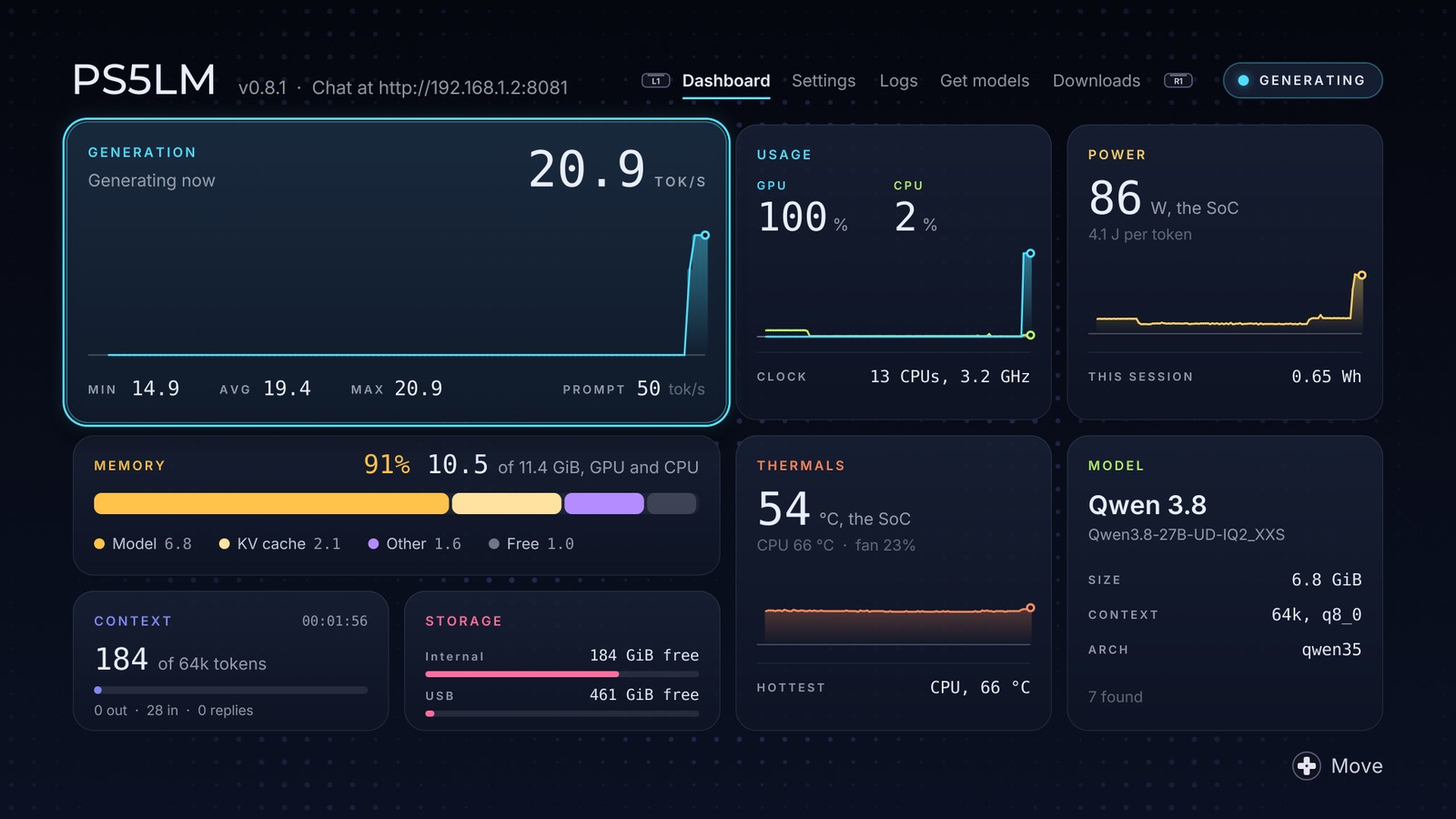
This means that a host originally used to run games can also act as a local large language model server without relying on cloud AI services. Users can access the services on the host through a computer or mobile phone in the same LAN and talk to the model. However, this is not a feature officially provided by Sony, but an experimental application that relies on system vulnerabilities, unofficial software and community development results.
The project is called PS5LM and was initiated by GitHub developer cobanov. The core idea of the project is not to write a new artificial intelligence reasoning framework from scratch, but to transplant the open source tool llama.cpp, which has been widely used for running local large models, to the PS5 platform, and then gradually solve the compatibility issues in the host operating system, memory allocation and GPU computing interface.
PS5 uses AMD's custom processor. The CPU uses Zen 2 architecture and has 8 cores; the GPU is based on AMD RDNA architecture. The host is equipped with 16GB GDDR6 unified memory, and the CPU and GPU need to share these resources. Although PS5 is not a device specifically designed for artificial intelligence inference, its GPU and high-bandwidth video memory provide the hardware foundation for running local language models.
PS5LM initially adopted a relatively simple operation mode, allowing the language model to perform inference through the host CPU and using the PS5's own browser to provide a chat interface. Users can download the model on the host, enter questions through the DualSense controller and on-screen keyboard, and then view the answers generated by the model.
This early build demonstrated the PS5's ability to run large language models, but quickly ran into performance and memory limitations. Since the program runs in the form of a payload, the memory that can be used is restricted by the system environment. Initially, only smaller models can be run stably. Project documents show that the early version mainly supports models with parameter sizes of approximately 0.8B and 2B, with the generation speed of the 2B model being approximately 9 Tokens per second.
For developers who want to run larger models on PS5, simply letting the program run on the CPU is not enough. To fully utilize the hardware performance of the host, the inference engine must be able to call the GPU and obtain enough memory space to store model parameters, cache and other running data.
The real breakthrough comes from GPU acceleration. Developers have further implemented a native application running environment on PS5, and through the graphics driver and Vulkan computing interface developed by the community, llama.cpp can call the host GPU to perform neural network calculations. Compared with the earlier solution that could only rely on the CPU, this change not only improves the inference speed, but also allows the program to obtain more available memory to try to run larger models.
In the latest demonstration, PS5 successfully ran the Qwen 3.8 27B model launched by Alibaba Tongyi Qianwen team. The model has 27 billion parameters and uses a hybrid attention architecture. The design goal is to provide strong language understanding, reasoning and code generation capabilities on relatively limited hardware resources.
However, PS5 does not load 27 billion parameters directly into memory with complete precision. In order to adapt the model to the hardware conditions of the host, the developers used low-bit quantization technology to compress the model parameters into a smaller storage space. The demonstration uses quantized versions such as IQ2_XXS, and the model file is about several GB to 7GB, and the specific size depends on the quantization scheme.
Quantification is a key technology in running large local models. Typically, model parameters are stored using a higher-precision data format, but this consumes a lot of memory. By compressing parameters into lower bit-width values, you can significantly reduce memory requirements and reduce the amount of data transfer during inference. The cost is that some precision information will be lost, which may affect the model's answer quality, reasoning ability, or specific task performance. Therefore, being able to run a 27 billion parameter model does not mean that PS5 can run a model of the same size at full accuracy.
Test data released by the developer shows that when using the GPU to perform inference, the text generation speed of Qwen 3.8 27B can reach about 20 Tokens per second. Token is the basic unit for large language models to process text. It is not strictly equivalent to a Chinese character or an English word. Therefore, 20 Tokens per second cannot be simply understood as generating 20 Chinese characters per second. Still, that's fast enough for interactive conversations to have some practicality, rather than just being a technical demonstration to prove a model can get off the ground.
In addition to the Qwen model, the same project also announced the test results of other models. Gemma 4 E4B generates approximately 61 tokens per second, while Llama 3.2 3B reaches approximately 124 tokens per second. Small models have fewer parameters, require fewer calculations and data reads, and therefore generally achieve higher generation speeds.
These results should still be regarded as test results published by developers under specific software and hardware configurations, rather than industry benchmarks verified by a unified test platform. Different models have different parameter scales, quantification methods, context lengths, and computing tasks. Their comprehensive capabilities cannot be judged based solely on the number of tokens generated per second.
The project also demonstrates the possibility of transforming PS5 into a LAN AI server. By running an OpenAI API-compatible service interface on the host, other devices can send requests over the same network and get answers generated by the model. In this way, users do not always have to face the TV screen to operate the console, and can also call the local model on the PS5 through a computer or mobile phone.
This approach is attractive to users who want to deploy local AI services in their home networks. When the model is running locally, daily conversation content does not need to be sent to third-party cloud AI services in principle, and users do not have to pay cloud inference fees based on the number of calls. However, the actual privacy protection still depends on the installed software, network configuration, and whether the device has other data transmission behaviors. The system cannot be deemed to be absolutely safe just by "running locally".
At the same time, PS5LM development still relies on a series of unofficial technologies. Users need to have a PS5 that can run the relevant cracking program and use compatible system firmware and payload loading tools. The applicable firmware range listed in the project document is 7.00 to 13.60, but specific functions, performance and compatibility may vary depending on the host model and software version.
Cracking the console does not mean that all PS5 users can directly install the program. The ordinary retail version of PS5 cannot download and run PS5LM through the PlayStation Store like regular games. Users need to first solve problems such as system access permissions, unofficial program loading and operating environment, which still poses a certain threshold for users who are not familiar with host cracking and software development.
In addition, modifying the host system may bring security and stability risks, may also affect the use of online services, and involve Sony's relevant terms of service. Developers recommend conducting research only on devices they own or have authorized. For console users who mainly use it for normal gaming, especially those who frequently connect to the PlayStation Network, there is no need to rashly hack the device just to run local AI.
From a hardware perspective, the significance of this experiment is not just to allow the game console to answer questions. It further illustrates that the GPU and high-speed video memory installed in consumer-level gaming equipment can also undertake some of the work normally completed by dedicated AI computing equipment after appropriate software adaptation.
Large language model inference is often significantly affected by memory capacity and bandwidth. When the model generates text, it needs to continuously read a large number of parameters and maintain context-sensitive caches. PS5's unified memory architecture allows the CPU and GPU to share high-speed memory resources, but the system itself also needs to occupy part of it, so the space available for models is far less than the nominal capacity of 16GB.
This is why developers must simultaneously solve issues such as quantization, memory management, and GPU computing interfaces. Simply having a powerful enough GPU does not guarantee that a model will run smoothly; whether the model architecture is supported, whether the driver can perform the required calculation operations, and whether the system can provide enough memory for the inference program will all affect the final result.
This result also provides an interesting reference for the selection of local AI hardware. Traditionally, users who wanted to run larger language models at home often needed to purchase a computer with a discrete graphics card and pay extra for the memory capacity and overall machine cost. The PS5 already has a relatively powerful GPU and high-speed memory, so developers hope to prove that existing game hardware can also be reused without having to purchase a dedicated AI workstation.
But this does not mean that PS5 can completely replace AI computers. Its hardware resources are still limited by fixed configurations, system footprint, and unofficial software environments. Compared with computers with larger graphics memory, mature drivers and rich development tools, PS5 requires more underlying adaptation work to run large models, and users cannot freely upgrade the graphics card or expand the graphics memory like ordinary AI computers.
From a practical point of view, this type of project is currently more suitable for technology enthusiasts, open source developers and users interested in local AI to study model reasoning, GPU computing and embedded operating environments. For enterprises that need to stably run production-level AI services, dedicated GPU servers or computers optimized by mature software stacks are still more suitable.
The development of PS5LM also reflects a trend in the open source AI ecosystem: model inference frameworks and open weight models have gradually lowered the threshold for running artificial intelligence, while community developers continue to try to port these tools to different hardware platforms. In the past, game consoles were primarily viewed as closed entertainment devices; now, thanks to the efforts of the cracking and reverse engineering communities, they have also become platforms for exploring GPU computing and native artificial intelligence applications.
In general, it is a representative technical attempt to let a cracked PS5 run a large language model with 27 billion parameters at a speed of about 20 Tokens per second. It demonstrates the potential use of game console hardware and also proves that through software adaptation and model compression, language models of a certain scale can be run on non-traditional AI devices. However, this achievement is still a community project that relies on a cracked environment, and there is still a considerable distance between it and official functions that ordinary users can use without complicated operations.
Comments