
Abstract:
Amy Kremer stands near the White House on January 6, 2021, urging MAGA supporters to stop Donald Trump's claims that the election was "stolen." Now she's once again mobilizing the president's supporters — this time, to join a protest against his pro-AI agenda.
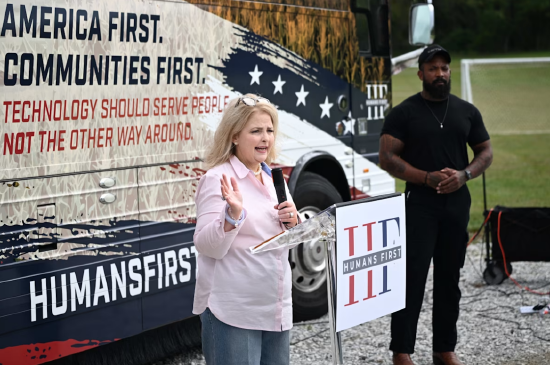
With just weeks to go before the midterm elections, the US president's support for Big Tech is alienating a group of once-loyal supporters.
“I’m not a sheep, and I’m not going to follow blindly,” the former Tea Party activist and founder of Women for Trump told a crowd last week at a protest against an AI data center in staunchly Republican Berkeley County, West Virginia.
"I want conservatives and Republicans to know that it's absolutely okay to stand up and speak out against this."
Kremer was not involved in the violence on January 6, 2021. She is one of many MAGA figures annoyed by Trump's decision to embrace the AI industry. The industry is dominated by Silicon Valley elites, who themselves have said their products have the potential to destroy humanity.
To the dismay of Republican strategists already facing a tough spot in the midterm elections, Trump has in recent weeks dismissed those who want to block data center construction as "backward and poor" and called AI security concerns - concerns shared by nearly two-thirds of Americans, polls show - a "hoax."
His comments were publicly opposed by former chief strategist Steve Bannon. Bannon called AI "radioactive" and joined forces with Bernie Sanders to call for a moratorium on the technology's development.
“American citizens will no longer kowtow to the oligarchs,” Bannon said last week.
Private unease is also growing within the White House and within the broader Republican base. A leaked memo this month showed that Trump pollster Tony Fabrizio warned the candidate that "unconditional support for building more AI data centers is a losing position" and reminded the campaign team not to "pass local concerns as ignorance."
Other strategists warned Texas Republicans that the issue could cost the party a U.S. Senate seat in November, as Democrats increasingly tap into voters' anxieties about Big Tech.
The issue is galvanizing voters across the political spectrum, fueled by a flood of campaign ads from well-funded Super Political Action Committees (Super Pacs). A poll conducted by PF Global showed that 43% of Americans said they have seen TV or online advertisements about data centers. More than one-third had spoken to someone else about the topic.
In the Oval Office, however, Trump still stood his ground. The push for a global agreement to limit the development of AI briefly gained momentum, but Trump quickly killed the initiative, saying his administration "completely rejects any attempt to construct a globalist system of control."
Conservatives worried about the political costs of Trump’s stance on AI have different explanations for his anti-populist turn.
Some believe that advisers such as Silicon Valley venture capitalist and former AI executive David Sacks have too much influence on the president and stifle critical voices. Trump also has a close relationship with Nvidia CEO Jensen Huang. Huang has downplayed AI safety concerns, accused tech industry executives of alarmism and opposed new AI laws.
“I think he has some people around him that he shouldn’t listen to,” Cramer, now chairman of the nonprofit Humans First, said of Trump. The group is organizing a nationwide bus tour called "AI Data Center Revolt."
"He's not a tech guy. He doesn't even send emails. He bases his judgment on what his advisors tell him...and these people don't have the interests of the American people at heart."
Others believe that the current fragile U.S. economy is the catalyst for this change. Today, the U.S. economy is highly dependent on AI growth as a line of defense against inflation triggered by Trump’s war against Iran.
Brendan Steinhauser, a former Tea Party activist and Republican strategist, said the president "usually stays in touch with his base... but he's really concerned about the financial implications if we don't continue down this path." Steinhauser currently heads the nonprofit The Alliance for Secure AI.
"I understand the concerns, but he should also be concerned about the national security risks and cybersecurity risks that many of us are concerned about."
However, in the tight election campaign, some Republicans are distancing themselves from Trump on technology issues. Mike Rogers, a Trump-backed candidate for the key U.S. Senate election in Michigan, is running against progressive candidate Abdul El-Sayed. He said last week that he believed "we have to slow down the development of AI" and called for "tougher protocols and protective measures" to protect Americans.
In Texas, a state that has actively attracted data center developers and was once considered a safe political environment for big technology companies, Trump's preferred U.S. Senate candidate Ken Paxton has promised to push for legislation that would hold AI companies accountable if they violate child safety regulations; ban the construction of data centers on rural land; and eliminate tax incentives for such projects.
Some ambitious Republican governors, seen as potential contenders in the 2028 presidential election, have also begun to position themselves as critics of AI.
Florida Gov. Ron DeSantis is trying to push for AI regulation over White House opposition, while Texas Gov. Greg Abbott said data center developers are getting "the backlash they deserve."
Even in the deep red state of West Virginia, some local candidates are defying the president to preserve their political futures. In Berkeley County, a $4 billion data center is planned despite opposition. Republican Chris Anders fears the issue could cost him his state House seat.
"I'm fighting for my political life now," he said. "I support the president in 2024, but that doesn't mean I have to be completely consistent with him on everything."
Back in Washington, Steinhauser and others are trying to persuade Trump. Steinhauser said some senior Trump administration officials, including Treasury Secretary Scott Bessent, "understand the problem" and "they are encouraging him to push for policies that put safeguards in place for AI."
Some conservative activists hope that Bessant can replace Sachs and his allies as Trump's new "AI director." Bessant has previously highlighted the national security and financial risks posed by advanced AI.
Some people also tried to bring the issue closer to Trump himself, emphasizing to him that if advanced AI breaks through the financial system, his bank accounts and family wealth may disappear overnight.
Conservative group Alliance for a Better Future is providing political cover for Rogers of Michigan, running ads highlighting his AI policy advocacy and praising him for "courageously supporting common-sense safeguards."
A person familiar with the group's operations said the ABF plans to "invest significant resources in key states in the coming weeks."
The White House said the president "always listens to a variety of opinions from multiple experts in different fields... to help him make decisions."
The White House also stated that "maintaining open channels of communication with technology industry leaders... is an important reason why the United States has expanded its lead in technology and innovation since President Trump took office."
Groups supporting the president's stance are also speaking out. Build American AI, a group aligned with the AI industry and indirectly funded by the founders of OpenAI and Silicon Valley venture capital firm Andreessen Horowitz, has launched a multimillion-dollar campaign to promote data centers in places like Ohio and Wisconsin. The Innovation Council, a political action committee formed with Sacks' support, is also pouring money into promoting the president's pro-AI agenda.
The Innovation Council said Trump is "absolutely right: if built right, data centers are transforming towns that have been abandoned by career politicians and left to decay."
Jordan Schachtel, a consultant at the Innovation Council, said: "I do agree that the polls are concerning, and some of the polls may indicate that the Republican Party still has a lot of work to do." He said Trump's stance on the issue is "courageous." "He told the truth: This will bring about a great era of innovation."
Despite the frequent and worrying news about out-of-control AI agents - Australia disclosed on Wednesday that an OpenAI intelligent agent had invaded the country's medical service system.
He said: "Americans might say, 'Hey, we want that too, or we want something better.'"
However, Cramer said she hopes Trump will listen to calls from his base for more regulation before then.
"I hope he changes his stance," she said. "I know that on the campaign trail, he will hear the voice of the American people. I hope he will switch to our side."
Comments