Recently, the Douyin Security and Trust Center website was launched and disclosed the principle of Douyin’s recommendation algorithm for the first time, introducing how its recommendation algorithm estimates the probability of user behavior and achieves better and richer content recommendations through multi-objective modeling and other methods.
Douyin was launched in 2016, which coincided with the recommendation algorithm beginning to enter the era of deep learning. The recommendation algorithm used by Douyin is also a type of deep learning algorithm. It is understood that the main models of Douyin’s recommendation algorithm include Wide & Deep models, etc.
At the 2025 China Online Media Forum, Douyin President Han Shangyou said at the meeting that many people have misunderstandings about recommendation algorithm technology. They believe that the algorithm tags content with corresponding tags, then tags users with corresponding attributes, and finally uses data calculations to recommend content with corresponding tags to users with corresponding attributes.
However, with the development of machine learning technology, Douyin's recommendation system almost does not rely on labeling content or users. Instead, it uses a series of neural network calculations to directly estimate each user's target behavior for each content, such as the probability of liking, following, sharing, and commenting, and selects the content with the highest probability to recommend to users. This means that algorithms can directly predict user behavior without understanding content type or semantics.
Regarding "recommendations only estimate behavioral actions", Douyin also explained on the Security and Trust Center website: When a user opens Douyin, Douyin's recommendation algorithm will score candidate videos and push the highest-scoring video to the user. Users can make various interactions with the videos they see while watching, and these interactions reflect the user's interest in the video.
For example, it is better for users to like it than not like it, to finish it is better than not to finish it, and to not dislike it is better than not liking it. Here, "finished watching" is a feedback action, and "like" is also a feedback action. Every feedback from users on the videos they watch has a positive or negative value.
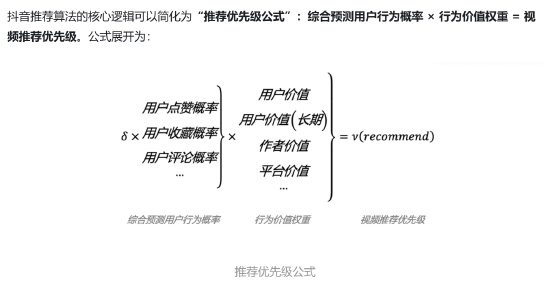
Douyin pointed out that Douyin’s recommendation ranking model learns this kind of behavioral feedback. The goal of the recommendation system is to push the videos with the highest feedback value to users. The core logic of its recommendation algorithm can be simplified as the "recommendation priority formula": comprehensive prediction of user behavior probability × behavior value weight = video recommendation priority.
So how does Douyin’s recommendation algorithm estimate user action rate? The Douyin Security and Trust Center website also shared its specific steps. The first is algorithm learning, that is, learning user behavior data, which includes both real-time new data and user historical behavior data. The second is probabilistic model prediction. The recommendation algorithm will predict the user's behavioral probability for candidate videos through the algorithm model; followed by the value model. Evaluation, through the value model, Douyin will calculate the value of the user's interactive behavior, and continuously adjust parameters, weight various values, and comprehensively consider multiple factors to evaluate the value of the candidate content; the last step is dynamic adjustment, by realizing "minute-level" real-time feedback updates, helping the algorithm to predict user behavior more accurately.
In order to guide the recommendation system to distribute richer and more diverse information, Douyin has built and balanced more than 100 different goals such as "collection" to solve the problem that the system is prone to repeatedly recommend similar content under a single goal. Douyin’s algorithm has set up special exploration traffic to help users continue to expand their interest content. Douyin has also strengthened the application of search behavior in the recommendation system, allowing the system to adjust based on user search interests in more real-time. Douyin has also optimized functions such as "not interested" and "set blocking words" to allow users to control the algorithm.