Earth and Mars have surprisingly low levels of elements such as copper and zinc that are critical to planetary chemistry and potential life. A new study overturns the old theory, showing that these elements were abundant in the early building blocks of planets. The real damage likely occurred in later epic space collisions, rather than in the early formation period as previously thought. This discovery revolutionizes our understanding of how habitable planets like Earth formed.
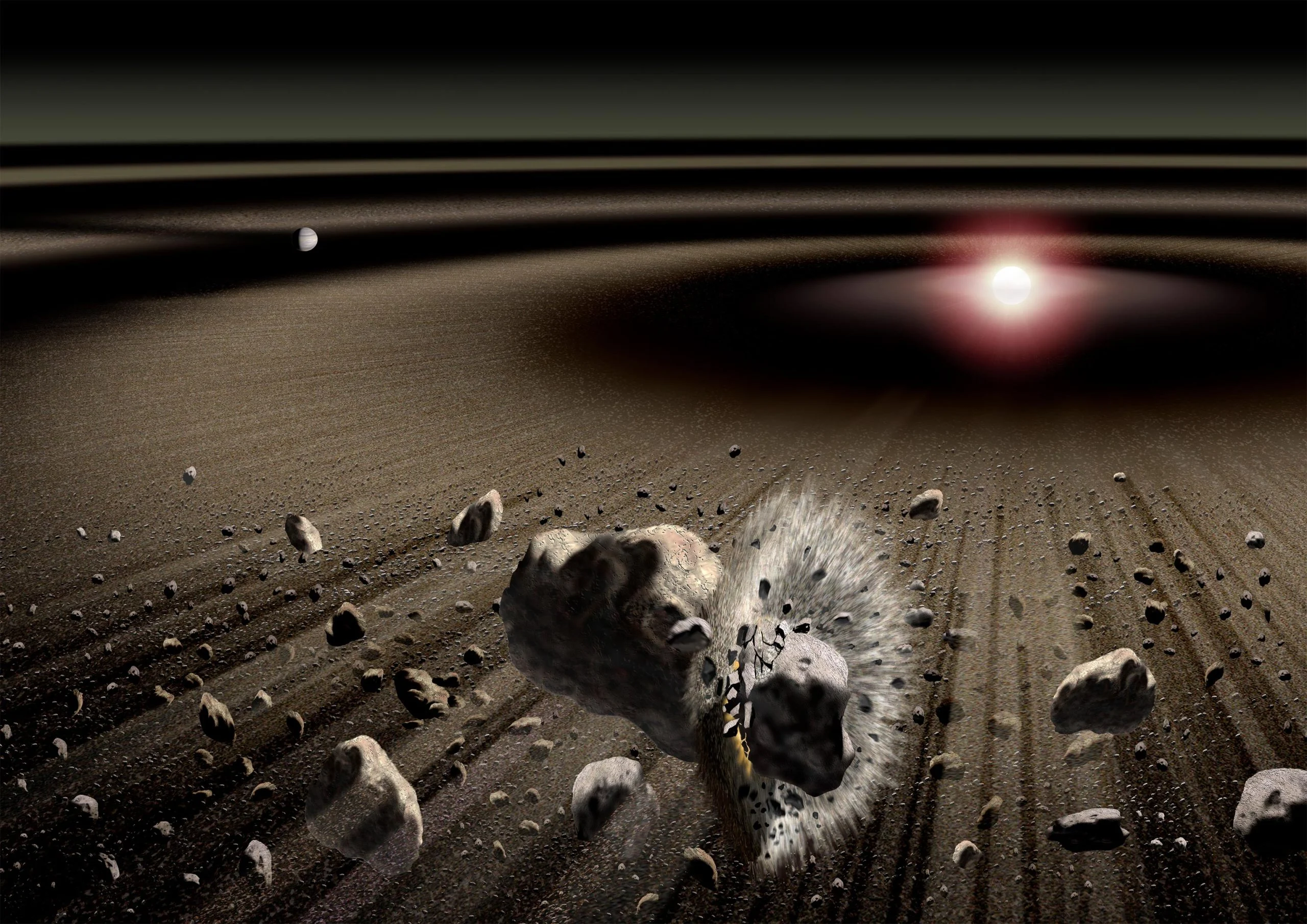
Planetary collisions during planet formation in the early solar system. Image source: Kouji Kanba
For decades, scientists have been trying to unravel a fundamental mystery: Where do Earth's key elements come from? Why do some of these elements disappear? A new study provides an unexpected answer that reshapes our understanding of how Earth formed.
The study, led by Damanveer Grewal, an assistant professor at Arizona State University and in collaboration with researchers at Caltech, Rice University and MIT, challenges long-standing understandings of why Earth and Mars are deficient in moderately volatile elements (MVEs). These elements, such as copper and zinc, are critical to planetary chemistry and often exist alongside life-sustaining ingredients such as water, carbon and nitrogen. Tracing their origins is crucial to understanding how Earth became habitable.
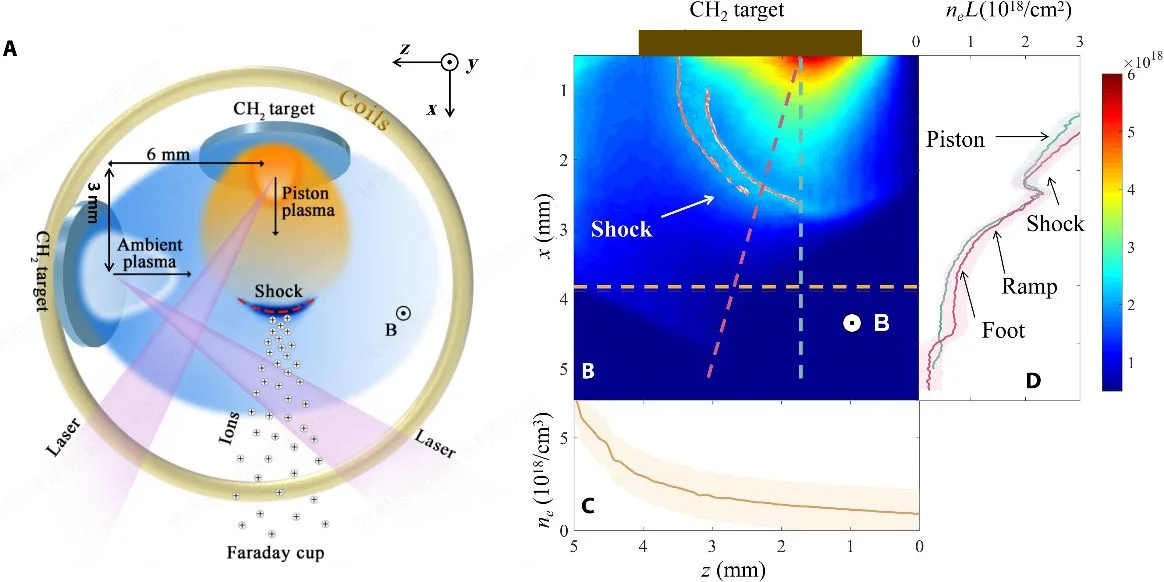
Collision-free impact experiments for laser-driven magnetization. Image source: Hui-bo Tang et al.
The study, published in the journal Science Advances, used a novel approach to study iron meteorites. Iron meteorites are the metal-rich remnants of ancient planetary building blocks, or planets, that formed in the early solar system.
"We found solid evidence that the first planets in the inner solar system were unexpectedly rich in these elements," Grewal said. "This discovery reshapes our understanding of how planets acquire their ingredients."
Previously, scientists thought that MVEs disappeared either because they never fully condensed in the early solar system or because they escaped during the planetary differentiation process. However, this study reveals a different story: Many early planets retained their MVEs, suggesting that the building blocks of Earth and Mars were lost during later periods of violent cosmic collision, which shaped their formation.
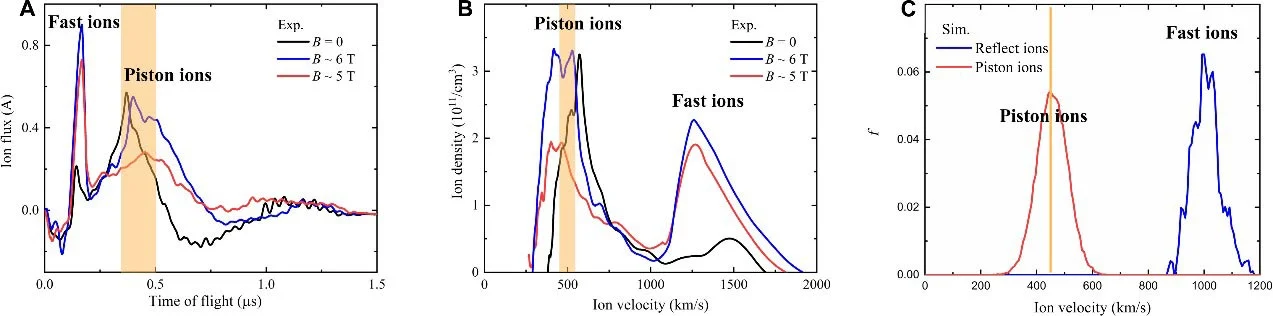
Experimental ion velocity spectra and one-dimensional PIC simulations. Image source: Hui-bo Tang et al.
Surprisingly, the team found that many inner solar system planets retain chondrite-like MVE abundances, suggesting that they accreted and preserved MVE as they underwent differentiation. This suggests that the progenitors of Earth and Mars were not initially deficient in these elements, but were gradually lost during long-term collisional growth, rather than incomplete condensation or planetary differentiation in the solar nebula.
"Our study redefines our understanding of planetary chemical evolution," Grewal explained. "It shows that the building blocks of Earth and Mars were originally rich in these essential elements for life, but violent collisions during the growth of the planets led to their depletion."
Compiled from /scitechdaily