Semiconductor company NEO Semiconductor recently announced the use of 3D X-DRAM technology to redesign memory in the era of artificial intelligence and high-performance computing. 3D X-DRAM imitates the 3D NAND flash memory in the storage industry, stacking chips vertically in multiple layers to increase density and performance.
NEO Semiconductor promises that the stacked layers can greatly increase storage capacity, enhance bandwidth and reduce power consumption. Its technical solution is to divide it into multiple sectors through vertical slits, and the word line layers are connected through a hierarchical structure (that is, the style of vertical stacking architecture).
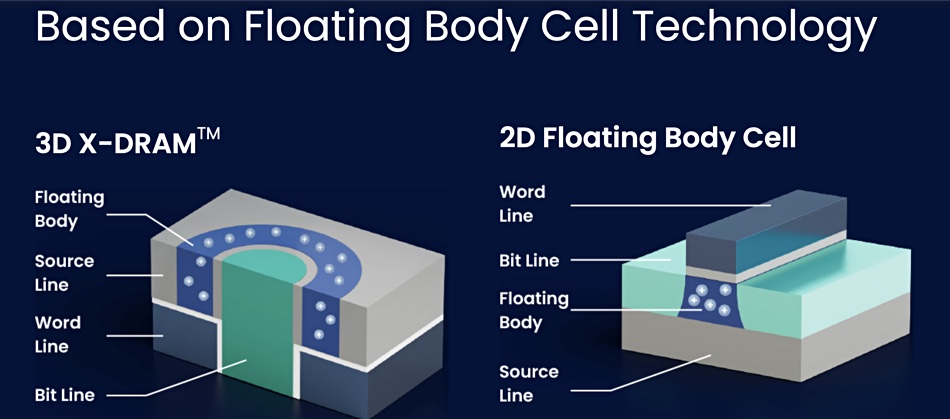
Compared with the current 0A node planar 48GB DRAM, NEO Semiconductor claims that its 3D X-DRAM architecture can allow memory sticks to reach 512GB. This type of ultra-large-capacity memory stick may have certain demand in the fields of artificial intelligence computing and high-performance computing.
However, the current proof-of-concept chip of NEO Semiconductor is still in its early stages. NEO is currently developing a simpler 1T0C architecture test version, and the more complex and advanced 1T1C version is planned to be launched in 2026. This version uses IGZO (Indium Gallium Zinc Oxide) thin film transistors with cylindrical high-k dielectric capacitors, which is expected to increase the data retention time to 450 seconds and can stack 128 layers. In the future, The 3T0C design will use dual IGZO layers, mainly for memory computing and AI applications.
Of course, these ultra-large-capacity memories will definitely not be launched for the consumer market in a short period of time, not to mention that the price will definitely be very high, and consumer hardware will not support a single large-capacity memory stick of 512GB. Therefore, after the successful development of NEO Semiconductor, it will also need to cooperate with hardware manufacturers, at least to be supported by server hardware first.