The National Academies of Sciences, Engineering, and Medicine (NASEM) recently released a report recommending that the United States build a new muon collider by the middle of this century to regain the particlephysicsleading position in the field. Muons are unstable heavy particles of electrons, and colliders use them to collide at high speeds to explore new physical phenomena. Compared with the existing Large Hadron Collider (LHC), the muon collider can theoretically achieve higher energy at a lower cost and produce new particles more efficiently.
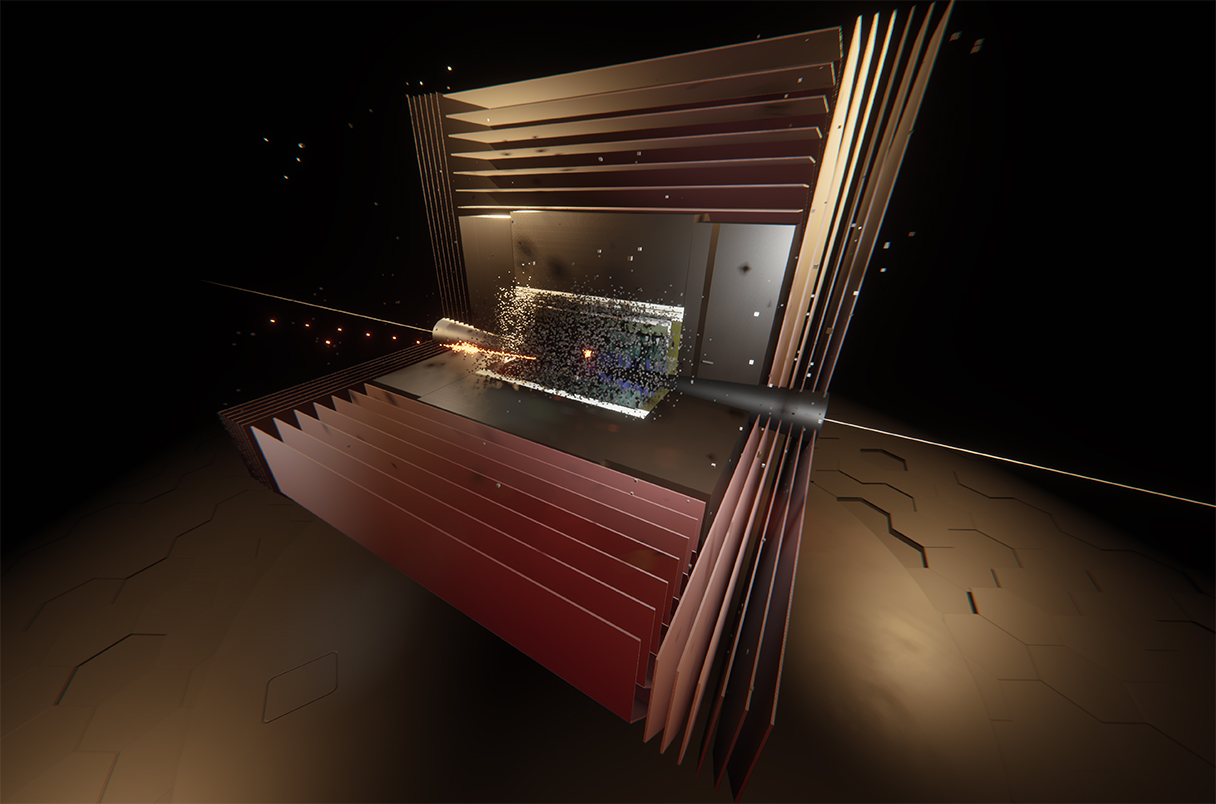
Currently, the LHC conducts research through proton collisions, but protons are composite particles, and only part of the energy participates in the reaction during the collision. Muons are elementary particles that can release all their energy when colliding, making a 10 trillion electron volt (TeV) muon collider comparable to a 100 TeV proton collider. In addition, muon mass is smaller and the circular orbit required for acceleration is more compact, which may significantly reduce costs.
However, muons have an extremely short lifespan, and the collider needs to complete generation, acceleration and collision in a very short time, making the technology extremely difficult. The report recommends launching an R&D program immediately to develop key technologies and build demonstration accelerators. This recommendation is consistent with the roadmap previously proposed by the US Particle Physics Project Priority Group (P5).
The report also recommends that before the muon collider is built, the United States should participate in the electron-positron collider project at CERN, the European particle physics laboratory, to produce large quantities of Higgs bosons and conduct in-depth studies of their properties. In addition, the report supports the exploration of areas such as dark matter, dark energy and neutrinos.
However, the program faces budget challenges. The U.S. federal government is currently cutting scientific research funding, and the muon collider is expected to cost $20 billion. The Department of Energy and the National Science Foundation may struggle to devote enough money to support research and development. Nonetheless, the authors of the report believe that this idea is not a fantasy, but an important direction for future particle physics.