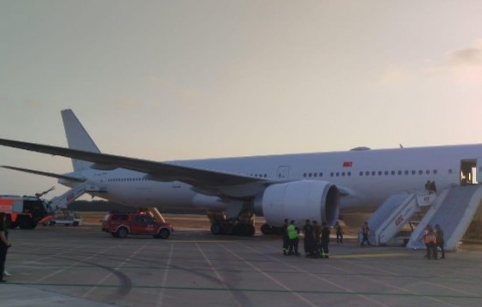
On July 29, local time, a Turkish Airlines Boeing 777-300 passenger plane numbered TK-2430 encountered an emergency while performing a flight from Istanbul, Turkey to Antalya.While the aircraft was taxiing to the ground, air traffic controllers observed smoke appearing in the landing gear and immediately notified the pilot.
Eventually, the plane made an emergency landing at Antalya Airport, causing widespread concern.
Currently, all 247 passengers and 13 crew members on board have been evacuated safely, and there are no casualties.The aircraft was successfully towed to a safe area under the inspection and guidance of relevant departments.
At 23:00 on the same day, the General Administration of Turkey's National Airports Authority issued a notice, reconfirming the above-mentioned incident and stating that the people on board had been safely evacuated, and that relevant investigation and assessment work was continuing under the coordination of the relevant competent authorities.
It is understood that the Boeing 777 is a twin-engine wide-body passenger aircraft developed by the American Boeing Company. Its research and development work was officially launched on October 29, 1990.
On June 12, 1994, the Boeing 777-200 made its first flight; on April 19, 1995, the aircraft obtained the type certificate from the FAA and the European Joint Airworthiness Certificate; on May 17, 1995, the first Boeing 777-200 was delivered to the user.
The Boeing 777-300 is an extended version of the Boeing 777-200 twin-engine aircraft.
The passenger capacity of the Boeing 777-300 is 368 passengers in the standard 3-class layout; 451 passengers in the standard 2-class layout, with a maximum passenger capacity of 550 people and a range of 11,135 kilometers.
It is worth mentioning that the Boeing 777-300 was the first aircraft to have cameras as standard equipment.
The cameras are installed on the leading edges of the left and right horizontal stabilizers and under the fuselage, allowing the aircraft pilot to see the wheels sliding, thereby improving the aircraft's maneuverability when taxiing on the ground.
Images captured by these cameras are displayed in a 3-way split on a multi-function display in the cockpit.
In addition, due to the long fuselage of the 777-300, it is equipped with a skid to prevent the tail from touching the ground, and also uses a new semi-lever landing gear, allowing it to take off at airports with poor conditions.