Wyoming may soon have one of the largest artificial intelligence data centers in history, using more electricity than all the homes in the state combined. The scale is staggering, and it raises an urgent question: How will the AI boom reshape America’s energy future?
On Monday, Cheyenne Mayor Patrick Collins announced a joint venture between energy infrastructure company Tallgrass and artificial intelligence data center developer Crusoe. The Associated Press pointed out that the first phase of the facility will consume 1.8 gigawatts of electricity and consume 15.8 terawatt hours of electricity annually - equivalent to five times the current electricity consumption of Wyoming households and accounting for 90% of the state's annual electricity consumption. When fully operational, the data center's annual power generation capacity will reach 10 gigawatts and its annual power consumption will reach 87.6 terawatt hours, exceeding the state's total power generation capacity.
Even if Crusoe and Talgrass plan to combine dedicated natural gas generation with renewables, removing so much electricity from the public grid would severely weaken Wyoming's energy system. For a state that exports nearly 60% of its electricity, such a large-scale power transfer represents a huge transformation.
Gov. Mark Gordon called the announcement a victory for the state's natural gas industry.
“This is exciting news for Wyoming and Wyoming natural gas producers,” he said.
The proposed site for the project is south of Cheyenne, near the Colorado border. Collins said he expects construction to begin soon on the project, subject to state and local government approvals. If approved, the project would immediately become one of the largest industrial projects in Wyoming history.
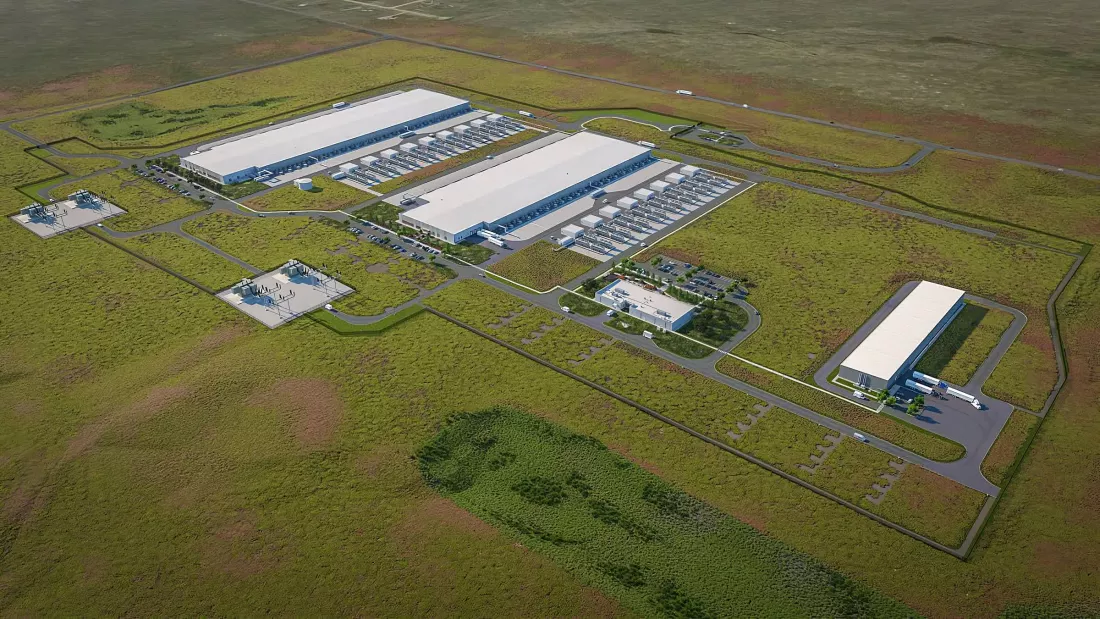
Meta’s Cheyenne AI campus (above) might pale in comparison to Crusoe’s project.
Since 2012, Cheyenne has quietly become a data center hub, attracting Microsoft and Meta Corp. with its cool climate and cheap energy. However, the scale of this project is very different, raising questions about who might need such computing power and what kind of strain it might put on Wyoming's power grid. The city plans to build a state-of-the-art nuclear power plant, but it's still a long way from being completed - even if it's approved.
Crusoe has yet to announce a tenant, and there is speculation whether OpenAI will be involved. The company recently partnered with Oracle to launch a massive Crusoe-built data center campus in Abilene, Texas. OpenAI says the campus alone has a capacity of about 1 gigawatt, the largest of its kind in the world, and has pledged to add an additional 4.5 gigawatts of capacity.
When pressed by The Associated Press, Crusoe spokesman Andrew Schmitt declined to say whether the Wyoming facility might be part of OpenAI's "Stargate" artificial intelligence infrastructure initiative.
"We're not ready to announce a tenant yet," he said. "I can't confirm or deny that it will be one of the Stargates."
What is clear is that this project is not just another mega-scale construction project, but marks a collision between the boundless demands of artificial intelligence computing and the hard limits of the national grid. Wyoming, the nation's least populous state with just 587,618 residents, could add new jobs and natural gas demand. However, it has also become a testing ground for whether the industry can advance AI in a responsible way or whether its demands will be too much for even energy-rich states to afford.