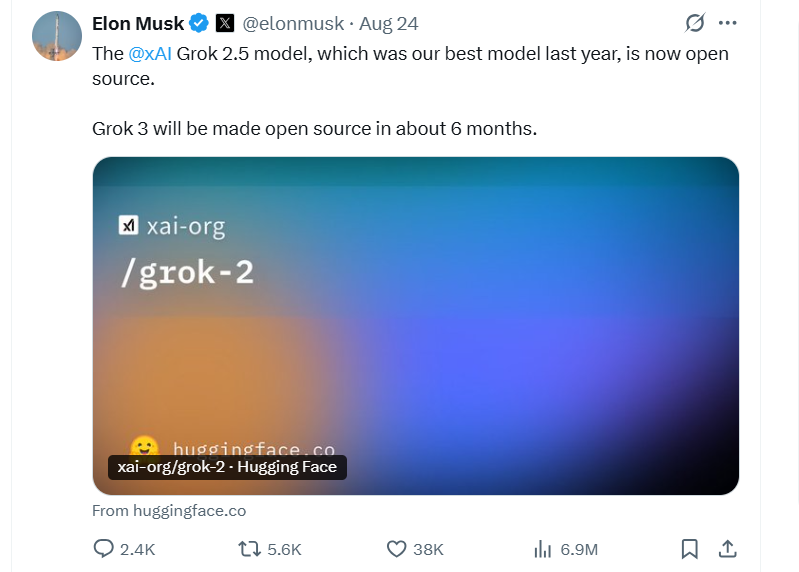
Elon Musk’s xAI open source model is now available. On Sunday (August 24), xAI announced that it would open source its artificial intelligence model Grok 2.5 and publish it on the open source platform Hugging Face. Musk wrote on social media X. “The Grok 2.5 model, xAI’s most impressive model from last year, is now open source. As for Grok 3, it will be open source in about 6 months.
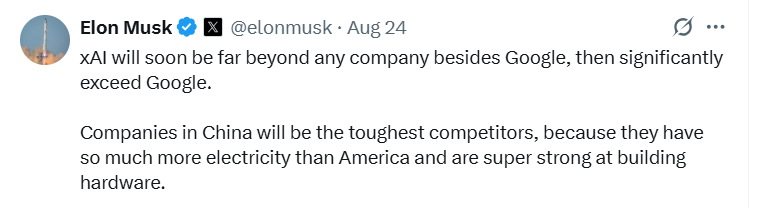
Musk also posted, "xAI will soon surpass any company except Google, and then it will also surpass Google. But Chinese companies will be the strongest competitors because they have much more power than the United States and are super strong in hardware construction."
The open source Grok 2.5 can be regarded as Musk's fulfillment of his original promise. When Grok 2.5 was released in August last year, Musk publicly stated that whenever a new version of Grok is created, the previous version will be open source.
With the latest Grok-4 model released in July, it’s time for Musk to open source a version of last year’s larger model. In July this year, xAI released the latest inference model of the Grok 4 series, which is divided into Grok 4 and Grok 4 Heavy, supporting a context window of up to 256,000 tokens.
Judging from the level of Grok 2.5, its total parameter volume is as high as 905 billion, of which 136 billion parameters are activated each time during inference, making it one of the most powerful open source models currently; it also supports a context length of up to 131,100 tokens, which can process long documents and conversation history at one time; it also uses a mixed expert (MoE) architecture, which can greatly expand the model scale without increasing the huge computing cost.
Regarding open source permissions, xAI stated that only non-commercial and compliant commercial use is allowed, but its use to train other basic models is prohibited. xAI clarifies that commercial use can only be used if the annual revenue of the affiliated company is less than one million US dollars. Commercial use exceeding this threshold requires a separate license from xAI.
In response, artificial intelligence engineer Tim Kellogg described Grok's license as a "customized version" because it contains some anti-competitive provisions.