The "age" of a group of dinosaur egg fossils located in the Qinba Mountains in the middle and upper reaches of the Han River has finally been determined. A scientific research team composed of experts from the Hubei Academy of Geological Sciences, Shaanxi Geological Survey, Xi'an Jiaotong University, and the Institute of Vertebrate Paleontology and Paleoanthropology, Chinese Academy of Sciences recently confirmed that the dinosaur egg fossils in Qinglong Mountain, Shiyan, Hubei were formed about 86 million years ago.
On September 11, the scientific research team published this research result in the authoritative journal "Frontiers of Earth Science" and issued "birth certificates" for these dinosaur egg fossil nuclei.
Zhao Bi, the corresponding author of the paper and a researcher at the Hubei Institute of Geological Sciences, said that the team successfully applied carbonate dating technology to the research of Cretaceous dinosaur eggs for the first time, and determined that the formation age of biogenic calcite in the eggshell of the Qinglongshan dinosaur egg fossil is 87.65 million to 84.17 million years ago. "The global climate has changed significantly during this period. Starting from 93 million years ago, it gradually cooled down from a typical greenhouse climate. The research results show that the dinosaur egg-laying event in Qinglong Mountain occurred during this period of global cooling."
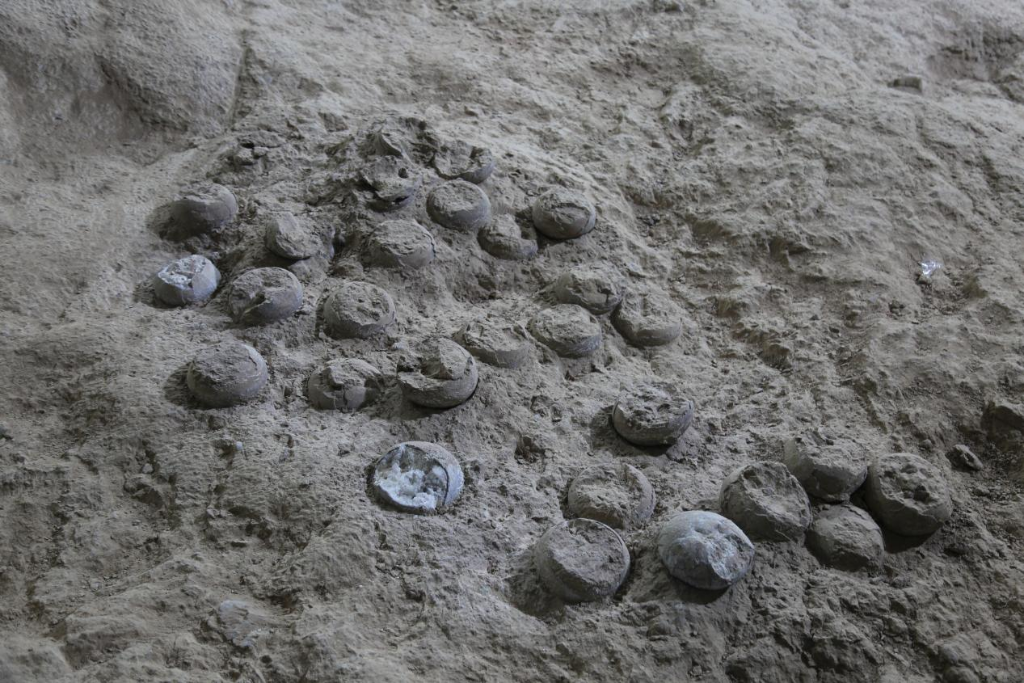
The picture shows the dinosaur egg fossils protected at the original site. (Photo provided by Hubei Institute of Geological Sciences)
According to reports, in the 1990s, dinosaur egg fossils were discovered one after another in Qinglong Mountain. In 2001, the State Council approved the establishment of the Hubei Qinglong Mountain Dinosaur Egg Fossil Group National Nature Reserve. There are now three dinosaur egg fossil sites in the reserve, with a total of more than 3,000 dinosaur egg fossils protected in their original locations. But before, the specific formation age of these dinosaur eggs has been a difficult problem that scientific researchers have been constantly exploring.
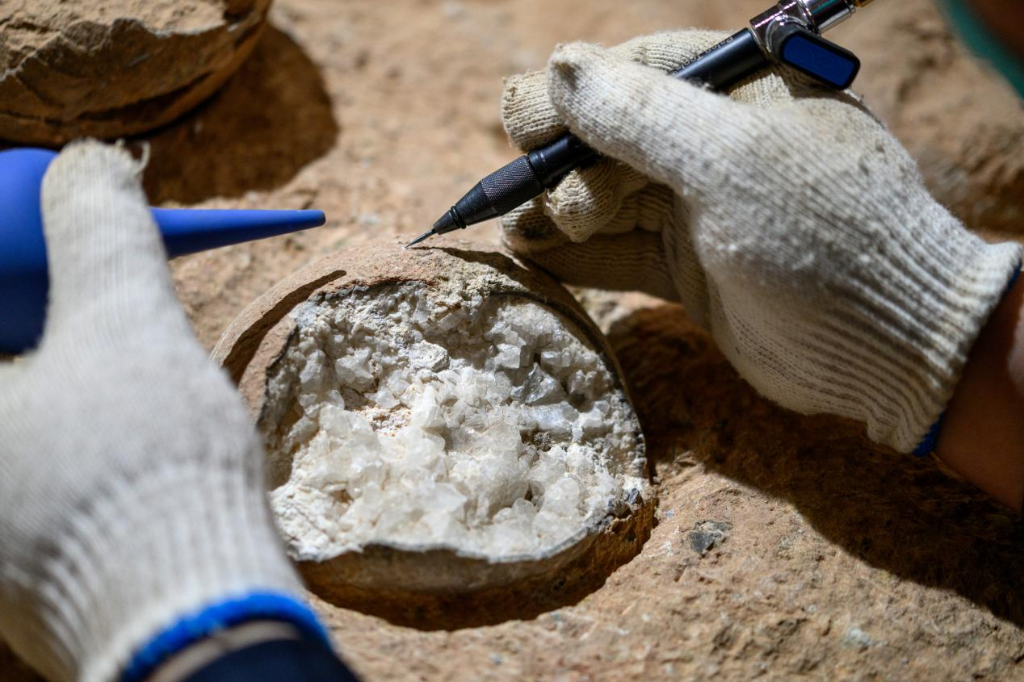
Workers are collecting research samples from dinosaur egg fossils. (Photo provided by Hubei Institute of Geological Sciences)
Zhao Bi said that this study has not yet fully covered all layers of dinosaur egg fossils buried in Qinglong Mountain. It cannot yet fully restore the process of dinosaur egg-laying events in this area and establish a timeline of the morphological evolution of dinosaur eggs in this area. Related scientific questions need to be answered by more in-depth research. However, this research result will provide new research ideas for further clarifying the burial time of different dinosaur egg fossils around the world and analyzing their evolutionary context. It will also provide new theoretical tools for drawing higher-precision paleoclimate change curves and in-depth exploration of the laws of ancient earth's environmental changes, the mystery of dinosaur evolution and extinction, and other major scientific issues. (Reporter Song Likun)