recently,The TIOBE official website announced the latest programming language rankings, and Python continues to top the list.It is reported that the TIOBE Programming Community Index is an indicator that measures the popularity of programming languages. The judgment is based on engineers, courses, suppliers and search engines around the world.
The latest ranking shows:
Python ranks first: accounting for 24.45%, an increase of 2.55% this month;
C ranked second: accounting for 9.29%, an increase of 0.91% this month;
C++ ranked third: accounting for 8.84%, down 2.77% this month;
Java ranks fourth: accounting for 8.35%, down 2.15% this month;
C# ranks fifth: accounting for 6.94%, an increase of 1.32% this month;
JavaScript ranks sixth: accounting for 3.41%, down 0.13% this month;
Visual Basic ranks seventh: accounting for 3.22%, up 0.87% this month;
Go ranked eighth: accounting for 1.92%, down 0.10% this month;
Delphi/Object Pascal ranked ninth: accounting for 1.86%, an increase of 0.19% this month;
SQL ranks tenth: accounting for 1.77%, up 0.13% this month.
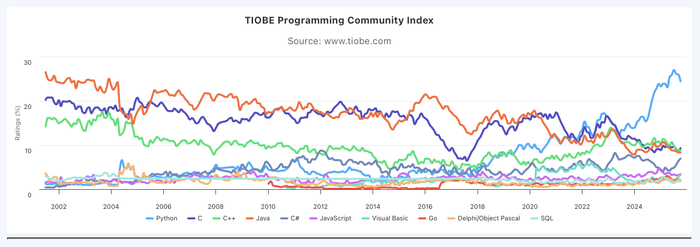
The CEO of TIOBE said,Nowadays, the battle for the "second place" in the TIOBE index is intensifying. Since Python began to dominate the TIOBE index at the end of 2023, C, C++ and Java have been fiercely competing for the second place on the list.
For more than a year, the gap between these three languages in the TIOBE ranking has been less than 1%, and Java has always followed closely behind.
This month, the C language returned to second place with the release of version C23. However, Java has just launched the Java 25 version, and C++ is also busy updating the C++26 version, so it is still difficult to predict who will eventually occupy the second place.
Each of these three languages has its own advantages: C is simple and extremely fast, C++ is high-performance and suitable for large-scale embedded systems, and Java is suitable for large-scale enterprise-level applications.
It is worth noting that C# is also gradually approaching these three competitors. At the beginning of this year, the gap between C# and C, C++, and Java was 4%, and now it has narrowed to only 1.4%.