Recently, Xi'an, Shaanxi and other places have issued policies to completely suspend low-price marketing practices such as "fixed price" for online ride-hailing services, and strictly prohibit any form of price fraud and malicious price reduction. Previously, many places such as Yingtan in Jiangxi Province, Kaifeng in Henan Province, and Qingyuan in Guangdong Province have also introduced similar policies, prohibiting platforms from forcing drivers to accept orders through the "fixed price" model, and curbing disorderly low-price competition.
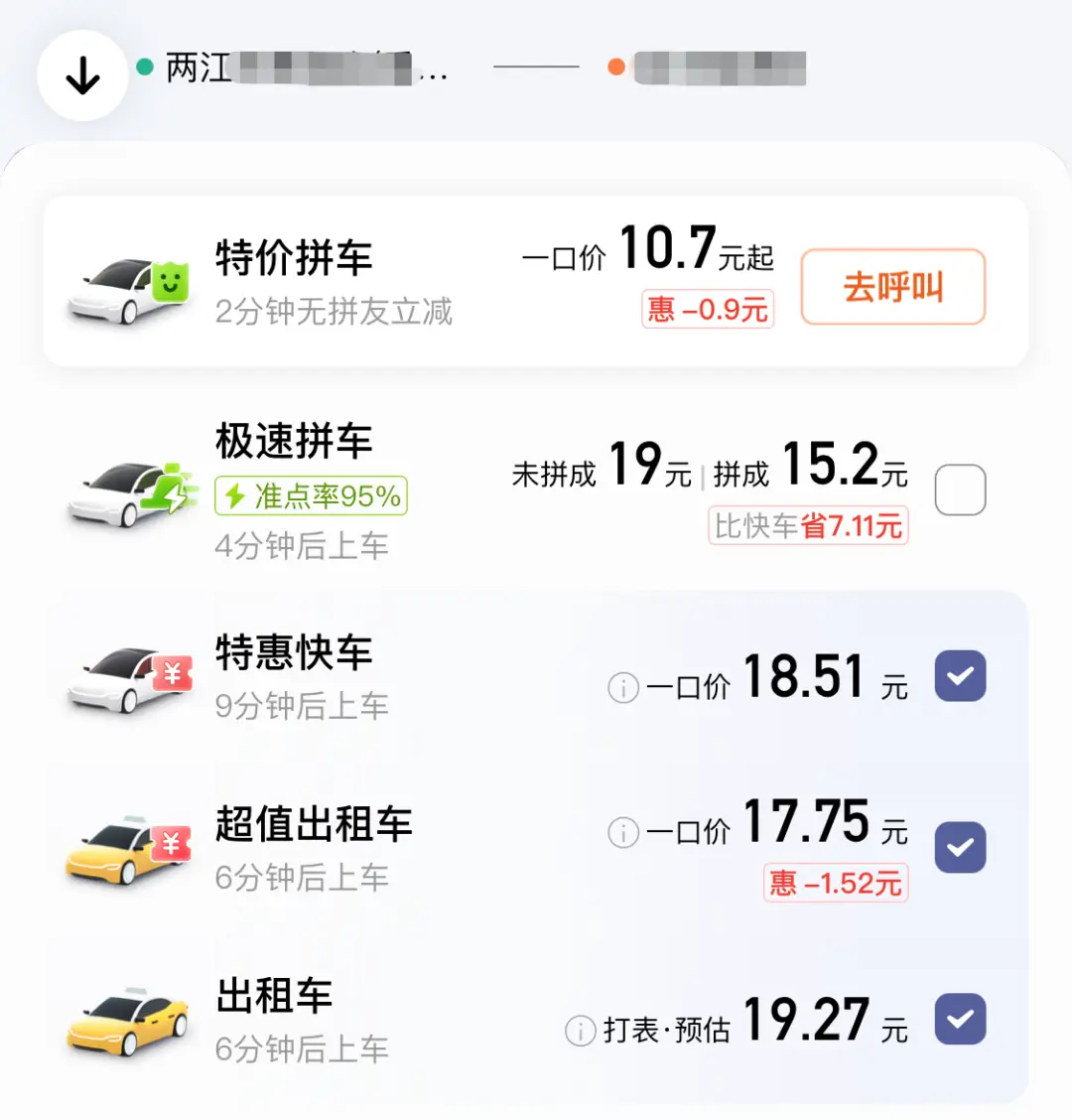
With many places issuing early warnings of saturation in the online ride-hailing market, what are the possible impacts of suspending "fixed-price" orders? How to further optimize the online car-hailing pricing mechanism and effectively protect the rights and interests of online car-hailing drivers and all parties? A reporter from "Worker Daily" conducted an interview.
Many places have suspended “fixed price” orders for online ride-hailing services
The so-called "fixed price" order for online ride-hailing means that after the passenger sets the destination, the system will give a fixed settlement price based on factors such as estimated mileage, duration, real-time traffic conditions, etc. Passengers will pay this price regardless of traffic jams or diversions. This model is attractive to passengers. Stimulated by cheap prices and controllable expectations, the demand for ride-hailing travel may increase, which will also help online ride-hailing platforms seize market share. However, some drivers said that under the "fixed price" model, orders increased but their income did not increase.
At the end of August this year, a "Notice on Regulating the Operating Price Behavior of Online Car Hailing Platforms" issued by the Xi'an Municipal Transportation Bureau was widely circulated on the Internet and attracted great attention in the industry. Subsequently, Xi'an Municipal Transportation Bureau and other departments confirmed the authenticity of the document, and stated that they were gradually advancing implementation and urging all platform companies to strictly implement it.
The notice clearly states that starting from 0:00 on August 19, the city will completely suspend low-price marketing activities such as "fixed price" and "special price", and strictly prohibit any form of price fraud and malicious price reduction. Previously, many places also suspended "fixed price" orders for online ride-hailing services.
The low-price strategy was once a powerful tool for online ride-hailing platforms to seize the market, but it also caused a lot of controversy. "The 'fixed price' order is lower than the normal unit price, and the driver is not charged for the time it takes to run the order." When it comes to the "fixed price" order, Master Han, an online ride-hailing driver from Zhengzhou, Henan, has a complicated mood. "I only pick it up when I have free time. I can't pick it up when there is traffic jam in the morning and evening peaks. It's not cost-effective."
Regarding the suspension of "fixed price" orders in many places, Zheng Linyi, a distinguished associate researcher at the School of Public Administration of Zhejiang University, said that this move has many benefits for drivers. The core demand of drivers is "matching income and effort", and the "more work but less gain" caused by low-price orders has caused most drivers to be resistant to such orders. Therefore, they hope that the industry will return to reasonable pricing and truly solve the problem of "increased orders but no increase in revenue".
Some passengers believe that the pricing mechanism can be further improved on this basis. Ms. Bai, who works for an Internet company in Beijing, said that "fixed price" orders can reduce risks such as unit price increases caused by detours. The interests of passengers, drivers, platforms and other parties should be balanced through rationalization of unit prices per kilometer and transparency of commission ratios.
The “price war” is unsustainable and may force platform transformation
"'Fix it price' orders are essentially a short-term 'price war' that does not comply with market rules and is not sustainable." Zheng Linyi analyzed that some platforms have seized market share through "Fix it price" orders, but part of the cost is actually borne by the drivers. This has also resulted in some drivers receiving an increase in order volume without an increase in income. On the contrary, the increase in order density has increased work intensity.
Yang Xinmiao, deputy director of the Institute of Transportation Research at Tsinghua University, believes that "fixed price" orders are essentially the platform's choice to deal with market uncertainty. The current growth space of the online car-hailing market is not obvious, and some platforms participate in competition through "fixed price" orders. This is a corporate-level strategy. Measures to stop this type of order model should be supported.
"As drivers, what we are most concerned about is the average unit price per kilometer and the commission ratio of the platform." Master Han revealed that recently, while reducing "fixed price" orders, some platforms have simultaneously adjusted the commission ratio through month-end rebates. "For example, if the commission exceeds 25% of the driver's order income, the platform will return it to the driver at the end of the month. This model has also increased the income of many drivers." Master Han said.
“After the ‘fixed price’ order is cancelled, the order volume of the platform may decrease, and the commission income will also decrease accordingly.” Zheng Linyi further said that this adjustment may force the platform to re-examine the existing profit model and formulate a more reasonable and long-term development strategy.
Establish a transparent pricing and driver rights protection mechanism
"Stopping the 'fixed price' preferential orders is only the first step. The key is to build a transparent and reasonable long-term pricing and commission mechanism." Zheng Linyi suggested that the commission ratio of the platform should be linked to the services it provides, forming a clear list, such as the proportion of navigation technology services and the proportion of insurance services. The charging standards for each service should be clarified to ensure that drivers and passengers can check the fee details and maintain the stability of the ratio within a certain period.
The reporter learned that after many places stopped “fixed price” orders, the industry saw positive changes. Master Zhou, an online ride-hailing driver from Xi'an, Shaanxi Province, said that his income has increased slightly while working the same hours. Many drivers interviewed reported that the suspension of "fixed price" orders means that the unit price has rebounded, but at the same time, disguised low-price competition in the name of "special discount orders" should be avoided.
When it comes to the protection of the rights and interests of online ride-hailing drivers, Yang Xinmiao suggested that relevant supervision work should shift from "two certificate management" to the construction of professional standards. We can no longer be satisfied with whether supervision is "certified", but should constantly optimize the professional treatment of online ride-hailing drivers, such as establishing minimum wage guarantees, etc., to further protect the rights and interests of relevant practitioners.
Zheng Linyi suggested that the platform should encourage intelligent dispatching and carpooling optimization through model innovation, support customized services such as mid- to high-end models and scenario-based travel, and break away from homogeneous competition. At the same time, he also reminded practitioners to carefully check car rental, insurance and other terms before signing with the platform, clarify cost and commission rules, avoid infringement of rights and interests due to poor information, and actively protect their legitimate rights and interests through legal channels.
"We hope that relevant departments can further standardize low-price competition while controlling the number of drivers and vehicles to avoid disorderly expansion of the industry." Master Han believes that online ride-hailing drivers themselves also need to actively pay attention to industry policies and price changes, actively collect industry information, summarize experience in running orders, continuously improve their skills, and receive more orders with high-quality services.