On the 5th of this month, my country's first electromagnetic catapult aircraft carrier "Fujian Ship" (hull number 18) held a flag-raising ceremony at a military port in Sanya, Hainan, marking the official entry of the Chinese Navy into the "three-carrier era." The Fujian ship has a full load displacement of over 80,000 tons. It is a large conventionally powered aircraft carrier and the largest conventionally powered aircraft carrier in the world.It is also the world's first aircraft carrier to use conventional power + electromagnetic ejection. The localization rate exceeds 98% and the energy consumption is only 1/3 of steam ejection..
From the Liaoning ship to the Shandong ship, and then to the Fujian ship that is now officially in service, Chinese aircraft carriers have completed the leap from ski jump takeoff to electromagnetic catapult in just over ten years.
So why does the Fujian ship use electromagnetic ejection instead of steam ejection? What is the technical support behind this? The latest CCTV news report reveals the secret.
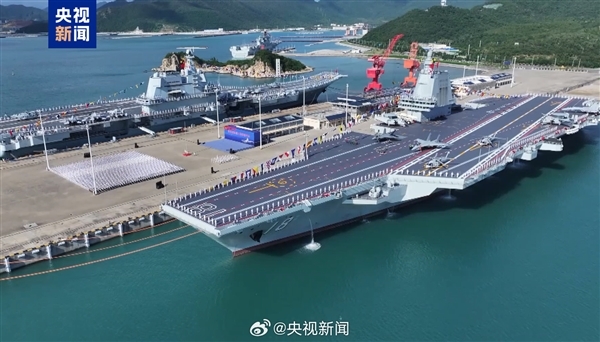
Expert introduction,The electromagnetic catapult system of the Fujian ship has significant advantages such as high aircraft dispatch rate, short preparation time, multiple ejection systems, and good maintainability., compared with steam ejection, the combat preparation time is exponentially shortened, the combat radius of carrier-based aircraft is doubled, and the comprehensive combat capability of the aircraft carrier is greatly improved.
The ejection force of the steam catapult is not adjustable, which may cause damage to the body structure of the carrier-based aircraft.The electromagnetic catapult does not require a complex pipeline system, takes up less space inside the aircraft carrier, and can flexibly select the ejection intensity according to the size and weight of the carrier-based aircraft..
With the electromagnetic catapult, carrier-based aircraft do not need a ski-jump deck structure to take off, and more carrier-based aircraft can be deployed on the flight deck.
During the process of ejecting a carrier-based aircraft, other carrier-based aircraft are on standby. This ensures that more carrier-based aircraft can be launched into the air for combat in the shortest time, forming a larger and more complete air combat system..