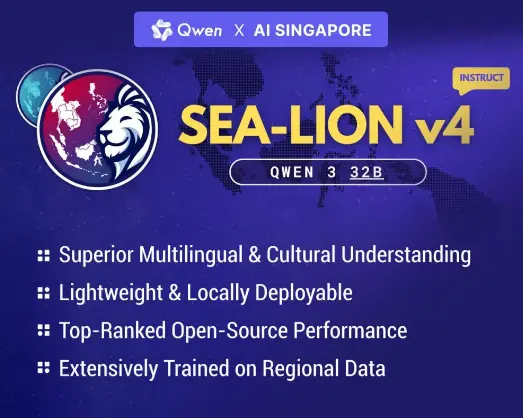
Singapore’s National Artificial Intelligence Initiative (AISG) is ushering in a critical strategic shift.In its latest Southeast Asian language large model project, AISG abandoned Meta's model and instead adopted Alibaba's Qwen open source architecture. This choice not only reflects a reconsideration of the technical route, but also marks an important step in the expansion of China’s open source AI model’s global influence.
On November 25, AISG released the "Qwen-SEA-LION-v4" model based on the Qwen architecture, which quickly topped an open source list that measures language proficiency in Southeast Asia. This move aims to solve the language adaptation problem that has long plagued the region——Western open source models, represented by Meta's Llama series, perform poorly when dealing with regional languages such as Indonesian, Thai, and Malay, which seriously restricts the development efficiency of localized AI applications.
Although Llama has leading performance among open source models, its "English-centric" underlying design is difficult to fundamentally change and is extremely inefficient when processing non-Latin scripts such as Thai and Burmese. AISG has gradually realized that relying on Silicon Valley’s open source models is not the optimal solution for Southeast Asian countries, and it must look for basic models that truly have multi-language understanding capabilities, especially Asian language contexts.
Against this background, AISG finally turned its attention to China and chose Alibaba’s Qwen3-32B as the base of the new generation Sea-Lion model.
Different from Western models, Qwen3 uses up to 36 trillion token data in the pre-training stage, covering 119 languages and dialects around the world.This "native multi-lingual ability" not only "recognizes" Indonesian, Malay and other characters, but also understands their grammatical structure from the bottom, which greatly reduces the technical threshold for AISG's subsequent training.
In order to better adapt to the unique writing habits of Southeast Asian languages, Qwen-Sea-Lion-v4 abandons the "sentence tokenizer" commonly used in Western models and instead adopts a more advanced Byte Pair Encoding (BPE) tokenizer. This technology can more accurately segment characters in languages without spaces such as Thai and Burmese, significantly improving translation accuracy and reasoning speed.
In addition to technological advantages, practical considerations for commercial implementation are also the key to Alibaba's success. Southeast Asia has a large number of small and medium-sized enterprises that cannot afford expensive H100 GPU clusters.The optimized Qwen-Sea-Lion-v4 can run smoothly on consumer-grade laptops equipped with 32GB of memory, allowing ordinary developers to deploy this national-level model locally. This feature of "industrial-level capabilities and consumer-level threshold" accurately fits the pain point of scarce computing resources in the region.
This cooperation is not a one-way technology output, but a deep two-way integration. According to the agreement, Alibaba provides a powerful universal reasoning base, and AISG contributes its cleaned 100 billion Southeast Asian language tokens. These data completely avoid copyright risks, and the concentration of Southeast Asian content is as high as 13%, which is 26 times that of Llama2.
In the Sea-Helm evaluation list, Sea-Lion v4 equipped with Alibaba's core technology quickly topped the list of open source models of the same magnitude, verifying the technical value and regional adaptability of this strategic cooperation.