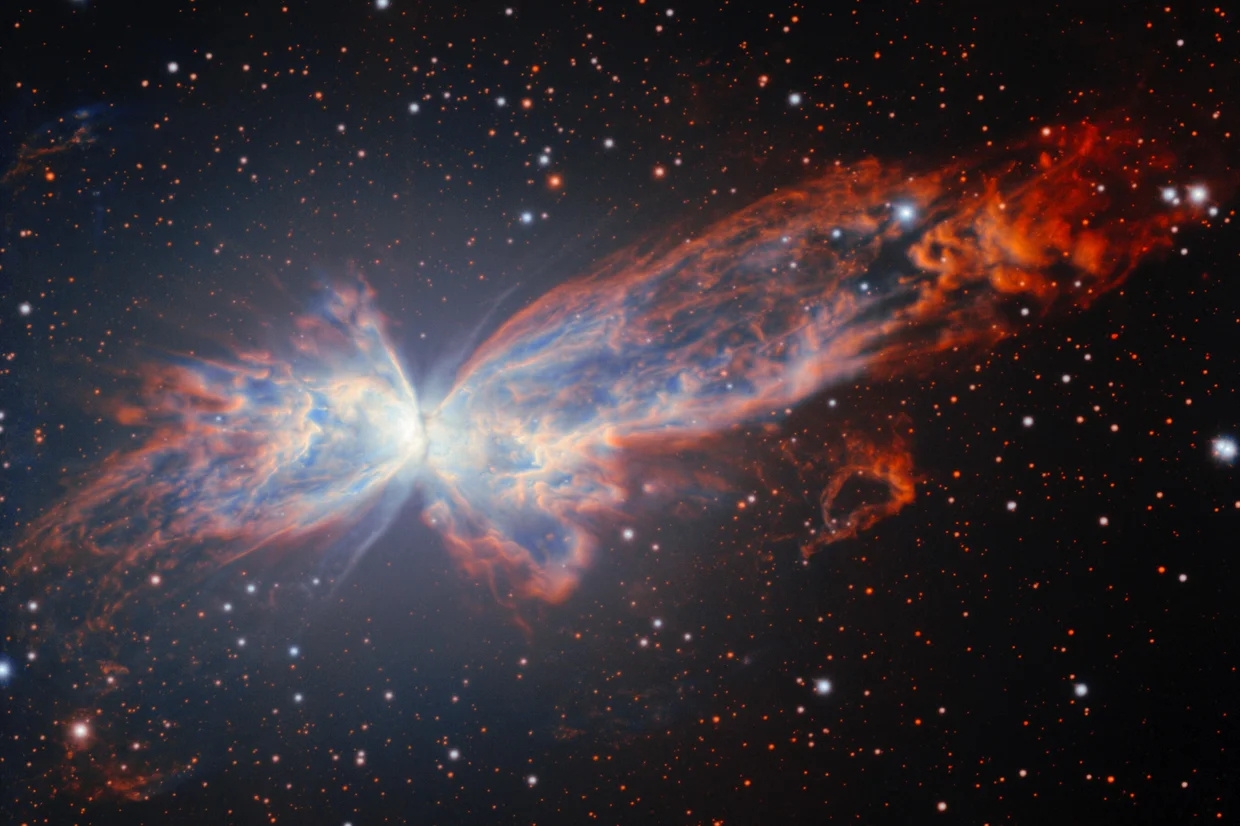
In October this year, the Gemini South telescope in Chile captured a breathtaking image of the nebula, which was released by the National Science Foundation's NoirLab on Wednesday.This is a churning planetary nebula that resembles a huge and elegant "cosmic butterfly" with glowing "wings" that appear to be exploding, so it is also called the Butterfly Nebula, the Bug Nebula or the Caldwell 69 Nebula.
It is reported that the nebula is about 2,500 to 3,800 light years away from the Earth (mainstream data believes that it is about 3,400 light years, and 1 light year is about 9.46 trillion kilometers). It is officially named NGC 6302 - a planetary nebula located in the constellation Scorpio.
The Butterfly Nebula is a product of the final stage of the evolution of a sun-like star and is a planetary nebula.Although "planet" is in the name, it has nothing to do with planets, but rather the outer shells of gas thrown off by dying stars..
In the center is a white dwarf star with a temperature of more than 250,000°C (about 40 times the surface temperature of the sun) and a mass of about 2/3 of the sun. The "wings" are made of gas ejected by the star in its red giant stage and extend for more than 2 light years. The dark matter ring surrounding the center is formed by material slowly ejected in the equatorial direction of the star.
Scientists speculate on the formation process of the nebula:
Once a red giant with a diameter about 1,000 times that of the Sun, the star underwent dramatic changes toward the end of its life.
First, matter is ejected from the equator direction at a slower speed to form a dark matter ring, and then gas is ejected from the pole directions at high speed (speed exceeds 3 million kilometers per hour), forming a symmetrical bipolar structure.
Eventually the core collapses into a white dwarf, and its intense radiation heats the surrounding gas to 20,000°C and emits light.
Note: The equipment for this shooting is the Gemini South Telescope.It has an 8.1-meter optical/infrared telescope and is the southern hemisphere "eye" of the International Gemini Observatory., jointly supported by the U.S. National Science Foundation, Canada, Chile and other countries.