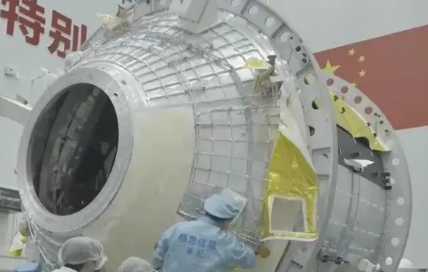
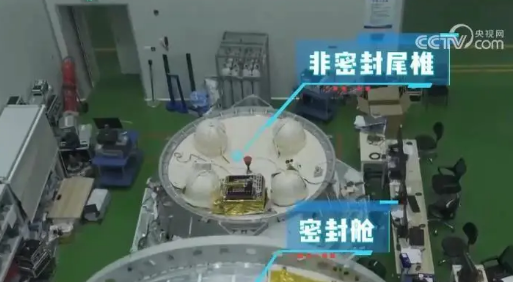
According to CCTV.com,my country's latest developed light boat cargo spacecraft has recently entered the overall testing stage, and a comprehensive pre-launch "ground-up examination" has been carried out.The spacecraft adopts a modular configuration of "sealed cabin + non-sealed tail cone", which can be vividly compared to a "space truck" - the front sealed cabin is used to transport precision instruments, astronauts' living supplies and other goods that need protection; the rear open tail cone can carry equipment that needs to be exposed to the space environment for experiments.
As a full-time "space express" spacecraft,The core tasks of "Qingzhou" include "door-to-door delivery" and "door-to-door pickup". It can stably transport 1.8 tons of cargo to the space station, and can collect waste and replaced equipment in the station on its return journey.
After the mission is over, the spacecraft will re-enter the atmosphere in a controlled manner and burn up completely over the uninhabited area of the South Pacific, truly achieving a "clean space departure" without leaving any space debris behind.
In addition to basic transportation functions, the cargo hold of the "light boat" also features a number of innovative designs. Its configurable cold chain system is like a set of "space refrigerators".
Each module has a volume of 60 liters, and up to 5 modules can be flexibly combined to achieve precise temperature control of 0-8°C. It can not only preserve fresh fruits and vegetables, but also store biological samples, providing support for future space station food supply and scientific experiments.
In addition, the cargo compartment also introduces an AI intelligent management system to support astronauts to quickly locate materials through voice interaction and grasp inventory status in real time, significantly improving the convenience and efficiency of on-orbit work.
It is estimated thatThe current transportation cost of the "Qingzhou" spacecraft is about 100,000 yuan per kilogram. With the participation of mass production and commercial aerospace in the future, the "postage cost" of space freight is expected to be further reduced.