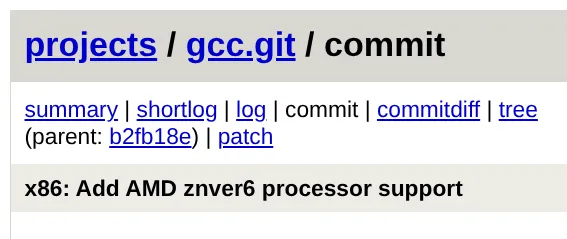
Before AMD is expected to launch the next-generation Zen 6 architecture EPYC and Ryzen processors in 2026, GCC 16 compiler support for Zen 6 (codenamed "znver6") has been officially integrated into the upstream code base. This means that before the processor is officially launched, Linux and other ecosystems that use GCC will be able to obtain instruction set optimization for the Zen 6 architecture in advance, laying a solid foundation for subsequent platform performance releases.
Compared with the early Zen architecture's practice of "releasing compiler patches just before release", starting with Zen 5 and continuing to Zen 6, AMD has significantly accelerated the pace of open source compiler support, so that relevant support is in place months before the hardware is released. In the past, AMD's support for GCC and LLVM/Clang was often stuck near or even after the architecture release window, which not only did not match the rhythm of GCC being released once a year and LLVM/Clang being released every six months, but also brought inconvenience to Linux distributions and users who hope to obtain complete optimization support in the official release compiler. In some Zen generations, partners such as SUSE even assisted in accessing new architecture support. Now AMD has changed to proactively and early promoting the upstreaming of relevant patches.
After AMD submitted the Binutils patch for Znver6 in November this year, it released the GCC patch for Znver6 this month. The patch confirms Zen 6’s new capabilities in the instruction set, including support for instruction extensions such as AVX512_BMM, AVX_NE_CONVERT, AVX_IFMA, AVX_VNNI_INT8, and AVX512_FP16. These extensions are expected to improve efficiency in matrix operations, deep learning inference, mixed-precision computing and related high-performance workloads. Through GCC's architecture identification and optimization options, developers can better take advantage of Zen 6's hardware features.
Currently, this set of GCC patches for Zen 6 has been integrated into the GCC Git repository and will be used as part of the GCC 16.1 stable version, which is expected to be released between March and April 2026. By then, the GCC 16 stable version will be earlier than the commercial launch of Zen 6 processors, paving the way for software optimization in advance for the new generation of EPYC and Ryzen platforms expected to be unveiled later in 2026.
At the Linux distribution level, GCC 16 will become the default compiler version for Fedora 44, but will not become the default compiler for Ubuntu 26.04 LTS. According to existing practice, Canonical usually switches to the major version of GCC in the non-LTS version in October of that year, so Ubuntu 26.04 LTS will still stay in GCC 15. Even so, AMD's overall front-end layout in open source compilers is still evolving in a favorable direction, ensuring that more users can experience the performance benefits brought by architectural optimization in a shorter period of time.
The Zen 6 support incorporated this time is an initial version and does not yet include the complete instruction cost table and more refined tuning configurations for Zen 6 processors. The report pointed out that AMD engineers still expect to have the opportunity to continue to push these more in-depth performance tuning patches to the upstream before the release of the stable version of GCC 16.1. As Zen 6 hardware enters mass production, coupled with continuously improving compiler support, AMD's software and hardware collaborative optimization in the server and desktop fields will be further enhanced.