According to OpenAI’s plan, by the beginning of the next decade, nearly one-third of the world’s population will be users of ChatGPT. This scale is about three times its current nearly 900 million weekly active users. Such a large user base seems to be enough to support a sizable advertising and e-commerce business.
But for ChatGPT,Where do new users come from?, its importance may be no less thanHow many new users are there?. According to estimates from market intelligence firm Sensor Tower, nearly 90% of ChatGPT’s current users are from outside the United States and Canada. This is undoubtedly a thorny issue for OpenAI, which aims to develop a large-scale advertising business.
OpenAI revealed to investors that in the next five years, the company is expected to earn $112 billion in revenue from the user base of the free version of ChatGPT. This revenue will most likely come from advertising sales and commissions generated by users completing online purchases through the application. In 2025, OpenAI will be focusing on two major tasks throughout the year: one is to explore ChatGPT’s advertising implant model, and the other is to launch a shopping function within the chat interface.
OpenAI predicts that if these two businesses can be rolled out smoothly, it will be able to generate $46 billion in revenue from the free user base in 2030 alone. However, based on the development experience of existing digital advertising companies, it can be seen that ChatGPT’s revenue will also depend to a large extent on the source of user growth.
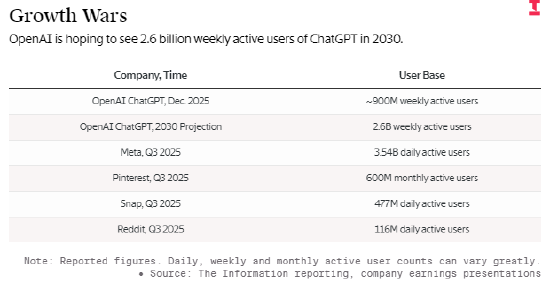
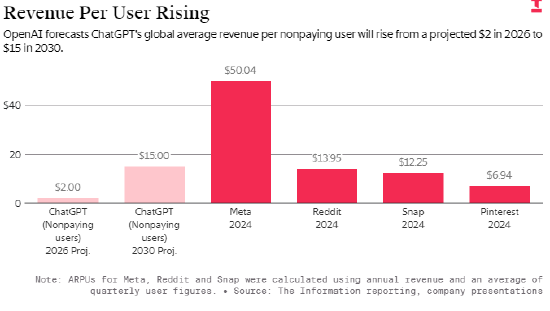
Taking Pinterest as an example, in the third quarter of 2025, the platform's average revenue per user was approximately US$7.64 in the US and Canadian markets, US$1.31 in the European market, and only US$0.21 in the rest of the world. This means that although users in the United States and Canada account for less than a fifth of Pinqu’s 600 million monthly active users, they contribute nearly 75% of the platform’s total revenue. In the same quarter, Snap’s relevant data also showed a similar trend.
However, both Pinqu and Sarabu are relatively small companies, with annual revenue of less than $6 billion each. The huge Metaverse Platform Company (Meta) has stopped disclosing geographical breakdown data on its user scale and average revenue per user since the end of 2023. But in the fourth quarter of 2023, users in the United States and Canada accounted for only 10% of Meta’s total daily active users, but contributed nearly 50% of total revenue. At that time, Meta's average revenue per user in the US and Canadian markets was US$68.44, in the European market it was US$23.14, while in the Asia-Pacific region it was only US$5.52, and in other regions it was only US$4.50.
OpenAI has never publicly disclosed the geographical distribution of ChatGPT users, but external analysis companies have given relevant estimates. Sensor Tower's calculations show that in the third quarter of 2025, users in the United States and Canada accounted for only 12% of ChatGPT's monthly active users, while about 66% of users came from other regions outside the United States, Canada, and Europe.
The Information News previously reported that India and Brazil are among the top five ChatGPT markets in the world, ranked by the number of weekly active users, with the remaining three being the United States, Japan and France. OpenAI CEO Sam Altman also said in early 2025 that India was already the company's second largest user market at that time.
Referring to the situations of Meta, Pinqu and Sarabu, it is not difficult to infer that although India and Brazil are the two largest user markets of OpenAI, the average revenue per user in these two regions is likely to be lower than that of the US, Japan and France markets.
In the next few years, whether OpenAI can successfully convert user growth into revenue growth will be a key problem facing the company's investors.
Currently, among ChatGPT’s nearly 900 million weekly active users, only about 5% of users have paid to subscribe to the ChatGPT Pro or ChatGPT Plus packages. The monthly fees for these two packages are approximately US$20 and US$200 respectively. OpenAI predicts that by 2030, the total number of weekly active users of ChatGPT will reach 2.6 billion, of which approximately 8.5% (or 220 million users) will subscribe to the ChatGPT Plus package.
In 2025, OpenAI also launched a more affordable subscription package-ChatGPT Go in countries such as India, with a monthly fee of about US$5. Currently, this package is available in more than 150 countries and regions around the world.
In addition to subscription revenue, OpenAI told investors that it plans to increase average revenue per user for free users from $2 in 2026 to $15 by the end of 2030.
OpenAI also informed investors that the company will continue to incur huge costs in the process of running artificial intelligence models. It is predicted that by 2030, companies’ cumulative model inference costs will reach nearly $150 billion. OpenAI hopes to generate revenue from the free version of ChatGPT to help offset these high costs.
At the same time, in the face of fierce market competition, OpenAI must first ensure that the user scale of ChatGPT can continue to grow. In December 2025, Sam Altman activated the “red alert” emergency mechanism and called on the entire company to focus on optimizing ChatGPT. In the same month, OpenAI also launched a number of new features, such as incorporating more image information into reply content, in order to enhance the appeal of ChatGPT.