Claude Code flattened NVIDIA's moat, and it only took half an hour! Recently, the technology circle has been completely detonated by a piece of news: on the Reddit platform, developer johnnytshi shared a disruptive operation——It only took Claude Code 30 minutes to successfully transplant a complete set of CUDA backend code to AMD's ROCm platform without any intermediate conversion layer.
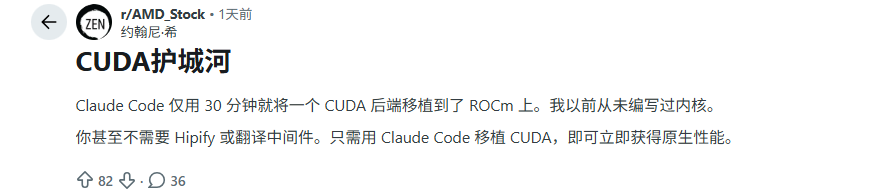

"CUDA has spent 20 years building this moat, and it may disappear in 6 months." johnnytshi said.
ps. Claude Code is an AI programming agent tool launched by the American company Anthropic. It can deeply understand code logic and support development tasks such as code transplantation and writing. It has become popular recently.
johnnytshi said,There is no handwritten code in the entire transplantation process. Such an efficient operation seems to directly bridge the gap between the two major ecosystems of CUDA and ROCm.
What is even more noteworthy is that this transplant completely abandons traditional intermediate conversion tools such as the Hipify translation layer, and can be completed with just one click using the command line (CLI).
Even Anush Elangovan, vice president of software development at AMD, was deeply shocked by this and bluntly said that the future of GPU programming will definitely belong to AI agents.
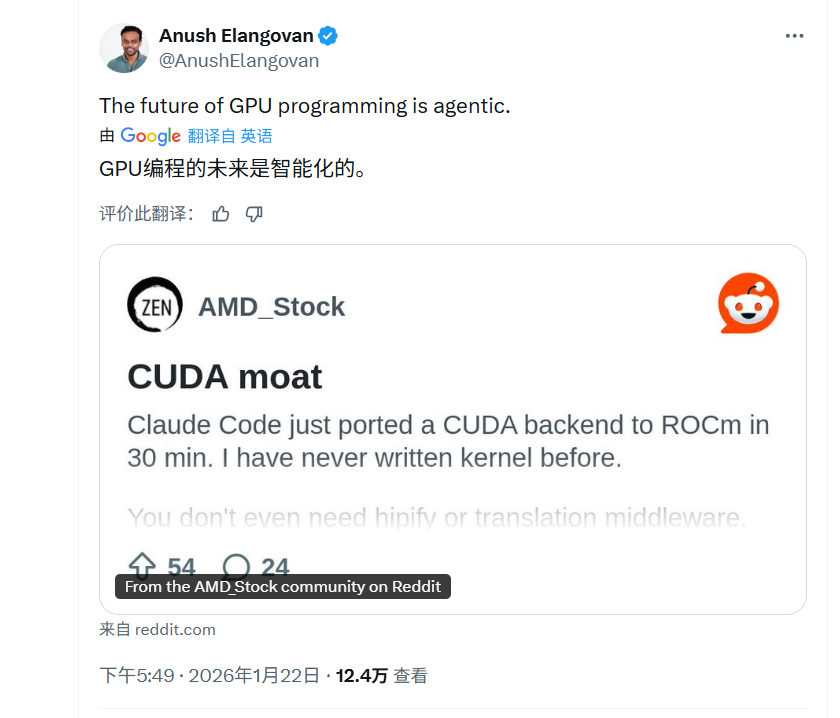
As soon as the news came out, the entire network was instantly excited, and many people in the industry lamented: NVIDIA may not be able to hold on to the CUDA moat it has maintained for many years. What is going on with all this?
As a tool running on the agent framework,The core advantage of Claude Code is its ability to think independently. During the code migration process, it does not mechanically replace keywords, but can deeply understand the code logic, especially the underlying operating principles of specific kernel functions.
According to developer johnnytshi, the most difficult problem in this transplant, the difference in data layout between the two platforms, was also perfectly resolved by Claude Code, ensuring the consistency of the core computing logic of the kernel.
What's even more amazing is that the entire transplantation process only took 30 minutes, and there was no need to set up a complex translation environment such as Hipify. It could be completed efficiently directly through the command line. The emergence of this operation completely broke the migration barrier between CUDA and ROCm.
You know, NVIDIA's dominance in the GPU field is largely based on the CUDA ecosystem. Today, CUDA has almost become an industry standard, and countless AI frameworks, deep learning libraries, and scientific computing tools are deeply bound to it.
On the other hand, AMD's ROCm, despite its powerful functions, has long been plagued by pain points such as insufficient ecological compatibility and high developer migration costs, making it difficult to compete with CUDA.
This time, Claude Code’s zero-code, high-time-efficiency transplantation operation has undoubtedly given a boost to the rise of the ROCm ecosystem. As AI agents continue to make breakthroughs in the field of code transplantation, there may be more and more CUDA codes in the future that can be easily adapted to run on AMD GPUs.
Of course, since the key to writing a kernel is to ensure "deep hardware" optimization, some argue that Claude Code still falls short in this regard, especially with regard to the specific cache hierarchy.
But with this beginning, NVIDIA's ecological monopoly may really seem to be facing changes.
In fact,Last month, NVIDIA's release of CUDA 13.1 triggered discussions about whether NVIDIA's "moat" would be weakened, although the official positioned it as "the largest and most comprehensive upgrade since the birth of the CUDA platform in 2006."
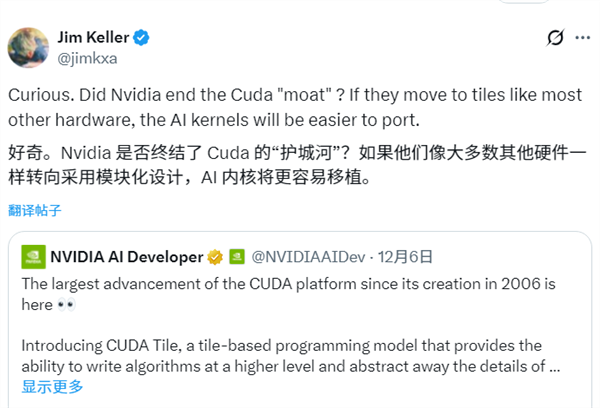
The biggest update of CUDA 13.1 is the adoption of the CUDA Tile programming model, which is a model based on data blocks (tiles). Its design goal is to significantly reduce the threshold of GPU programming, so developers can focus on organizing data into blocks and performing calculations.,The underlying complex thread scheduling, memory layout, and hardware resource mapping are automatically handled by the compiler and runtime system.
Jim Keller, a senior figure in the chip design industry who has participated in the design of AMD Zen, Apple A series and Tesla Autopilot, believes that if mainstream GPU programming in the future gradually shifts to this Tile-based approach, once developers get used to this model, the same set of program logic will be easier to transplant to different GPU hardware.It is not as highly bound to NVIDIA hardware as CUDA in the past, which may provide entry opportunities for AMD, Intel or emerging AI companies.