Can AI make money? Is it too much money to spend on AI?Friends who read a little bit of news in the AI circle must have the above two murmurs in their hearts. But just two days ago, Google’s parent company Alphabet (for the convenience of subsequent reading, only replaced by Google) released its latest fourth-quarter financial report, which once again swollen the faces of AI pessimists.
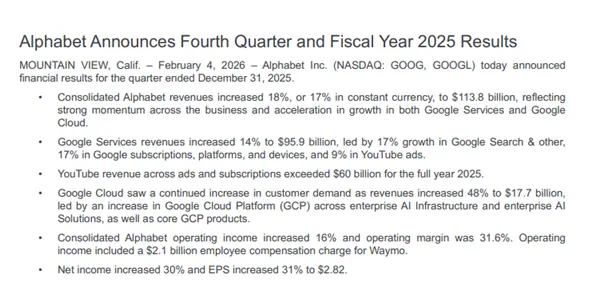
In the latest financial report, Google's total revenue increased by 18% year-on-year, which was their first record in the third quarter after their revenue exceeded 100 billion.
In this way,Google's revenue will exceed $400 billion for the first time in 2025, the full-year net profit reached US$132.17 billion, a year-on-year increase of nearly 30%.
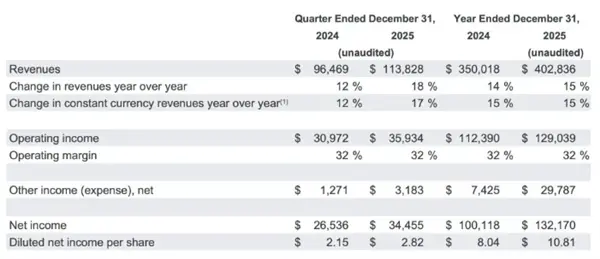
This is Google’s most perfect response to the fact that AI will subvert the traditional search narrative.
But what shocks the outside world even more is that Google actually plans to take nearly half of its revenue from this.That is, the astronomical US$180 billion in funds will continue to fuel AI in 2026.
You know, this figure is almost twice Google’s investment in 2025, and a full 50% more than the estimated US$120 billion expected by the outside world.

A few days ago, Meta said that it would invest US$135 billion in AI in the new year, which has caused controversy among the outside world. Many people thought that Xiao Zha had gone crazy because of AI.
As a result, Google came back with a super double.
To give you a simple calculation, the 180 billion budget means that Google will spend 500 million US dollars every day this year to add AI-related facilities such as data centers, chips, and electricity.
It can be said that Google is not simply investing more in the AI field, but wants to use its abundant cash strength to forcibly expand the infrastructure supporting facilities between itself and its competitors.
I can't think of any other company that is so rich that it can take so much money in one go and compete with Google alone.
And Google is not a fool if it is willing to give so much money to continue to burn the hot pot of AI, because they have already proved to the world that AI has begun to make money for Google.
Take search advertising, which has been questioned by everyone every day for the past two years and is about to be destroyed. Google perfectly explains that you are still your uncle.
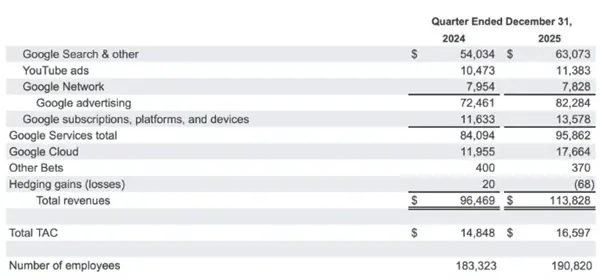
According to the fourth quarter financial report,Google search revenue rises 17% instead of falling, the AIs that were previously considered to be capable of killing traditional search, in the eyes of Brother Pichai, did 0 damage: "We didn't see any evidence of cannibalization", and even used it a little bit to become an all-powerful dragon soul, making their own search stronger...
Because they have launched more than 250 updates in the AI mode and AI overview, and integrated Gemini 3.
After such operations, the average daily AI mode query volume in the United States has doubled, and the average query length has tripled compared with traditional searches.

Not only that, among Google's many businesses, the cloud business has become the biggest bright spot. In the fourth quarter, Google Cloud revenue surged nearly 50% year-on-year. By the end of 2025,Google Cloud’s annualized revenue has exceeded $70 billion.
This rapid growth still comes from the help of AI, because Google sells enterprise AI infrastructure and enterprise AI solutions quite well.
In addition to these fundamentals, for Google, the AI circle in the second half of 2025 will be full of good news.
Since the release of Gemini3 announcing its return as the king, the number of users has surged, especially after the release of Nano Banana. In the third quarter alone, Google added 200 million users, and another 100 million users in the fourth quarter. The overall scale has approached the leader OpenAI next door.
On the other hand, Google's full-stack AI advantages are still expanding. The TPU's success has not only gained popularity in the external market, but also reduced internal AI costs by a huge margin.
Pichago said that through "model optimization, efficiency improvement and utilization improvement", Gemini's service unit cost has been reduced by a full 78% last year.
This is also why Google has been able to lower the API price to an ultra-low price of only US$0.5 per million Tokens. This kind of dimensionality reduction attack through software and hardware collaboration has almost made second-tier (maybe not second-tier) AI manufacturers unable to keep up.
Of course, Google also successfully won a large order from Apple, directly making Gemini the brain of billions of Apple devices around the world.
Although it is generally seen as a defensive victory, it is undoubtedly a landmark moment in Google's development history.
The subsequent impact is expected to be revealed slowly. I can't even imagine such a bright future.
As the AI competition intensifies, on the AI battlefield in 2026, the limiting bottleneck is no longer just computing power. Infrastructure facilities such as electricity may be the top priority. At this stage, the old power grid system and long power access cycle in the United States have become the biggest obstacles restricting the construction of data centers.
In order to protect its position in the AI competition, Google also made a large-scale deployment in the energy industry at the end of the year.Acquired clean energy developer Intersect Power for $4.75 billion.
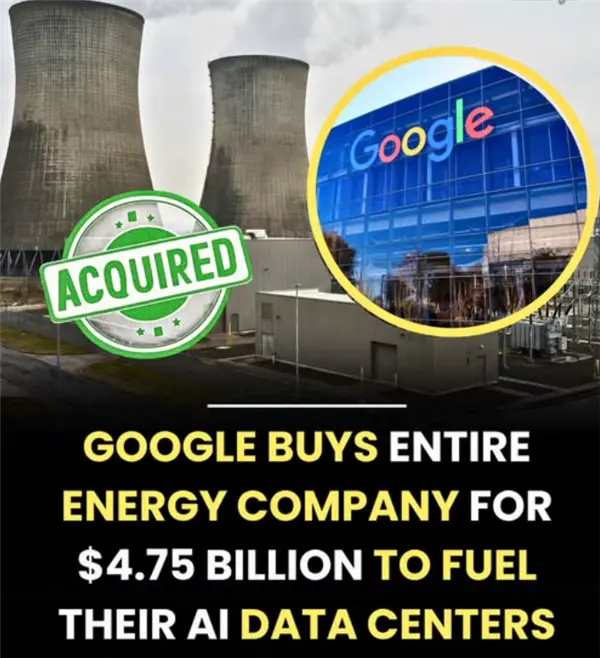
This also allows Google to directly bypass the old system and build supporting photovoltaic, wind power and battery energy storage systems while selecting the location of the data center.
I always feel that there are experts in Google's family, and they are starting to move forward without using food and grass.
However, having said that, the financial report seemed to be in full bloom, but Google's stock experienced repeated roller coaster-like fluctuations that day: it fell 7.5% after the opening, and its market value instantly evaporated by about 350 billion U.S. dollars.
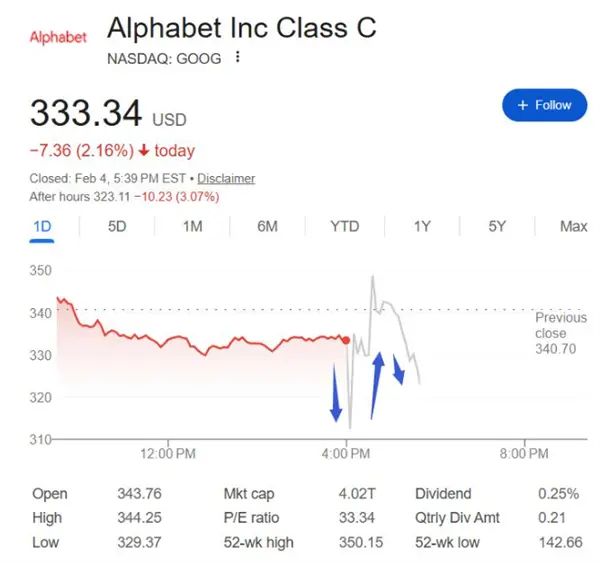
This kind of stock price performance,In fact, it also reflects the ambivalence of the current market to a certain extent.: On the one hand, I was frightened by Google's all-round red financial report, and on the other hand, I was frightened by Google's ruthless money burning.
After all, everyone is still murmuring about the current stage of AI, wondering whether it will be a repeat of the metaverse and web3 bubbles of the past two years. Even the vigorous Internet wave had an unbearable bubble period before it finally exploded.
Moreover, behind this wave of Google's cash-generating ability, there is also depreciation pressure to a certain extent.
Much of the more than $180 billion in capital expenditures will turn into depreciation expenses on the books. Even if Google's revenue continues to surge this year, its net profit growth will most likely slow down because of this astronomical investment in infrastructure. This is obviously not a good thing for investors.
But Google doesn't seem to care about these fluctuations. Maybe in their view, the competition in AI has become a bit "heavy".
Combining assets such as chips, land, electricity, and water conservancy, and sacrificing part of the profits in the short term to hoard land, buy electricity, and manufacture cores is just a step towards building a more solid moat.

Suddenly, I feel that in the second half of the AI competition, it is no longer a script that a few talented programmers can subvert the world by writing code in a Silicon Valley garage (it seems that this was not the case originally).
But we see that it is turning into a resource war that is extremely money-consuming, extremely asset-heavy, and even has a hint of the "big industrial era".
Google's wave of the hand is a sky-high price of 180 billion. The entry threshold for AI has been so high that even major manufacturers can't look directly at it.
We can’t help but wonder, is this path really the right one? If AI still needs several big leaps before it evolves into the ultimate form of our psychology, can the existing resources be able to sustain it?
Could it be said that any development bottleneck is ultimately the amount of resources?
Maybe this is the truth, very unaesthetic, but quite scientific?