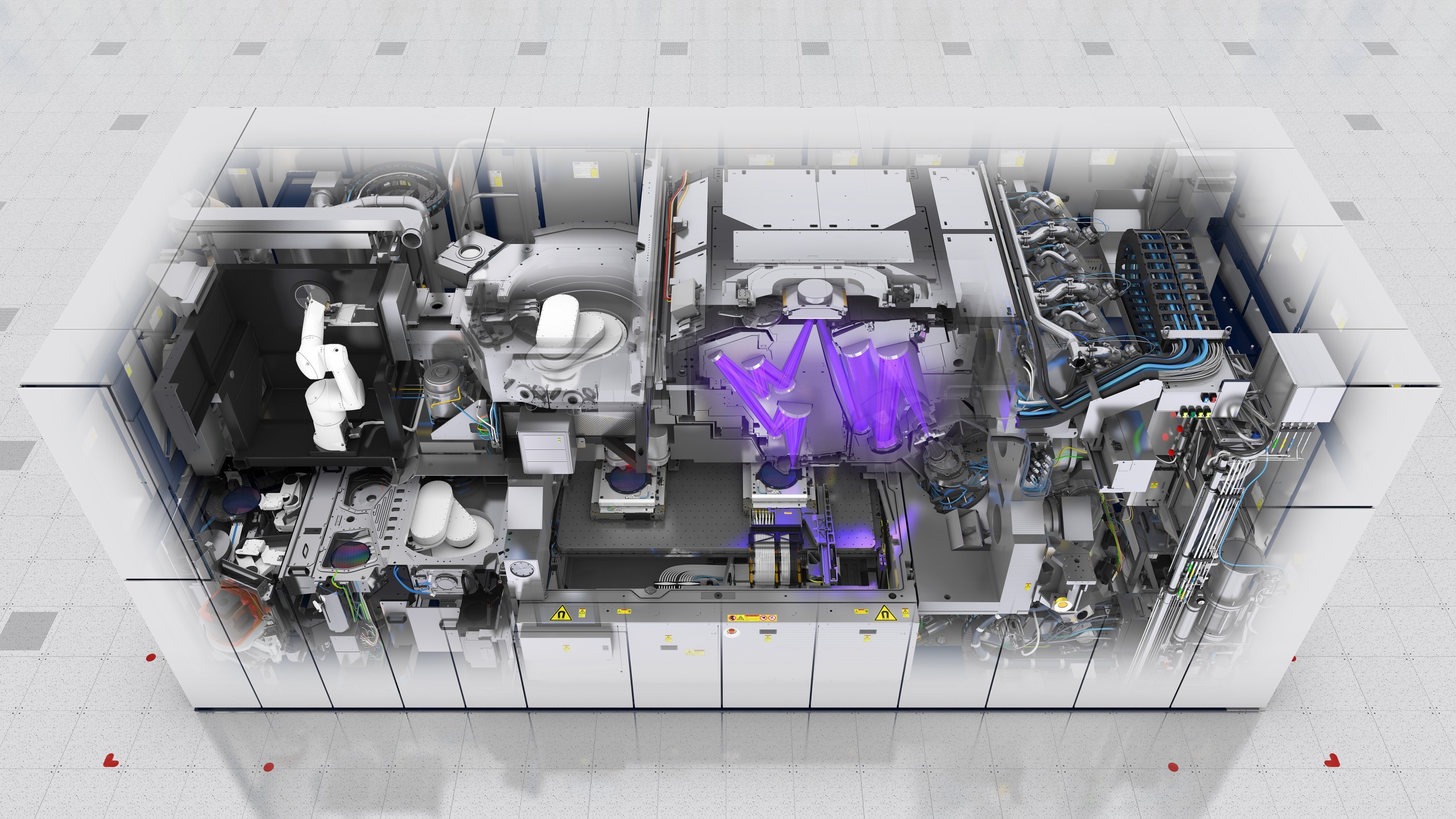
ASML recently confirmed that the development of a new generation of Twinscan NXE EUV lithography machine is progressing smoothly. The light source power will be increased by 50% to 1000W, and the production efficiency will also be increased by 20% to 330 wafers per hour. It is expected to be released in 2030 or later.ASML is extremely proud of this achievement and is full of confidence thatA clear technical path for 1500W light source has been found, and theoretically there is no fundamental obstacle to achieving 2000W!
Of course, many obstacles need to be overcome to achieve a 1000W light source and a complete lithography system.
First,ASML must quickly complete the three-pulse extreme ultraviolet light generation technology announced by the end of 2024.
It first flattens the tin droplets through a 1-micron pre-pulse, and then uses a 1-micron rarefaction pre-pulse to make the tin droplets form a sparse state. Finally, a 10-micron carbon dioxide laser main pulse converts the tin droplets into extreme ultraviolet plasma.
ASML has applied for a patent for this technology, but it has not yet been commercialized. It is expected to wait until the Twinscan NXE:4000 series lithography machine will be withdrawn at the end of this decade.
Second, 1000W light sourceA new tin droplet generating device must be equipped to nearly double the emission frequency to 100,000 per second.
This device is still in the research and development stage and will take several years to be commercialized.
Third, with the large increase in the number of tin droplets emitted, it will inevitably lead to an increase in the amount of impurity residues on the wafer (more precisely, the wafer protective film).
thereforeMust be equipped with a new impurity collection device, clear them quickly.
Fourth, after the 1000W light source is generated, it is also very difficult to accurately transmit it to the wafer.Brand new high transmission projection optical system.
After the system is further upgraded, the production capacity can be increased to more than 450 wafers per hour, and the corresponding light source power will also reach about 1500W.
Fifth, yesWafer stage and mask stageNew requirements have also been put forward, and upgrades must be completed simultaneously.
Sixth, we still needNew photoresist and wafer protection film, adapt to it.
Therefore, the birth of a new lithography machine is not just the work of ASML, but requires the entire industry chain to be fully prepared.

It is worth mentioning that ASML has not integrated 1000W EUV light sources into the high and low numerical aperture (NA) EUV lithography technology roadmap.
In terms of low NA, the new generation Twinscan NXE:4000F lithography machine is planned to be launched in 2027. It is designed for the 1.xnm process node, including Intel 14A and TSMC 16A/14A), with an overlay accuracy of up to 0.8nm, and a production capacity of more than 250 wafers per hour.
In 2029 we will seeTwinscan NXE:4200G, with a production capacity of more than 280 wafers per hour.
In terms of high NA,Twinscan EXE:5200CThe lithography machine will debut next year, with a production capacity of more than 185 wafers per hour, and an overlay accuracy of better than 0.9nm.
2029,Twinscan EXE:5400DPhotolithography machines will follow, and production capacity will exceed 195 wafers per hour.
