Although Apple's latest iPad Air is also labeled with an "M4" chip, its actual hardware specifications are significantly different from the M4 previously used for iPad Pro, with both multi-core and graphics performance reduced.
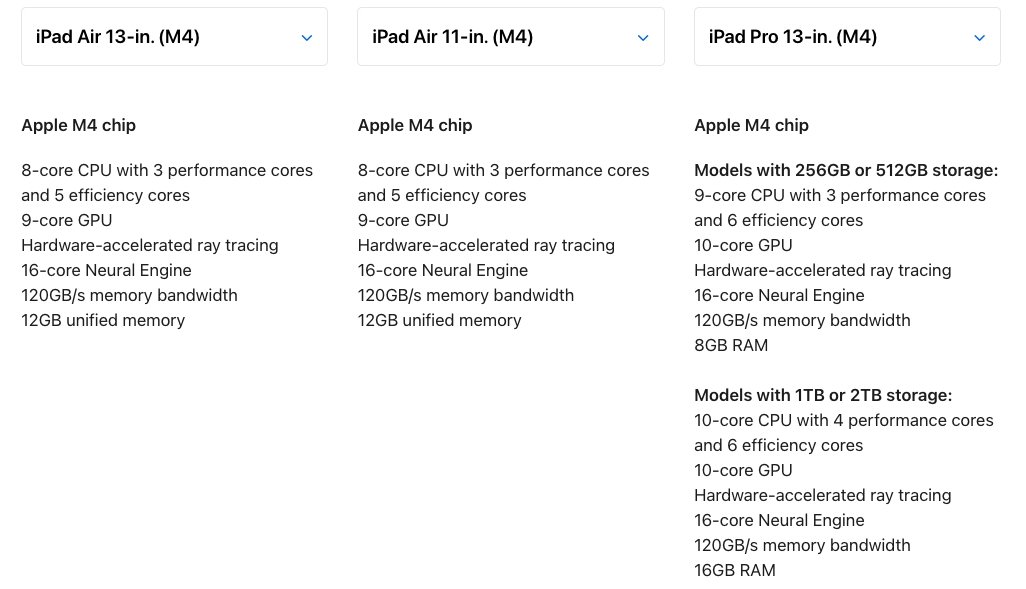
In the technical specifications announced on Apple’s official website, the M4 chip equipped with the new iPad Air is different from the iPad Pro version in terms of CPU and GPU core configurations. iPad Air uses an eight-core CPU, including three performance cores and five energy efficiency cores, and is equipped with a nine-core GPU. In contrast, the previous M4 iPad Pro is available in two configurations: the 256GB and 512GB models use nine-core CPUs (three performance cores plus six energy-efficiency cores), while the 1TB and 2TB models are upgraded to ten-core CPUs (four performance cores plus six energy-efficiency cores), and all versions are ten-core GPUs. This means that the iPad Air version of M4 has reduced the number of CPU energy-efficiency cores and GPU cores, leaving less hardware resources available for multitasking and graphics rendering.
This is not the first time that this practice of using the same name but different cores has appeared. Before the M4, Apple had repeatedly used "chip binning" to divide different performance levels based on the same architecture on A series and M series chips to differentiate product lines and configuration levels. On this iPad Air, part of the CPU core and one GPU core of the M4 were "castrated", forming a slightly lower-positioned variant under the same architecture and process.
From the perspective of actual performance impact, single-core performance will hardly be affected, because single-core benchmarks usually only schedule one performance core, while the iPad Air version still retains three performance cores. For most daily operations that are mainly single-threaded, such as application startup, interface switching and light office work, this difference is not obvious. What really widens the gap are multi-core loads and graphics and professional applications that rely on Metal: In scenarios that require more CPU and GPU cores to be used at the same time, the iPad Air version M4 will lag behind the iPad Pro, which is also an M4, and it is even less likely to approach the performance level of the new iPad Pro using the M5 chip.
It is worth noting that the iPad Air occupies the "middle range" in terms of memory configuration. According to Apple's specification list, the new iPad Air is equipped with 12GB of unified memory, while the M4 iPad Pro is divided into 8GB (low-capacity model) and 16GB (high-capacity model), with the iPad Air right in between. In addition to the different number of cores, other key features of M4 remain the same on iPad Air and iPad Pro, including a 16-core neural network engine, support for hardware-accelerated ray tracing, 120GB/s memory bandwidth, and a media engine that can process 8K video.
Overall, Apple has continued the strategy of subdividing performance levels through chips of the same name on the iPad Air: uniformly using the "M4" label at the marketing level, and at the same time using the difference in CPU and GPU core numbers to distance itself from the iPad Pro and even the M5 iPad Pro in terms of performance and positioning. For users who value price and daily use, the new iPad Air still has enough performance redundancy; but users who have higher requirements for multi-core computing, professional graphics or high-load workflows need to be aware that there is still a big gap between this "shrunk version" M4 and the full M4 on the iPad Pro.