After the news of OpenAI’s cooperation with the U.S. Department of Defense was made public, the number of ChatGPT mobile app uninstalls in the U.S. market surged 295% from the previous day, much higher than its average daily uninstall growth rate of approximately 9% over the past 30 days. In the context of the Trump administration renaming the Department of Defense to the "Department of War" (Department of War), this cooperation triggered a large number of consumers' concerns about military and surveillance purposes, and some users chose to express their dissatisfaction by deleting the application.
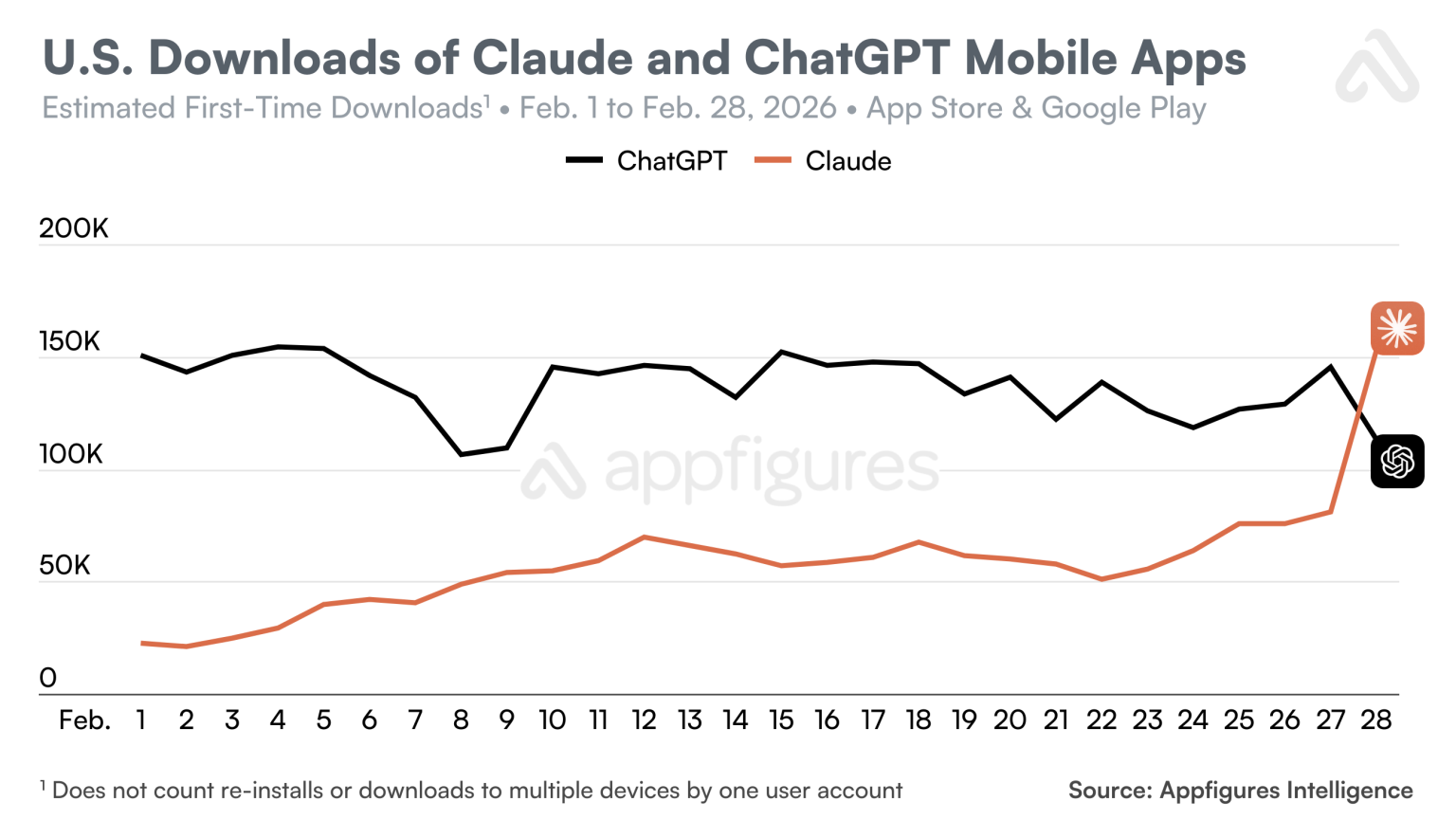
The above data comes from market intelligence agency Sensor Tower. Statistics from the agency show that while ChatGPT has been controversial for its cooperation with the Department of Defense, downloads of the Claude app owned by rival Anthropic have significantly strengthened in the United States. On Friday, February 27, Claude saw a 37% increase in U.S. downloads from the previous day, and a further 51% increase on February 28. Previously, Anthropic had just publicly stated that it would not cooperate with the U.S. defense department because the company was unable to accept the relevant terms and was particularly worried about artificial intelligence being used to monitor U.S. citizens and fully autonomous weapons systems. Anthropic believed that current AI technology did not yet meet the conditions for safe deployment in these scenarios. Market data shows that some consumers clearly agree with this stance.
Judging from the new downloads, ChatGPT was also dragged down by news of cooperation. Sensor Tower statistics show that after the news was announced, the number of new downloads of ChatGPT in the United States dropped by 13% on Saturday compared with the previous day, and continued to decline by 5% on Sunday. On the Friday before the announcement of the partnership, the app's downloads also achieved a 14% day-to-day growth, which is in sharp contrast.
The ranking changes also confirm this round of "voting with your feet." On the U.S. App Store, Claude shot to the top of the free apps list on February 28 and remained at the top as of Monday, March 2. Claude has moved up over 20 spots compared to a week ago (around February 22nd). This not only reflects the drastic changes in short-term user downloading behavior, but also reflects that the polarization of public opinion around the integration of AI and military is rapidly transforming into actual product choices.
Consumer dissatisfaction also erupts in app store ratings. Data from Sensor Tower pointed out that the number of 1-star reviews received by ChatGPT surged 775% in a single day on February 28, and continued to grow at a 100% day-to-day rate the following day. In contrast, 5-star reviews fell by 50% during the same period. This means that users are not only uninstalling the app, but also recording their dislike of OpenAI’s cooperation with U.S. defense in public reviews.
Other third-party data institutions have also provided side evidence for the above trends. Statistics from market analysis platform Appfigures show that on February 28, Claude’s total single-day downloads in the US market exceeded ChatGPT for the first time. Appfigures also observed that Claude's U.S. downloads increased by as much as 88% on the day, which was higher than Sensor Tower's estimates. The agency also pointed out that Claude has now topped the list of iPhone free apps in six countries outside the United States, including Belgium, Canada, Germany, Luxembourg, Norway and Switzerland, showing that its international user base is also rapidly expanding.
Similarweb, a third market intelligence agency, provided supplementary data from a longer time perspective: In the past week, Claude’s downloads in the United States were approximately 20 times those in January. However, the agency also reminded that compared with a single political event, the surge in users may be due to multiple factors such as product iteration and marketing promotion. Therefore, it is not appropriate to simply attribute all growth to the public stance of "refusing to cooperate with the defense department."
At a time when controversies surrounding the militarization and surveillance of AI technology are heating up, OpenAI’s cooperation with the U.S. “Department of War” is becoming a watershed that tears apart the user community. On one end is the pressure ChatGPT is under in terms of uninstalls, ratings, and new downloads; on the other end is the short-term traffic bonus gained by Claude, who clearly refuses defense cooperation. This user “migration” triggered by a cooperation agreement is sounding the alarm for global AI companies: As artificial intelligence capabilities develop rapidly, business choices and ethical boundaries will also directly shape the brand image of the product and the fate of users.