Intel recently officially released two new processors for desktop players: Core Ultra 7 270K Plus and Core Ultra 7 250K Plus, calling them "Intel's fastest gaming desktop processors to date." The two new products are expected to go on sale on March 26. They aim to surpass the previous Raptor Lake and Core Ultra 200 series Arrow Lake flagships in terms of gaming performance, while achieving a more attractive balance between multi-threaded productivity performance and price.
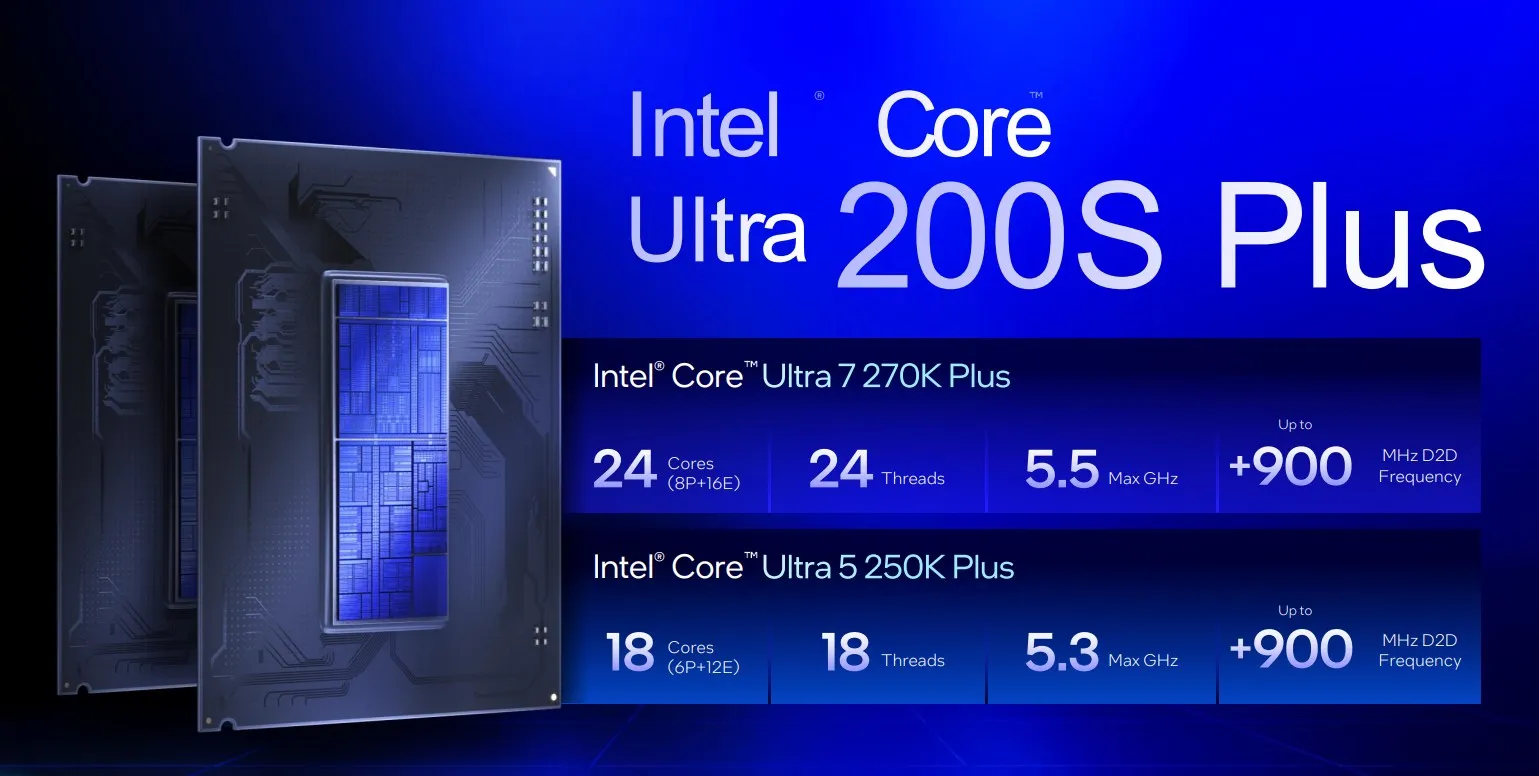
Intel's flagship desktop CPUs haven't had an easy reputation over the past few generations. The 2022 and 2023 Raptor Lake products are known for their high power consumption, high temperatures, and notorious stability issues. The crash problem of the 13th and 14th generation Cores once became the focus of the industry. The 2024 Core Ultra 9 285K based on the Arrow Lake architecture performed mediocre in terms of game performance and failed to establish the image of a "next generation flagship" in the minds of players, forcing Intel to "make up for it" through multiple rounds of microcode and performance updates.
In this context, the new Core Ultra 7 270K Plus and 250K Plus are regarded as a "battle for reputation." Intel claims that the Core Ultra 7 270K Plus, which has 24 cores and a maximum turbo frequency of 5.5GHz, can finally surpass the i9-14900K of the Raptor Lake era and the Core Ultra 9 285K of Arrow Lake in terms of gaming performance. Officials also emphasized that with the combination of 24 cores, 24 threads and a price of $300, the chip is expected to benchmark or even suppress AMD's Ryzen 7 9700X in terms of multi-threaded productivity, especially for users with limited budgets who need to handle multi-threaded workloads.
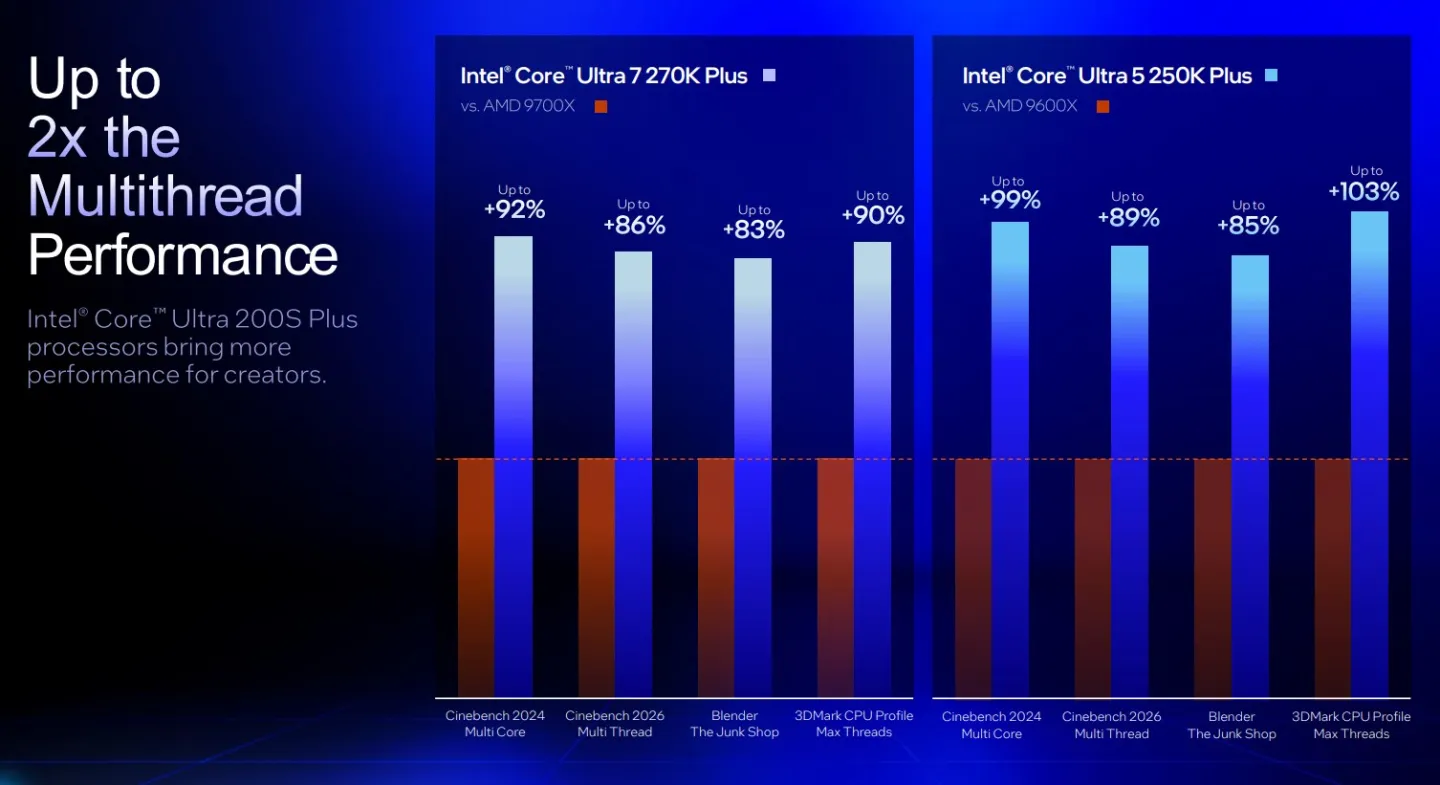
However, the report also pointed out that AMD's Ryzen 7 9700X itself is not the company's current top-tier gaming processor product and has been around for about a year and a half. Therefore, Intel's choice to compare with a "not the strongest" but still representative Ryzen product at the $300 level is more like fighting for the right to speak on the multi-threaded cost-effective battlefield, especially to strengthen its appeal in budget-level multi-threaded application scenarios.
Targeting the lower-priced market, the Core Ultra 7 250K Plus is priced at $200. Intel claims that compared to the AMD Ryzen 5 9600X in the same price range, this processor can achieve an average improvement of 103% in multi-core performance, which means that it is expected to achieve nearly double the performance advantage in a multi-core load environment. In the context of the current high overlap between gamers and content creator groups, this kind of "double multi-core performance" promotion is obviously increasing the appeal of its budget platform.
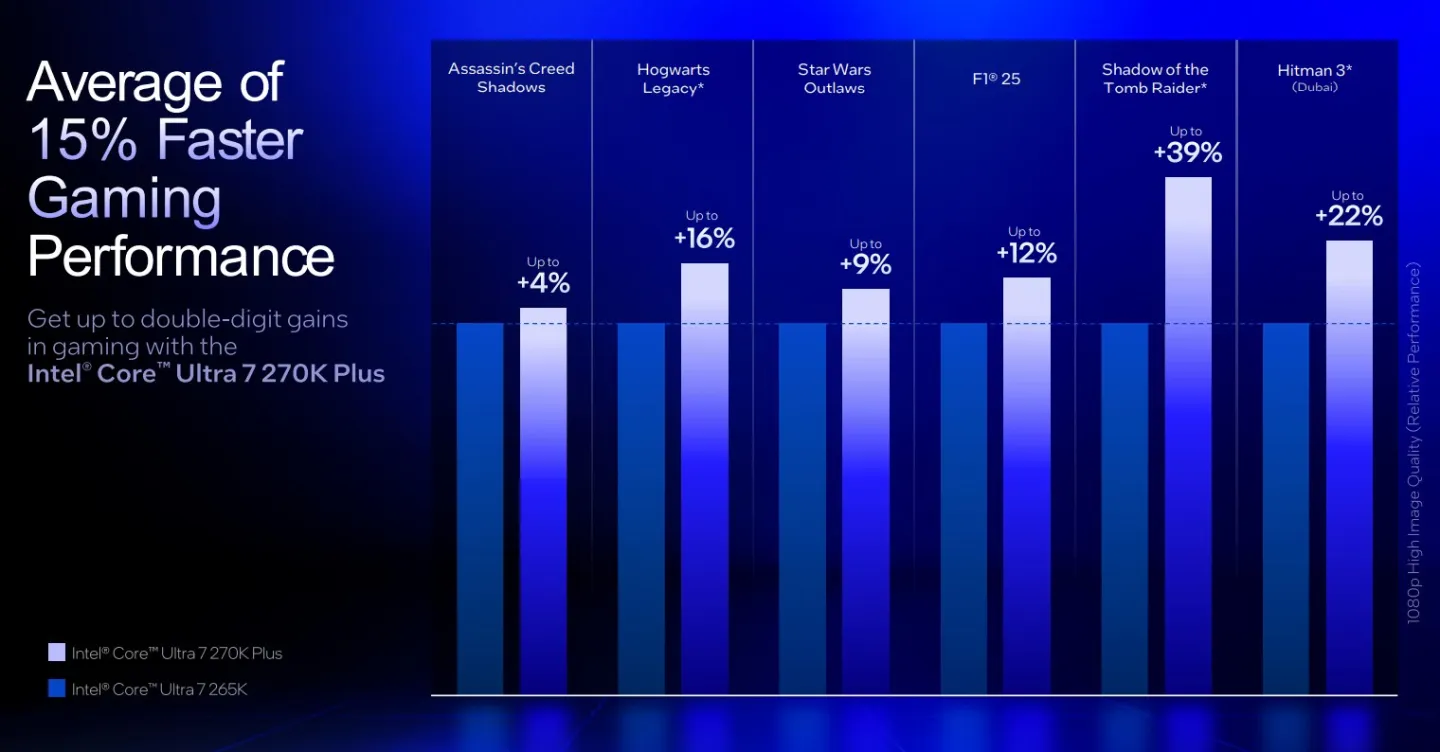
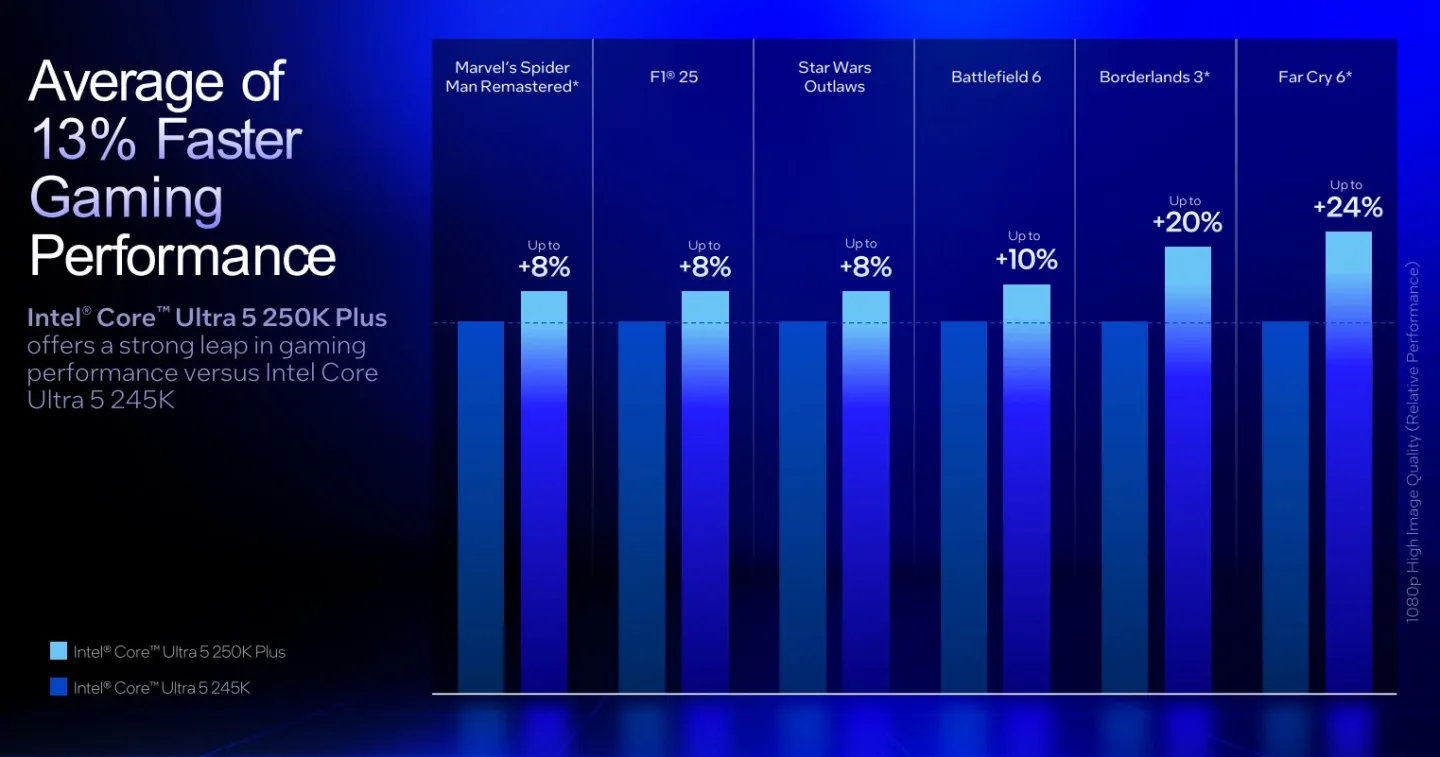
However, in terms of the most critical "game performance comparison", Intel's official information has become relatively vague. Intel did not give a detailed game frame rate comparison between the 270K Plus and the 250K Plus compared to the previous generation flagship i9-14900K or Core Ultra 9 285K in its external presentation, nor did it directly compare it head-on with AMD's latest generation of high-end game processors. Instead, the company chose to primarily compare the two new products to their immediate predecessors, the 265K and 245K, using percentage increases to demonstrate the extent of the generational upgrade.
Judging from the game data released by Intel, the game performance improvements brought by Arrow Lake Refresh vary significantly among different works. For example, in Assassin's Creed: Shadows, performance improvements were only up to 4%, while in Shadow of the Tomb Raider, performance improvements were up to 39% after enabling a new tool called the Intel Binary Optimization Tool. The tool is described as a "first-of-its-kind binary translation layer optimization capability" that can further tap performance potential in some native games. This approach shows that Intel is trying to further improve the performance of existing hardware in specific games through software optimization and automatic adjustment at the binary level.

In terms of architecture and specifications, Core Ultra 7 270K Plus and 250K Plus are still based on the Arrow Lake Refresh platform, but have made many detailed adjustments for performance and energy efficiency. Intel said that the new processor added four additional energy-efficiency cores (E-core) to the previous generation, and also increased the basic frequency of the processor: the basic frequency of the performance core (P-core) was increased by 200MHz, and the basic frequency of the energy-efficiency core was increased by 100MHz. In addition, the link frequency between the CPU and the memory controller has been increased by 900MHz, and support for DDR5 7200 MT/s memory has been added. In terms of memory topology, the new product also provides "early support for four-rank CUDIMM memory modules", provided that the 800 series motherboard used by the user has the corresponding support capabilities.
Despite the frequency and core configuration upgrades, the nominal TDP of both new processors remains the same as their direct predecessors, at 125W. The report mentioned that the base frequency of Core Ultra 7 270K is now 4.1GHz, which means that at the same power consumption level, Intel is trying to make up for its previous shortcomings in gaming and multi-threaded performance through higher base frequencies, multiple E-cores, and faster memory and bus interconnections. However, since Intel has not disclosed detailed game comparison data with the previous generation flagship and AMD's high-end models, the extent to which these improvements can actually change the purchasing preferences of gamers and enthusiasts remains to be verified by subsequent third-party reviews.
Overall, Core Ultra 7 270K Plus and 250K Plus shoulder the important task of repairing Intel's desktop flagship image: on the one hand, they are promoted as "the fastest gaming desktop processors to date", trying to get rid of the shadow of the past two generations in terms of power consumption, stability and game performance; on the other hand, in the price range of 200-300 US dollars, they focus on comparing AMD 9700X and AMD 9700X 9600X also shows that Intel hopes to win back the mid-to-high-end player and creator market through multi-threaded performance and price advantages. Before the actual launch performance and independent evaluation are released, whether these two new products can truly "shake off the dust of i9-14900K" is still the focus of continued attention of the market and players.