Currently, Xbox PC applications already support Advanced Shader Delivery (ASD), and Intel and Nvidia have also stated that they are working with Microsoft to push this feature to the entire Windows system.
Microsoft is teaming up with Intel and Nvidia to develop two new DirectX features aimed at solving problems often encountered by PC gamers. One of them is to make the AI functions in the game run more efficiently; the other is to reduce frame drops (stuttering) caused by shader compilation and the long waiting time when starting the game for the first time.
1.AI performance optimization: Make AI run more smoothly
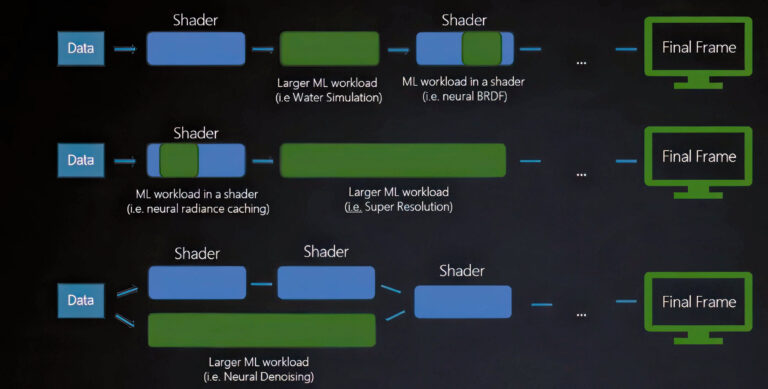
In terms of AI, Microsoft is preparing DirectX Linear Algebra and DirectX Compute Graph Compiler.
Simply put, these tools allow developers to run AI tasks directly through DirectX without the need to write special code for different graphics card brands. This is very important for functions such as neural rendering, AI super-resolution (scaling), and mapping tools to ensure that these special effects run at high speed without interfering with the normal performance of the game.
2. Progress of cooperation between Intel and Microsoft
Intel and Microsoft continue to promote the development of the PC gaming ecosystem by providing new features for core APIs such as Direct3D and DirectStorage. Intel is proud to announce support for all the latest advancements in the Windows ecosystem, including:
DirectX Machine Learning: Introducing DirectX Linear Algebra.
Advanced Shader Distribution (ASD): Ensures players enjoy a smooth experience from the moment they launch the game.
DirectStorage: Now supports Zstandard compression algorithm.
Microsoft PIX: Continuously adding new features to bring host-level development tools to the Windows platform.
Intel said it is working with Microsoft to support DirectX linear algebra, and Nvidia also said it is helping to standardize hardware-accelerated AI in DirectX. Its core goal is to reduce the overhead incurred when AI tasks are passed between different parts of the GPU pipeline. In layman's terms, Microsoft hopes that AI tasks can be better integrated into the game process, saving developers trouble and allowing players to obtain more stable frame rates.
3. Say goodbye to lag: Advanced Shader Distribution (ASD)
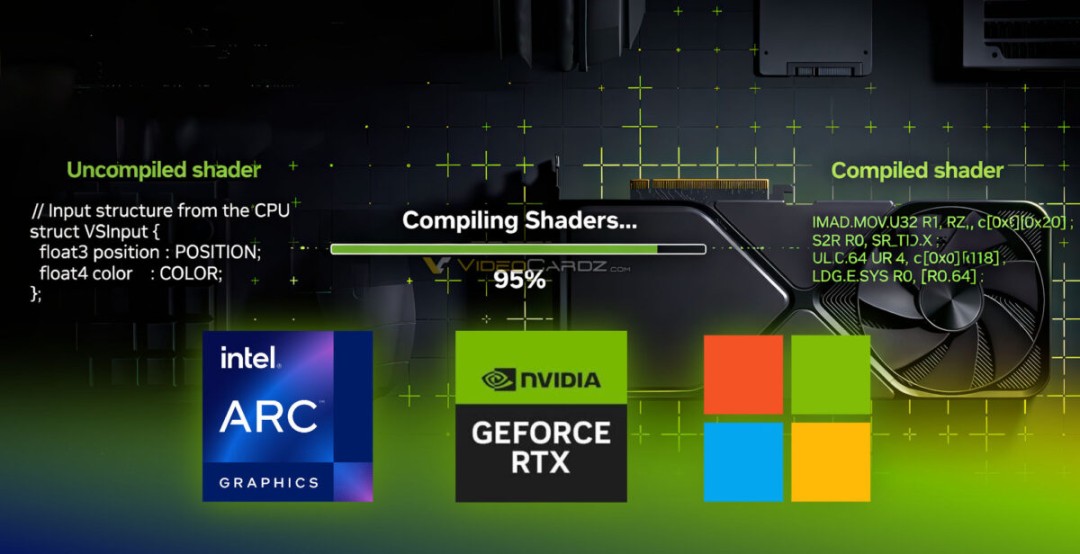
Another focus of this collaboration is Advanced Shader Distribution (ASD).
This is Microsoft's new way of handling shader compilation: by sending precompiled shaders synchronously when the game is downloaded, rather than handling these tasks when the game is running. This means there will be less of that annoying lag when you launch the game for the first time or enter a new scene, and load times will be faster.
Intel confirmed that ASD will support Lunar Lake and Panther Lake processors, while Nvidia also plans to provide support for GeForce RTX graphics cards later this year.