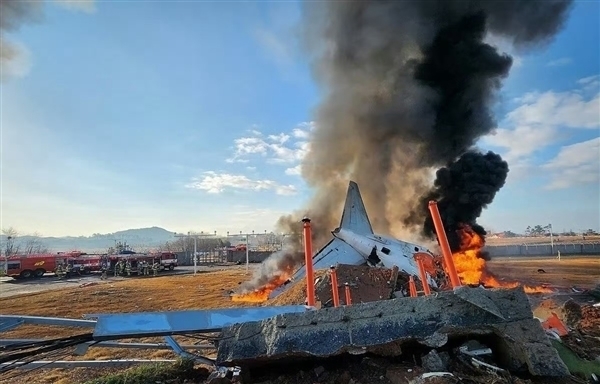
According to the latest reports from Korean media, as of the 12th local time of this month, the site of the Jeju Air crash that occurred one year ago in South Korea wasAfter the investigation was restarted, a total of 33 suspected remains of the victims were found, 9 of which were confirmed to belong to 7 victims through DNA comparison, and the remaining 24 are still under further identification..
This incident aroused strong public doubts. On the same day, South Korean President Lee Jae-myung ordered a thorough investigation into the reasons why the remains were not collected in time and were left on hold for more than a year, and those responsible were severely investigated.
This tragedy occurred on December 29, 2024.Jeju Air flight 7C2216 crashed while landing at Muan Airport in Jeollanam-do. Among the 175 passengers and 6 crew members on board, only 2 flight attendants were rescued, and all the remaining 179 people were killed.
This is the most serious air crash in South Korea with casualties. After the air crash, relevant departments conducted a search and rescue investigation, but the work of collecting the remains was not completely completed.
Some of the 33 newly discovered bones were found on the right wing of the crashed passenger plane, and most of the rest came from the wreckage that had been bagged and left at Muan Airport.
It is reported that during the initial investigation of the air crash,Some of the remains that were considered of "lower importance" were hastily bagged and shelved without detailed classification and testing. In addition, relevant departments had previously cleaned up the scene without consulting the families of the victims, resulting in the remains being left out for more than a year..
In response to this matter, Lee Kyu-yeon, the chief secretary for communiqué communication of the South Korean President's Office, said that there were indeed omissions in the aftermath. President Lee Jae-myung has given clear instructions to quickly and thoroughly advance the investigation, find out the complete process of the remains being shelved, clarify the ownership of the responsibilities, and require relevant departments to improve the storage and handling procedures of the remains to prevent a recurrence of similar situations.