Microsoft recently released a non-security preview update for Windows 11 24H2/25H2 in March 2026. This update is of a testing nature and is usually installed by the system only if the user actively clicks the Check for Updates button. The newly released non-security preview update number is KB5079387, and the corresponding system version numbers are Build 26100.8106 and Build 26200.8106. This update brings some interesting new features to Microsoft.
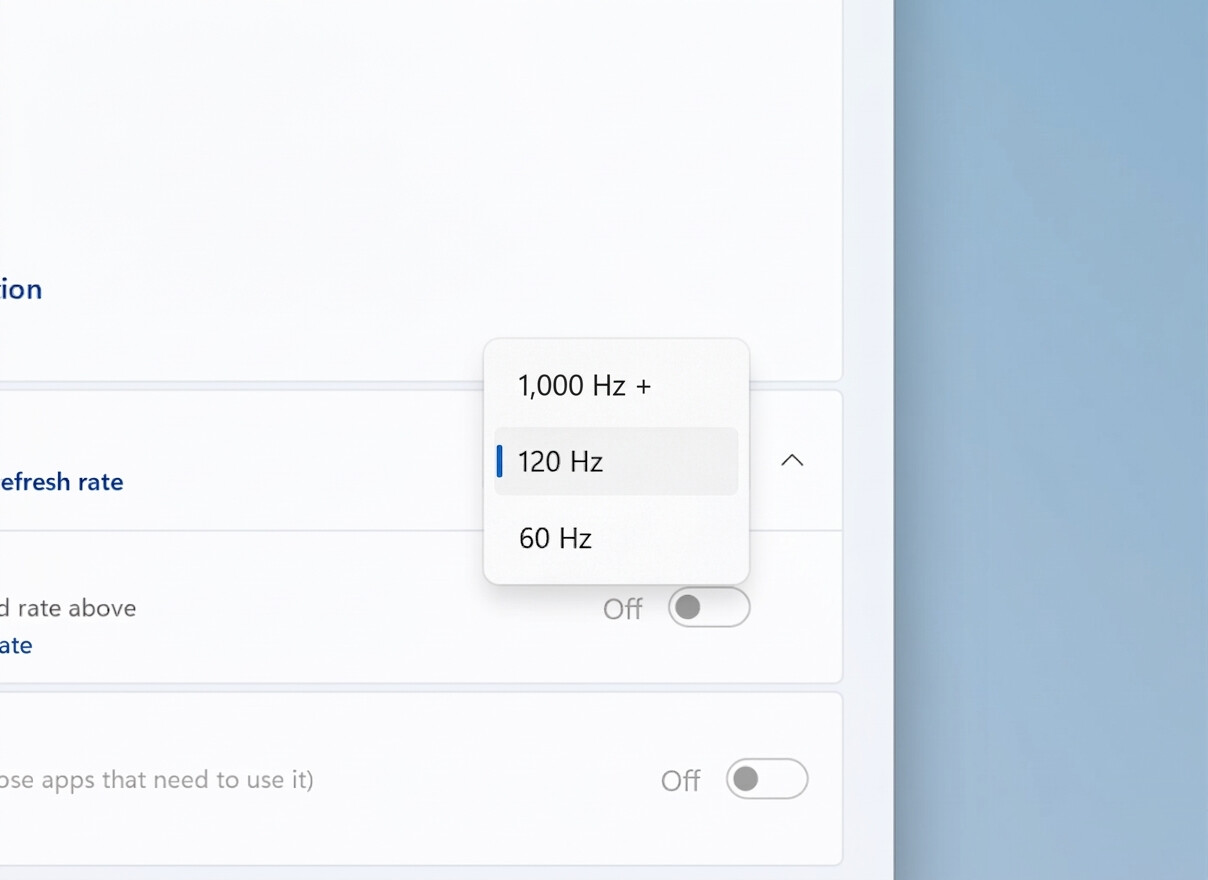
Perhaps the most noteworthy thing is that Windows 11 supports monitors with a refresh rate exceeding 1,000Hz for the first time. In fact, Microsoft did not clearly state what the highest supported refresh rate is. It only said that the monitor can display at a refresh rate higher than 1,000Hz.
At present, most mainstream office monitors still have a refresh rate of 60Hz, some mid-range game monitors can have a refresh rate of 120Hz, and mid-to-high-end game monitors can have a refresh rate of 360Hz or even higher.
The current market with a refresh rate exceeding 1,000Hz is mainly the Samsung Odyssey G6 series (G60H). This monitor supports a refresh rate of up to 1040Hz and is positioned as a professional e-sports gamer.
The G60H supports a 1040Hz refresh rate at 720P resolution and up to a 600Hz refresh rate at native QHD resolution (2560x1440), but there are other manufacturers launching ultra-high refresh rate monitors during CES 2026.
For example, TCL 27P2A Ultra also supports a refresh rate of 1,040Hz at 720P resolution, and HKC ANT275PQ MAX supports a refresh rate of up to 1,080Hz at 720P resolution. However, these products are currently only displayed and do not seem to be on the market yet.
It is worth noting that the human eye's perception improvement for frequencies greater than 500Hz is very weak, so unless you are a professional e-sports gamer who pursues the ultimate experience, you will not be able to use a monitor with a refresh rate exceeding 500Hz.
In addition, driving these ultra-high refresh rate displays also requires powerful graphics cards and bandwidth output. The graphics card is responsible for rendering work, and if the bandwidth is too small, data transmission will be limited and such an outrageous refresh rate cannot be achieved.
Microsoft Blogs