According to news on March 14, the leakage of policy information is no longer an isolated phenomenon. Whether it is a private car or a commercial vehicle, whether it is auto insurance or life insurance, many consumers have encountered the problem of precise harassment. At the Guangdong 315 party held tonight, the chaos of policy information leakage was exposed.

"They can all check our car information. Whoever's insurance is about to expire will call and sell insurance." "Many people contact us when it expires, especially operating vehicles. In fact, a lot of information is now transparent outside." Many car owners said this. A staff member of an insurance company’s offline store said frankly, “As long as you buy a car, the information is basically transparent.”
Is policy information leakage an isolated phenomenon, an occasional phenomenon, or a common phenomenon? The investigation found that on multiple social platforms, some people were openly selling insurance policy data. In order to avoid supervision, relevant posts often used code words, letters and special symbols. After contacting multiple sellers, they all asked to add QQ or WeChat first for peer-to-peer communication. An auto insurance data seller just sent a sample through a friend. The customer's name, gender, ID number, mobile phone number, chassis number, engine number, vehicle model, first registration date, and commercial insurance expiration date were all available. The seller bluntly stated that you can choose data only in Guangdong area, 1,000 items are priced at 200 yuan, and each item only costs 0.2 yuan on average. The information of three car owners was randomly selected for verification, and the results were all consistent.
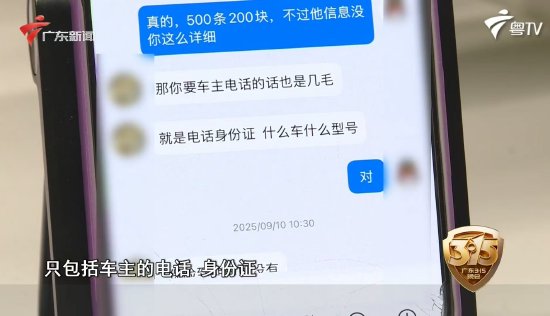
There are also auto insurance data sellers who offer more detailed information, with simple information costing 0.8 yuan each, including only the car owner’s phone number, ID card, car model, and whether the insurance has expired, while more detailed information costs 2 yuan. It claims that the data comes from an insurance company with the prefix "XX" in China. If you purchase 500 pieces of information, you can also select samples sent from designated areas. Some of the sample information has been blurred, but key contents such as vehicle frame number, expiration date, insurance type, and premium are clearly visible. After random checks, the information was completely correct.
Some sellers have broader resources and directly send a list covering multiple insurance companies. You can choose life insurance, annuity insurance and other insurance types at will, and can accurately filter by regional expiry date. The seller claims that data is only sold once and is in very short supply, especially for popular insurance types. All policies that expire in 2029 are sold out. Of course, the price will be high, with the sales price of one customer information being as high as 10 yuan. The sample information provided by the seller involves the policy information of dozens of insurance institutions. The customer's name, mobile phone number, address, policy number, and premium start and end dates of the insured products are all at a glance, covering almost all the major domestic insurance institutions.
How does the core data of various insurance companies flow to the sellers? Sellers were approached via social media and they were all secretive about the source of their information. Some people say that the data comes from external networks, while others reveal that it is obtained from some overseas encrypted communication software, such as on airplanes. Many sellers admit that due to the domestic crackdown on illegal information trading, these transactions are now basically transferred to external network platforms, which has long become an unspoken rule in the industry. In order to avoid crackdowns, they only communicate by text and refuse voice contact. Some even refuse to accept direct transfers and require the use of Alipay passwords and red envelope virtual currencies to complete transactions.
Insurance institutions generally do not take the initiative to leak customer data. Experts believe that insurance sales staff are highly mobile and leaks by insiders may become the biggest risk.
Experts say the credibility of the entire insurance industry will be greatly harmed when consumers discover that information has been leaked. It also reflects from the side that during the entire information collection process, insurance companies may lack data protection. As information processors, insurance companies collect consumers’ personal information, and they have corresponding security obligations. If an insurance company fails to fulfill its corresponding security obligations and personal information is leaked, the competent authorities can order it to make corrections and give a warning. If the circumstances are serious, it can also impose a fine and revoke the insurance company's business license. If it constitutes a crime, it can be transferred to the public security agency and its criminal liability can be investigated.