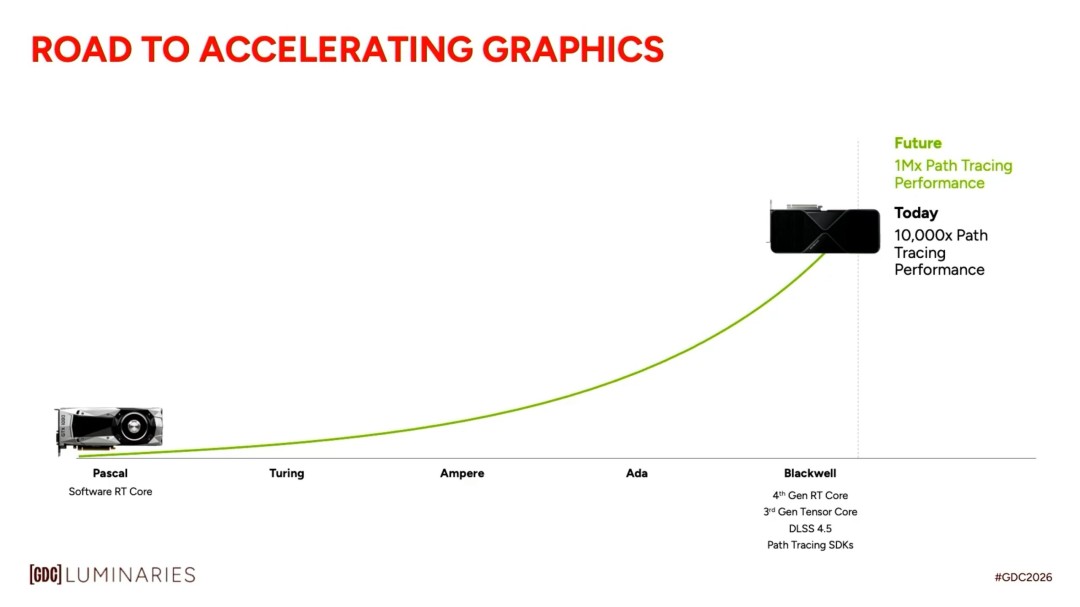
At GDC 2026, Nvidia did not release a new game graphics card. Instead, it focused on a long-term rendering technology roadmap through John Spitzer's RTX technology speech. The company stated that the current 50-series graphics cards based on the Blackwell architecture have achieved a 10,000-fold improvement in path tracking performance compared to the 2016 Pascal architecture (10 series). The future architecture aims to achieve a performance improvement of 1 million times compared to the 10 series.
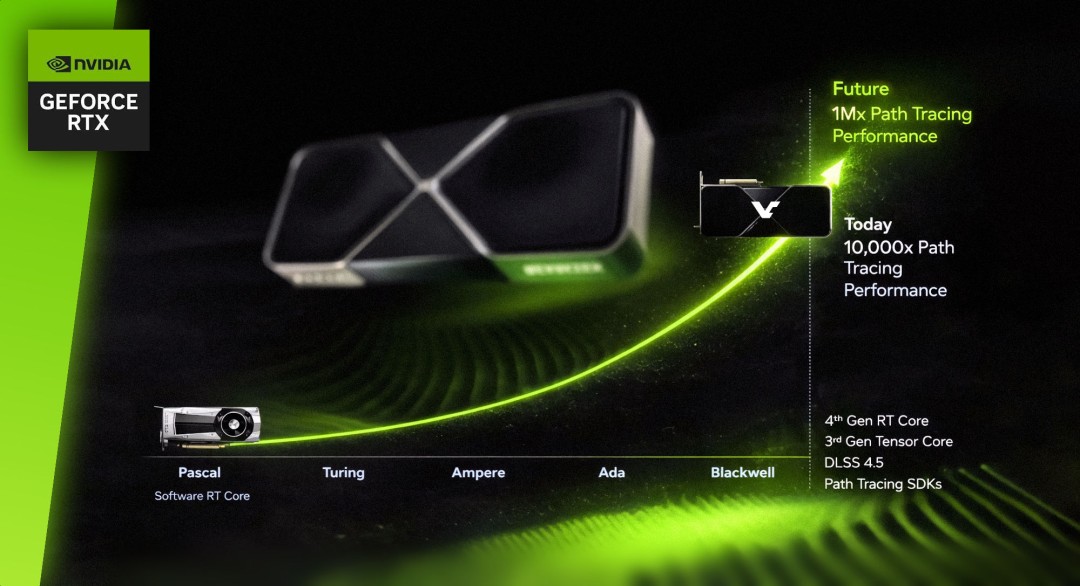
However, this comparison is obviously not rigorous. Because in the Pascal era, there was no dedicated ray tracing core (RT Core), Tensor Core, or DLSS technology. Therefore, this is not a true generational performance comparison of graphics cards. If you want to make a more reasonable comparison, you should at least start from the Turing architecture that was first introduced to RT Core in 2018.
In fact, NVIDIA has superimposed all the hardware advancements, software optimization and AI-assisted rendering technology of the past ten years for calculation. As such, this number is presented by the company as a long-term roadmap goal, rather than a promise of short-term product performance improvements.
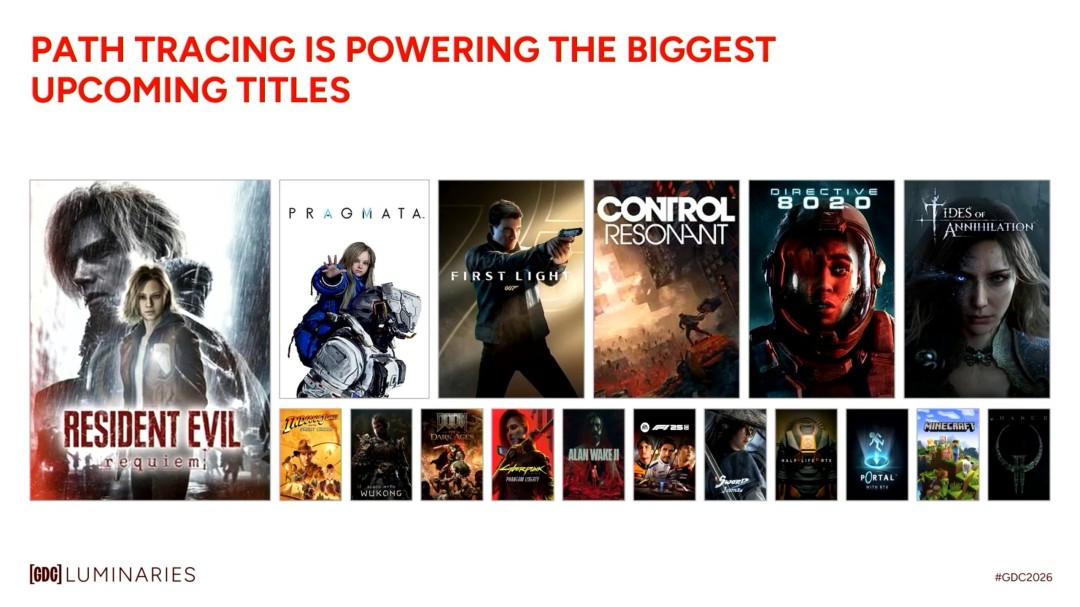
Spitzer explained in his speech:
"If you look back at RT Core, which was only implemented in software, and compare it to today, we already have the fourth-generation RT Core, the third-generation Tensor Core, and DLSS4.5 that can infer 23 out of 24 pixels. These technologies can be superimposed on each other - multiplying them all together, combined with algorithm improvements, ultimately resulted in a performance improvement of about 10,000 times in the past 10 years."
Spitzer also said that Nvidia does not believe that larger chip size alone can bridge the gap between real-time rendering and film-level rendering. He believes that "Moore's Law has expired", so the next stage of breakthroughs must come from algorithmic advancements and larger-scale AI participation.
In terms of actual technical direction, this means that the future will rely even more on:
-More advanced DLSS and AI super-resolution technology
-Neural Rendering
- Stronger ray tracing hardware
-Reduce the amount of calculations that the GPU needs to complete per frame through path tracing algorithms
In the official information of this GDC, NVIDIA also highlighted several technological advances, including:
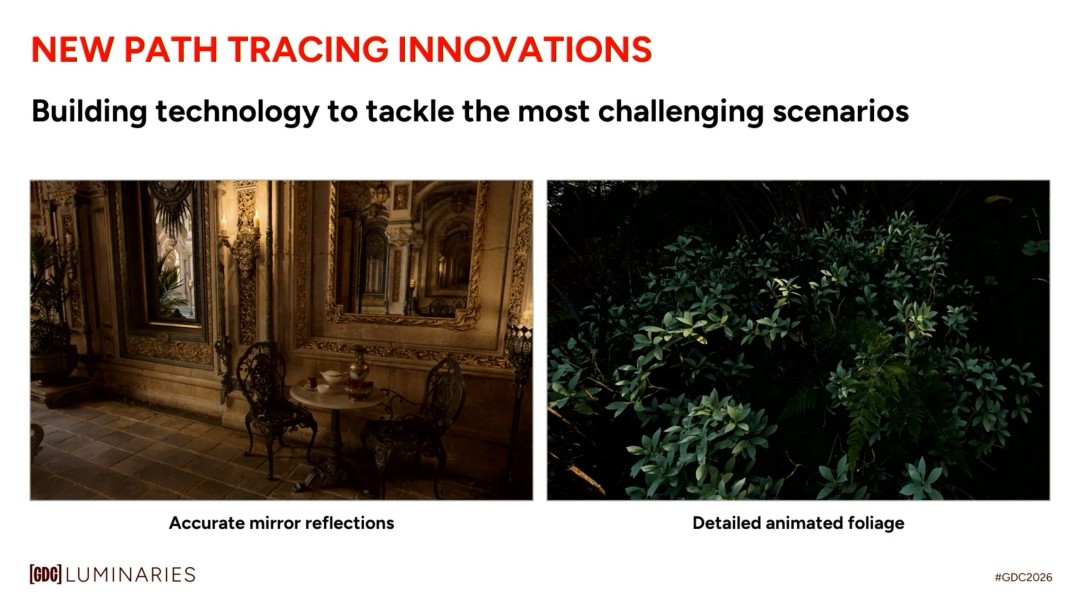
-Re STIRPT: used to improve highlight reflection quality and achieve path reuse
-RTX MegaGeometry vegetation system: used to render ultra-high density vegetation in path tracing scenes
-Progress of cooperation with CD PROJEKT RED on "The Witcher 4"
In addition, NVIDIA also announced that DLSS 4.5’s dynamic multi-frame generation and 6X mode will be launched on March 31 and support GeForce RTX 50 series related workflows.
Therefore, the real message of this announcement is not that Nvidia promises a 100x performance leap in the next generation of GeForce graphics cards. The company would like to emphasize that future improvements in path tracing performance will come more from neural rendering, frame generation technology, smarter light transmission algorithms, and more specialized RT tool chains.
Of course, Nvidia always likes to use exaggerated numbers to show its technological vision, but hopefully this does not mean that prices will also rise accordingly.