The anti-privacy screen technology equipped with Samsung Galaxy S26 Ultra has attracted widespread attention in the market since its release. This function aims to use technical means to ensure that when the user turns on anti-peep mode, others around him cannot see the specific content of the screen, thereby providing strong physical protection for personal privacy.
It is reported that this leading anti-peep feature is based on the new Flex Magic Pixel OLED panel. Its core lies in the integration of a set of electronically controllable dual optical structures inside the screen, which achieves precise control of the light propagation path through a combination of physics and electronic technology.
When the user turns on privacy mode, a microscopic grating appears on the bottom layer of the screen by applying a specific voltage. These tiny structures can effectively change the propagation trajectory of lateral light and produce specific diffraction effects.
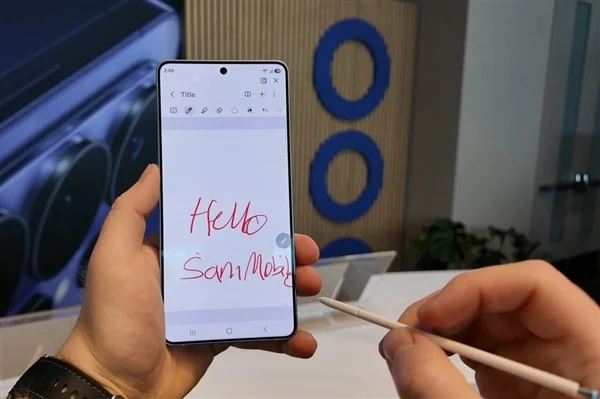
This design physically blocks light from oblique viewing angles, thereby achieving an excellent privacy shielding effect. This is undoubtedly an attractive innovation for users who often handle sensitive information in public places or value their personal space.
However, with the large-scale launch of the product, some users began to report discomfort during use on social platforms. Many users said that after using the Galaxy S26 Ultra for a period of time, they experienced symptoms such as obvious eye fatigue, dizziness and even nausea.
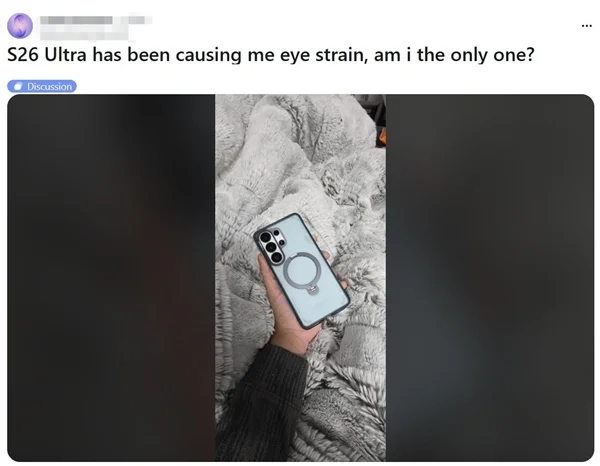
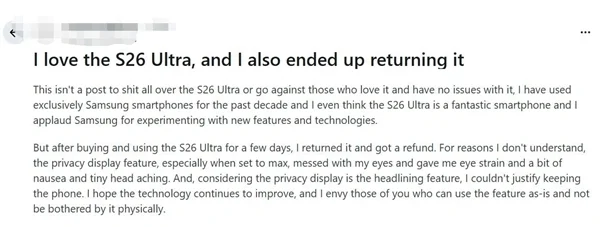
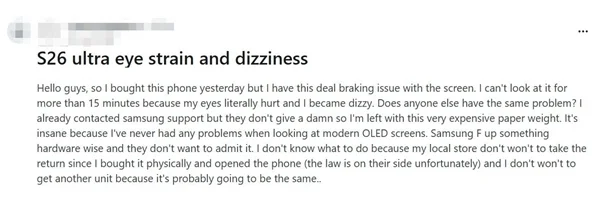
This situation has even led some affected users to choose to return their products. One user mentioned in feedback that he could not use the phone for more than 15 minutes continuously due to a strong stinging sensation in his eyes and dizziness, and his body reacted very violently.
At present, this discomfort may be related to the special refraction of light in privacy mode. Although the anti-peep function effectively solves the pain point of privacy protection, the microscopic changes in the screen display effect seem to put a burden on the visual nerves of some sensitive people.
Despite this negative feedback, a large number of users reported not experiencing anything unusual. Judging from the current overall data, the phenomenon of dizziness and nausea caused by privacy screens is still a small number of cases and has not generally occurred in large groups of people.
This also reminds consumers that when choosing products with special screen technology, it is best to go to offline stores for actual experience. After all, everyone has individual differences in their adaptability to screen colors, strobes, and grating structures.