If Huawei had not been sanctioned by the United States, Kirin's level would now be at the top of all SoCs. In the past ten years,The main frequency of smartphone SoC has increased several times, and this year, the industry is about to usher in a historic node, and the main frequency of mobile phone SoC will exceed the 5GHz mark for the first time.
The core of this round of performance leaps comes from the in-depth cooperation between Apple, Qualcomm, MediaTek and TSMC. Relying on TSMC's advanced process nodes, these leading manufacturers have not only developed the industry's most cutting-edge mobile phone chip technology, but also achieved previously unimaginable performance breakthroughs.
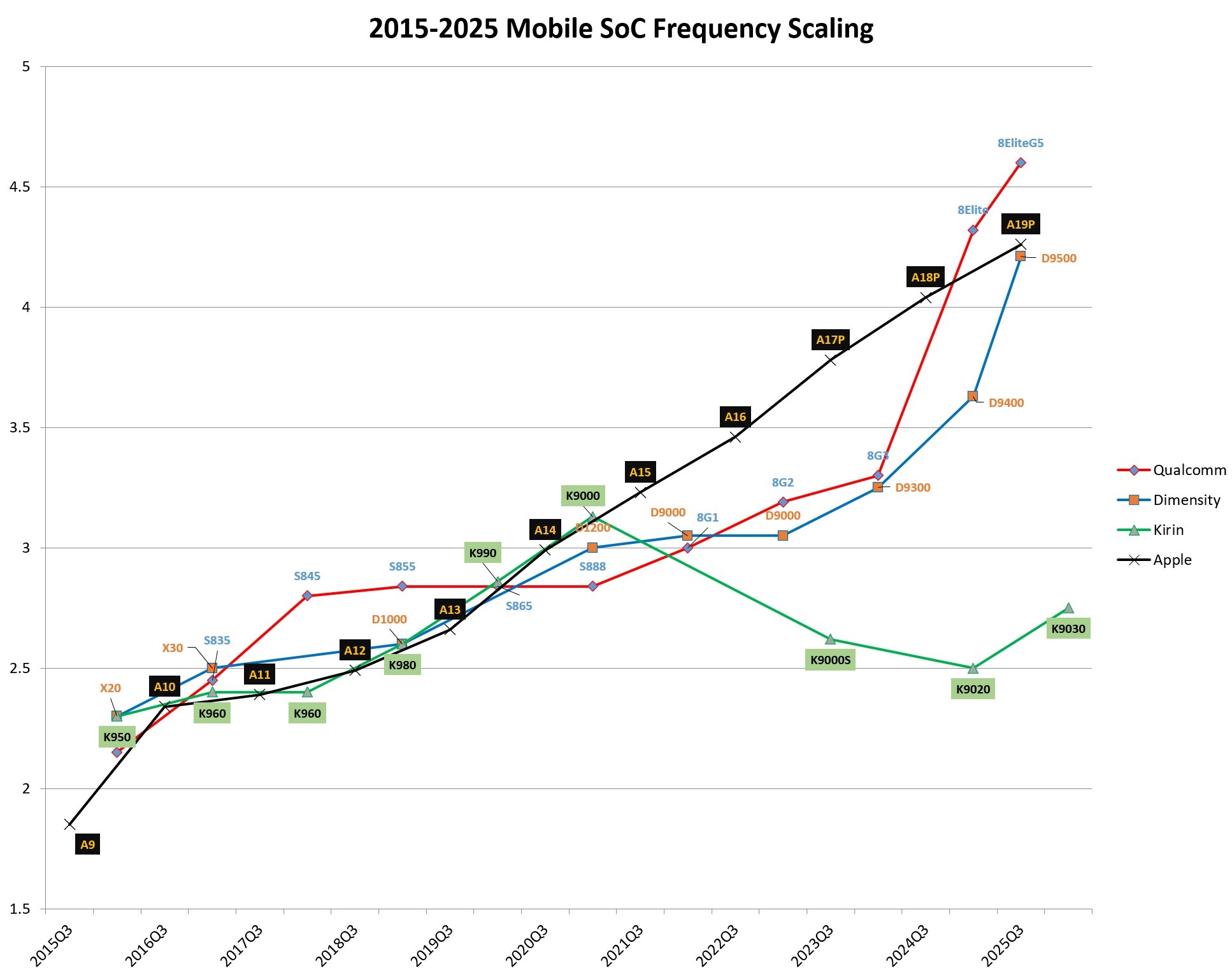
The chart shared by industry insider Kurnal clearly shows the main frequency climbing path of leading manufacturers.At present, the default main frequency of Qualcomm Snapdragon 8 Elite Gen5 has reached 4.61GHz. The next generation of Snapdragon 8 Elite Gen6 Pro will officially reach 5GHz, and the MediaTek Dimensity 9600 Pro will also reach the same level.In addition, the performance core frequency of Apple A19 Pro has also reached 4.26GHz.
The steady improvement of the main frequency directly drives the new chip to achieve a substantial performance jump in single-threaded and multi-threaded tasks.Huawei is the only one among the leading manufacturers that has not been able to enjoy this wave of technological dividends.
Huawei’s latest Kirin 9030 SoC has so far failed to break through the 3GHz frequency threshold. The core source of the gap is the US trade sanctions that took effect in 2019.
After the ban was implemented, Huawei could no longer cooperate with TSMC and could only rely on SMIC's 7nm process to produce chips. SMIC did not have a new generation of EUV extreme ultraviolet lithography machines and could only rely on older generation DUV equipment to produce wafers. The upper limit of the process technology was firmly restricted.
Of course, chips with a main frequency of 5GHz cannot escape the limitations of the laws of thermodynamics. The higher the frequency of silicon-based chips, the more likely they are to experience dramatic temperature surges and thermal underclocking.
However, manufacturers have already come up with mature solutions. Through advanced cooling technologies such as larger VC vapor chambers and micro active cooling fans, the new chips can not only stabilize performance release but also achieve more stable temperature control performance in sustained high load scenarios.