US President Donald Trump claimed on social platform Truth Social on Wednesday that he had successfully secured the release of eight Iranian women sentenced to death for taking part in anti-government protests. He said he pressured Iran to prevent the women's scheduled executions. However, this statement was immediately questioned by Iranian officials and the outside world. Not only were the details of the case inconsistent with the statements of the Iranian judiciary, but the photos used to show the identities of these women were also suspected to have been generated or tampered with by artificial intelligence.
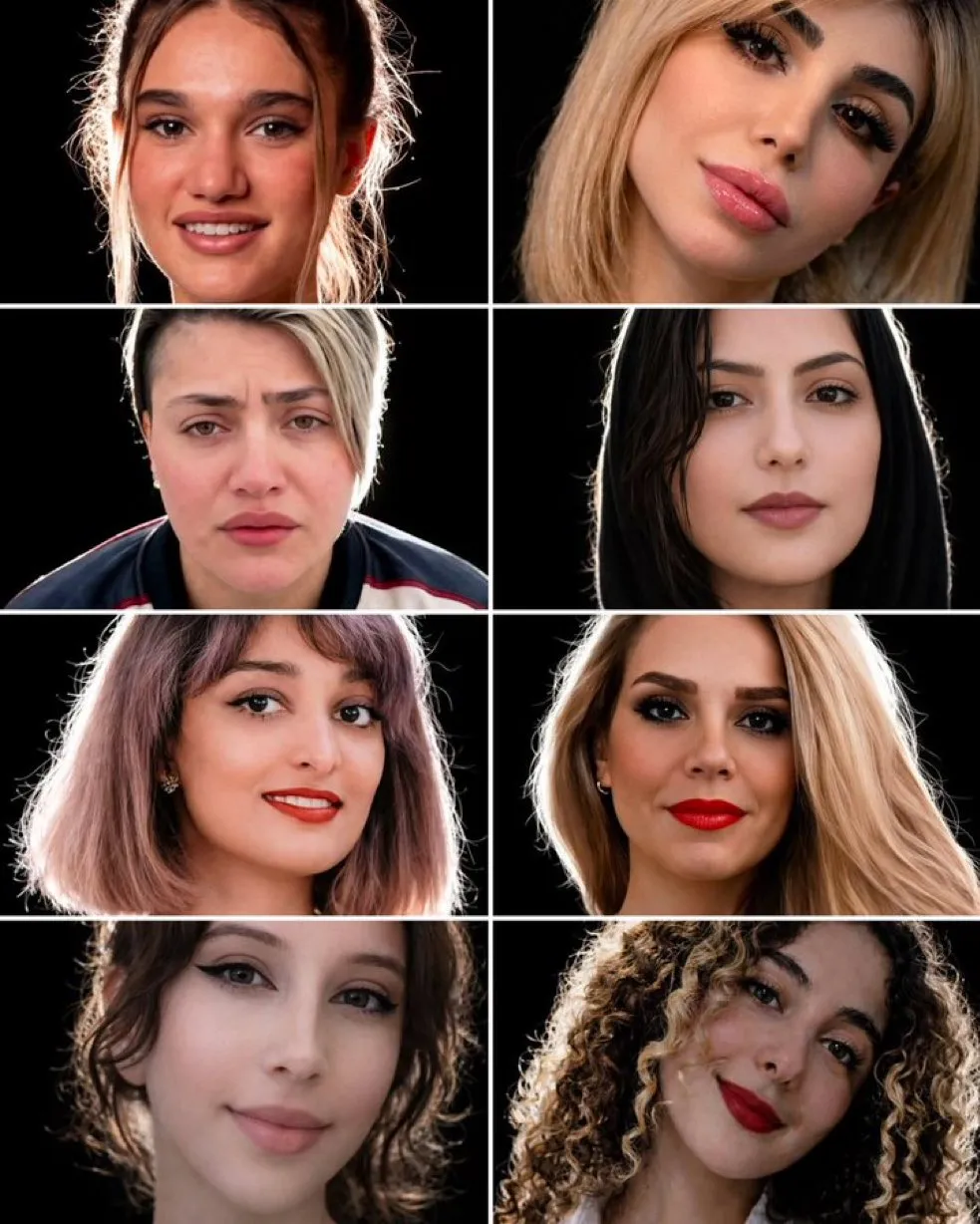
The night before Trump claimed to "save lives," he posted on Truth Social, warning that eight Iranian women would be summarily executed, along with a collage of eight women's faces. These photos were exquisitely lit and soft-focus processed, similar to the "beautified portraits" commonly seen on social media. However, netizens and commentators soon pointed out that the faces of the characters contained unnatural details and repeated features, which were suspected to be produced by generative AI. One post that went viral on social platform
Shortly after Trump released the news of "successful mediation", Iran's judicial department media "Mizan News Agency" publicly refuted his statement, saying that the whole thing was "based on completely wrong news." Mizan said that some of the women mentioned by the outside world had indeed been arrested before, and some of them had been released. Some were facing imprisonment instead of the death penalty, and there was no so-called situation where "eight people were about to be executed at the same time." The news agency also emphasized that Tehran has not made any concessions to the United States on this matter, implying that the judicial status of the relevant personnel has not changed due to Trump's remarks.
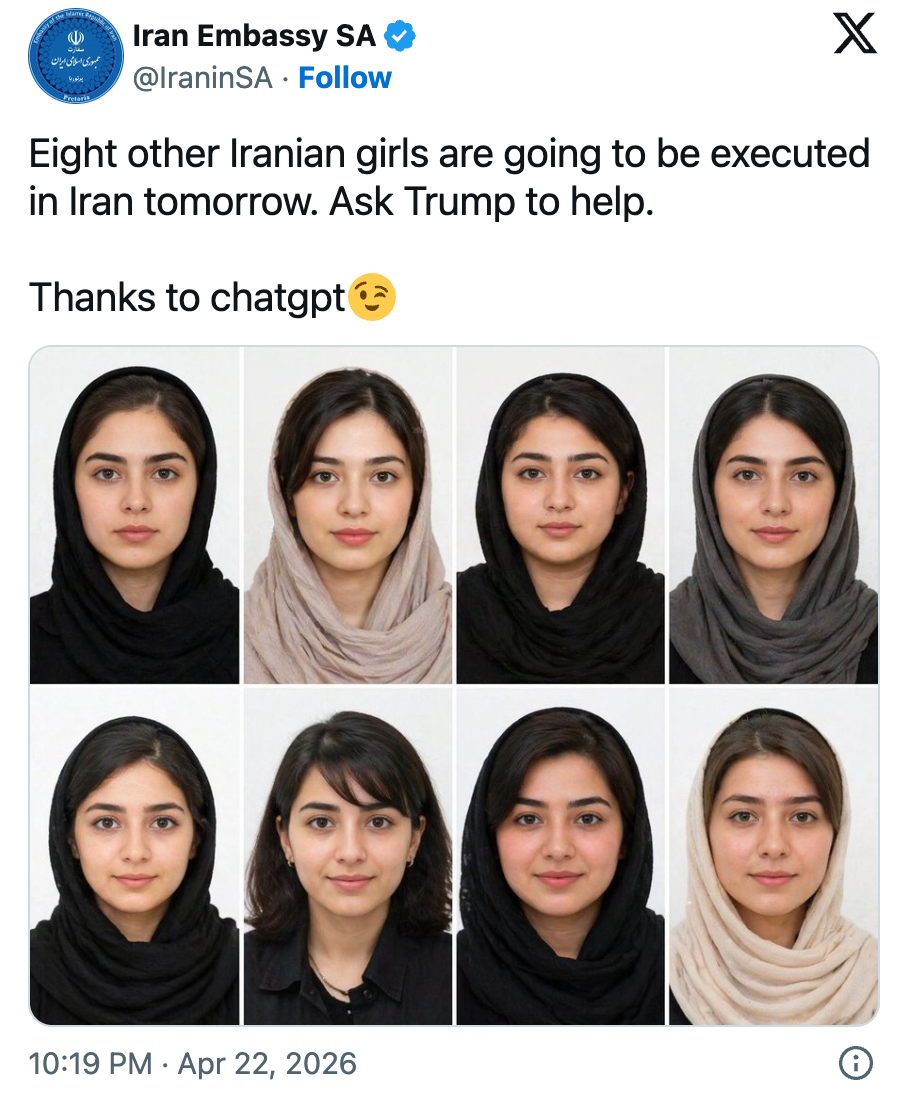
When Iran officially denied it, the official X account of the Iranian Embassy in South Africa also joined the public opinion war, and was regarded by the outside world as one of the social accounts best at "playing tricks" in the Iranian government system. The account posted another collage of eight young women's heads, with the text saying, "Eight more Iranian girls will be executed in Iran tomorrow, please ask Trump for help." At the same time, the account directly named the images generated using ChatGPT in the text to satirize the authenticity of the photos cited by Trump.
Regarding the group of female portraits that Trump initially forwarded, a researcher who has long been concerned about Iran’s information environment and technological threats pointed out that the images were “at least modified by AI.” Mahesa Alimadani, deputy director of the WITNESS agency's "Technology Threats and Opportunities Project", said in an interview that these photos are not simple real captures, but more like AI beautification or redrawing superimposed on real people, so that the characters' faces have realistic details and present a sense of dissonance and a unified style common in generated images. In her view, such "half-truth and half-false" images are easier to spread on social platforms and easier to be used by politicians to package stories, but at the same time it makes it more difficult for the public to discern facts.
This incident exposed multiple levels of information distortion: On the one hand, Trump used a set of photos from unknown sources and suspected of being produced by AI to tell a story of "personally saving a death row prisoner", but there was a lack of subsequent confirmation from the other country or independent channels. On the other hand, Iran denied the US president's statement and responded ironically by creating a self-made AI female avatar, turning sensitive human rights issues into a "meme war" on social media. In a context where AI-generated images have widely penetrated political opinion fields, this incident highlights the risk of technology being used as a propaganda tool, a discursive weapon, and even fodder for diplomatic ridicule.
At present, except for Iran's official claims, there is no public evidence that these eight women have been uniformly sentenced to death, let alone the "release before execution" unilaterally claimed by Trump. The focus of public opinion is shifting from "whether anyone was saved" to "how politicians create fictitious or exaggerated humanitarian victories without verification", and the role that various types of AI-generated or tampered images play in this. While the facts are still vague, what the parties are amplifying through social platforms is more of a narrative battle around lies, manipulation and technology.