On the afternoon of May 15, the World Cup copyright, which had been delayed for a long time, finally came to fruition. According to CCTV Sports news, China Central Radio and Television and FIFA jointly announced that they have reached a consensus on copyright cooperation in the new cycle of the FIFA World Cup. Cooperative events include the 2026 World Cup, 2030 World Cup, 2027 Women’s World Cup and 2031 Women’s World Cup.
More importantly, the main station has obtained the exclusive all-media rights and media sub-licensing rights for this cycle's cooperative events in mainland China, covering open-circuit TV, pay TV, the Internet and mobile devices. According to Beijing time, the 2026 World Cup will be held from June 12 to July 20. It will be jointly hosted by the United States, Canada, and Mexico. This is the first time in the history of the World Cup that it will be co-hosted by three countries. The participating teams will expand from 32 to 48, and the total number of games will reach 104.
The price is also out. The official announcement did not disclose the specific amount, but The Paper quoted people familiar with the matter as saying that the copyright agreement between China Central Radio and Television and FIFA came into effect on the afternoon of May 15. According to the agreement, the copyright fee for the 2026 U.S.-Canada-Mexico World Cup is US$60 million. Let’s make it clear here: US$60 million corresponds to the disclosed price of the 2026 US-Canada-Mexico World Cup, not the total package price of the four events in the entire new cycle.
So what’s really interesting about this matter is not that CCTV “finally bought it”, but how the price was negotiated. FIFA's initial offer to CCTV was US$250 million to US$300 million, which was later reduced to US$120 million to US$150 million. The budget range of CCTV disclosed by the media was approximately US$60 million to US$80 million.
In other words, what FIFA wanted to sell at the beginning was a high price for a "top global IP", but CCTV never accepted it. If it finally lands at US$60 million, it will basically fall at the bottom of CCTV’s budget range.
So this is not a simple "CCTV picked up the leak" story. To be more precise, this is a recalculation of the World Cup copyright in the Chinese market. FIFA sells the world's number one event, while CCTV buys the World Cup that Chinese audiences will actually watch. These two things sound similar, but they are actually very different.
01: FIFA raises prices, not without reason
Let me talk about FIFA first. It was not completely illogical for it to dare to shout high prices at the beginning.
The 2026 World Cup is indeed special. With 48 teams, 104 games, and co-hosted by the three North American countries, the scale of the tournament is much larger than in the past. From FIFA's perspective, there are more games, a longer cycle, and a larger amount of content, so the copyright naturally wants to be sold more expensively. Coupled with the large population, audience and brands in the Chinese market, FIFA will certainly feel that copyright in mainland China should be a high-priced market.
Moreover, broadcasting rights are originally one of FIFA's core money bags. Judging from public data, during FIFA's 2019-2022 World Cup business cycle, TV broadcasting rights revenue reached US$3.426 billion, accounting for approximately 45% of FIFA's total revenue; in the 2023-2026 cycle, FIFA expects broadcasting rights revenue to further increase to US$4.264 billion. In other words, for FIFA, after the expansion of the World Cup, it certainly hopes to turn more games, more teams and a larger market into higher copyright income.
But the problem is that FIFA is calculating the global account, while CCTV is calculating the Chinese market account. What FIFA sells is the total package of 104 games. What CCTV wants to see is the effective package that Chinese audiences will actually watch. A group match at 3 a.m. and a prime-time knockout match cannot have the same commercial value. The increase in the number of games does not mean that each game is valuable; the increase in the number of games does not mean that advertising revenue will increase linearly.
This was the core reason why the two sides could not reach agreement at the beginning. FIFA sets its price based on "the World Cup is the world's number one sporting event", while CCTV sets its price based on "how Chinese audiences will actually watch it, whether advertisers are willing to invest, and whether the platform can recoup its costs." One looks at the IP aura and the other looks at the market return. Naturally, the prices are very different.
02: CCTV did not accept the high price because this World Cup was not that easy to sell in the Chinese market.
The biggest practical problem for the Chinese market in this World Cup is the time difference.
The US-Canada-Mexico World Cup is held in North America, which is not friendly to Chinese audiences. A considerable number of games will fall in the early morning, early morning or morning of Beijing time, and the prime viewing period is not friendly. Real die-hard fans will of course watch it. Strong teams such as Argentina, Brazil, France, England, and Germany still have their bases, and the knockout rounds and finals will still be top-notch content. But it is impossible for ordinary viewers to stay up late every day for a large number of group matches. More people may read highlights, watch goals, watch hot searches, and watch controversial penalties the next day. The Guardian also mentioned when analyzing copyright negotiations between China and India that time differences, national team performance and local market competition will all affect the pricing of World Cup copyrights in these markets.
This is critical for advertisers. What advertisers buy is not “contest presence” but “user attention.” If a large number of games are not in prime time, the participation of ordinary viewers will decrease, and the advertising value will naturally be discounted. You can't use the commercial value of an early morning game to price it according to the standards of a prime-time focus game.
The second practical problem is that the Chinese team has been eliminated from the Asian qualifiers. Guangming.com reported in June 2025 that the Chinese men's football team lost 0-1 away to the Indonesian team in the ninth round of the top 18 Asian qualifiers for the 2026 US-Canada-Mexico World Cup. They were eliminated from the group one round early and missed the US-Canada-Mexico World Cup.
This sentence doesn’t sound good, but it is an unavoidable item in the business account. The absence of the Chinese team does not mean that no one will watch the World Cup. The World Cup is still the World Cup, and the top teams and top stars are still attractive. But the absence of the Chinese team will reduce the national sentiment. The World Cup with the Chinese team is a sports event and a national event; the World Cup without the Chinese team is more of a major event in the fan circle.
This is not to say that ordinary viewers do not care about the World Cup, but that its ability to break the circle will be weaker. The most expensive part of sports copyright is often not just the game itself, but national sentiment, social discussion and advertising space. The Chinese team is absent, and the time difference is unfriendly. It is difficult to calculate this account according to FIFA's initial quotation.
The third change is that China’s sports copyright market itself has cooled down.
In the past few years, Internet platforms have indeed gone through a period of fierce competition for sports copyrights. Platforms are willing to spend money to buy events because sports can attract new members, gain membership, grab users, and support brand reputation. But things are different now. Long video platforms no longer burn money carelessly, and Internet companies pay more attention to profits and cash flow. Everyone began to ask a very simple question: After buying this copyright, can I sell advertisements? Can I become a member? Can it be distributed? Can the cost be covered?
The biggest change in the content industry in the past few years is that in the past, buying content was about telling stories, but now buying content is about returns. The World Cup is certainly good content, but good content does not mean any price is reasonable.
Therefore, it’s not that CCTV has no money this time, or that it doesn’t pay attention to the World Cup, but it just doesn’t want to pay for an overvalued price at a point where commercial returns are uncertain.
03: 60 million US dollars, which eliminates the inertia of price increases in the past two decades.
If we only look at this negotiation, US$60 million seems to be a sudden result. But if the timeline is stretched out, it is more like a price revaluation.
To sum up, in the two World Cups in 2002 and 2006, CCTV spent a total of about 24 million US dollars to obtain broadcast rights; in 2010 and 2014, the price rose to 115 million US dollars; in 2018 and 2022, the price further increased to about 300 million US dollars. In other words, over the past two decades, the World Cup broadcast fees in China have risen from tens of millions of dollars to hundreds of millions of dollars.
This historical line is important. It shows that CCTV is not suddenly stingy this time, but that the price of World Cup copyrights has indeed risen too fast in the past. In the past, everyone would assume that it was normal for top events like the World Cup to become increasingly expensive. But after the price rises to a certain level, the buyer must recalculate: Are there really more viewers? Is advertising really more expensive? Can the platform really make money back?
By 2026, this account will finally be settled.
At first, FIFA wanted to continue to sell at a high price according to the inertia of price increases in the past, but CCTV is facing a completely different market environment: the time difference in the Americas is not friendly, advertisers are more cautious, Internet platforms no longer burn money, and the viewing methods of viewers are more fragmented. These variables are stacked together. Of course, the World Cup is still valuable in the Chinese market, but it is already difficult to support FIFA’s initial offer of 250 million to 300 million US dollars.
Therefore, the US$60 million is not "picking up a leak", it is more like CCTV bringing the World Cup copyright from the emotional price back to the real price.
04: FIFA has to make a concession in the end because the Chinese market cannot really be lost.
Of course, FIFA is not without any leverage. The World Cup is still the world's top sporting event, and it's not like Chinese audiences don't watch the World Cup.
FIFA data shows that China accounts for 17.7% of the global linear TV reach of the 2022 World Cup; India accounts for 2.9%. The two countries together accounted for 20.6% of the World Cup’s total global digital streaming reach. Therefore, if China and India sign the World Cup copyright too late, it will not only be detrimental to advertising investment and copyright distribution, but also detrimental to the promotion of the World Cup in the world, especially in Asia.
Moreover, FIFA divides the global market into three levels. China and India are classified as first-level high-priced markets alongside the United States and the United Kingdom due to their large population base. This is also the core market for achieving its total revenue target of US$13 billion in the 2023-2026 cycle.
That's where the pressure is on FIFA. It can set a high price initially, but it cannot really leave the mainland Chinese market hanging for a long time. The World Cup is about to start. If there is no clear broadcast arrangement in the Chinese market, the loss will not only be the copyright fee itself, but also the publicity of the event, sponsors' rights and interests, and global business narrative.
This time the copyright was released less than a month before the opening of the event; looking back at the 2018 and 2022 World Cups, CCTV usually obtained the copyright earlier and launched publicity and investment in advance.
So this negotiation dragged on until the end, and the pressure was actually two-way. CCTV must ensure that Chinese audiences can watch the World Cup, and FIFA must not let the Chinese market go offline. It finally fell to US$60 million, which essentially meant that both parties took a step back: CCTV accepted a reasonable price, and FIFA dropped its initial high price expectations.
05: What CCTV bought was not a live broadcast, but the distribution order in mainland China.
Many people said that CCTV had won the rights to the World Cup, and their first reaction was "I can watch the football games now." This is of course important, but from the perspective of the sports copyright business, what CCTV really gets is the main entrance to the World Cup communication in mainland China.
The official announcement this time made it very clear that the main station has obtained exclusive all-media rights and media sub-licensing rights. This means that CCTV not only broadcasts it itself, but also has the right to decide how these events are distributed to TV, the Internet and mobile devices. If other platforms want to participate in World Cup live broadcast or related content distribution in the future, they must do so under the authorization system of CCTV.
The past two World Cups have proven this model. In the 2018 World Cup, CCTV started copyright distribution for the first time, licensing new media copyrights to Youku and Migu; in the 2022 World Cup in Qatar, platforms such as Douyin and Migu will continue to distribute copyrights from CCTV. According to Reuters, CCTV has asked China Mobile's Migu to sign a distribution agreement for the 2026 World Cup.
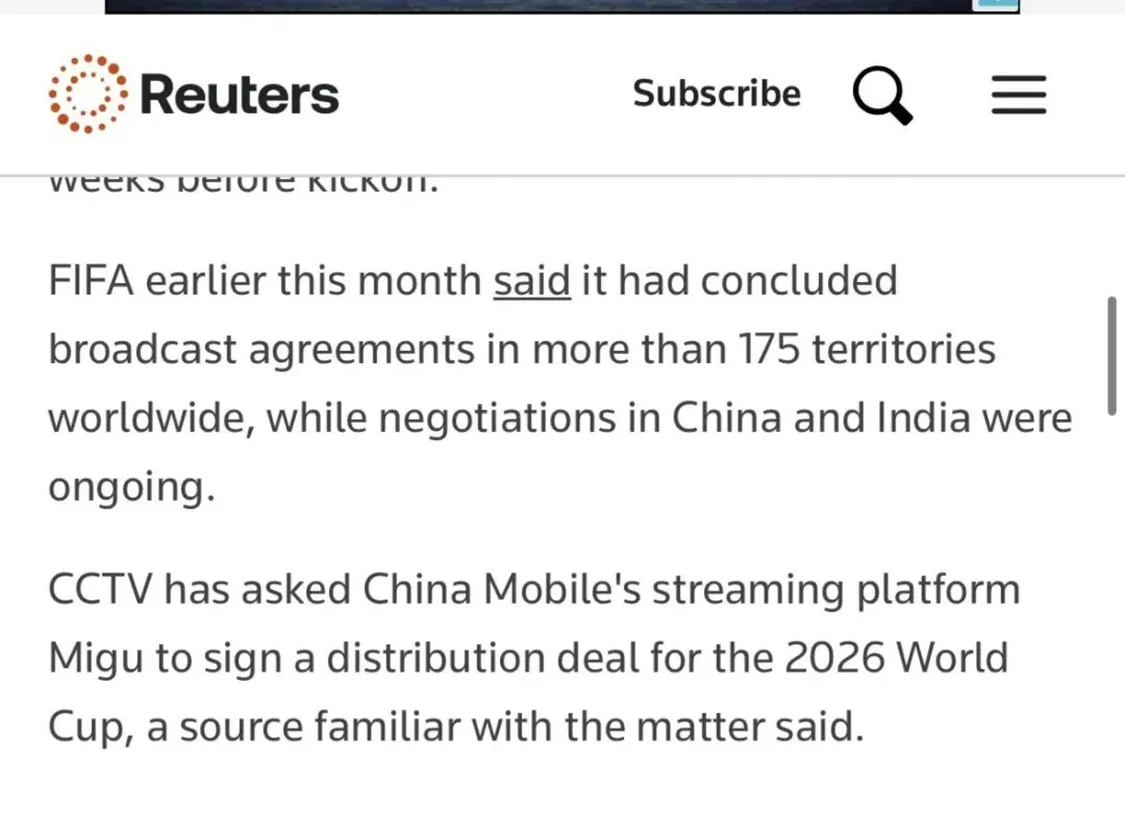
This explains why CCTV wants "exclusive all-media rights and media sub-licensing rights." What it bought was not a single-screen live broadcast, but the distribution order of the World Cup in mainland China. TV, mobile, short video platforms, local stations, and Internet platforms will ultimately be arranged around this total copyright.
This is also the reason why CCTV has the confidence to negotiate. It is not an ordinary commercial platform. It does not need to rely on a World Cup to tell user growth stories, nor does it need to burn money without a bottom line to grab users. What it wants to do is two things: first, let Chinese audiences watch the World Cup stably; second, not let the Chinese market pay for unreasonable sky-high copyright prices.
Finally, I think: What the US$60 million really shows this time is not that CCTV has taken advantage, but that the World Cup copyright has been recalculated in the Chinese market. FIFA charges according to the number one event in the world, while CCTV counter-offers according to the real returns in the Chinese market. The final deal was concluded, indicating that both parties recognized one thing: the World Cup is still the World Cup, but the Chinese sports copyright market is no longer the market in the past where as long as you put up a price, I will take over.