OpenAI just connected ChatGPT to bank accounts. This feature is currently open to ChatGPT Pro users in the United States in preview form. You can connect to accounts at 12,000 financial institutions through Plaid to obtain consumption analysis and financial planning assistance. From now on, next to the chat box, there is a large model that can help you see your monthly account flow.
OpenAI starts letting ChatGPT read your bank account data.
Just now, OpenAI launched a preview version of ChatGPT’s personal financial management function.
After authorization, users can connect to more than 12,000 financial institution accounts in ChatGPT through Plaid, and obtain consumption analysis, budget sorting and long-term financial planning assistance based on data such as balances, transactions, investments and liabilities.
OpenAI officially disclosed that 200 million people chat about money in ChatGPT every month: talking about budget, investment, and whether they can afford a house. In fact, users have already used ChatGPT as a financial advisor, and OpenAI just added the data channel this time.
In the past, when you asked ChatGPT “How should I save money,” it would give you textbook-like general advice:
Focus on meals and subscriptions, 48-hour purchasing rule, automatic transfer to separate savings account, leave a low consumption default, add a little income, only track one number every week...
This all sounds right, but it actually has little to do with your financial situation.
Now, by asking the same question through the personal finance function, ChatGPT can directly retrieve your real bills from February to May - about $1,620 for dining, about $1,250 for shopping, about $1,450 for transportation, and about $420 for subscriptions. Based on these data, it can generate a personalized financial plan for you:
The monthly cap for dining is 450, the monthly cap for shopping is 300, the monthly cap for transportation is 400, the weekly grocery shopping goal is 125-150 US dollars, and 500 US dollars will be automatically transferred to the savings account, with the goal of saving an additional 705 US dollars per month.
It’s about your own money, and the advice it gives is tailored to you. This is the difference between a “general Q&A” and a “personal financial assistant.”
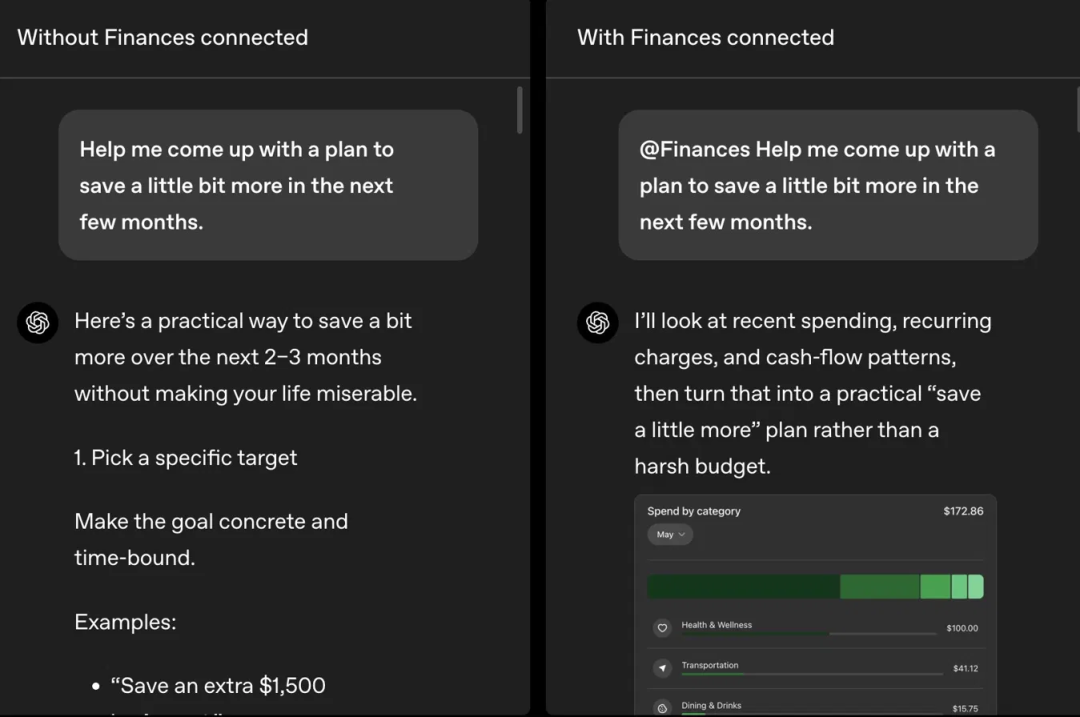
Compare the answers to the same question before and after connecting the account. Left: General savings suggestions; Right: ChatGPT provides targeted solutions after reading real consumption classification data.
This is also the first time that a general AI assistant has entered the "wallet-level" sensitive data scenario with a user scale like ChatGPT. From then on, next to the chat box, there is a large model that can see your salary statement, credit card bill, subscription deductions, and debt balance.
With this release, OpenAI has launched both the web and iOS apps for personal finance functions. After account synchronization is completed, the dashboard will directly display portfolio performance, consumption classification, subscription items and pending payments.
OpenAI officials also draw a boundary for this function: it is not a substitute for professional financial advice, nor does it make decisions for users.
12,000 financial institutions, one authorization
More than 200 million people ask ChatGPT financial-related questions every month. The question-and-answer ability is ChatGPT’s inherent ability.
The biggest change in the personal finance function this time is the right to data access. Through Plaid, this function covers more than 12,000 financial institutions.
The entrance operation to enter the preview version of the personal finance function is very simple:
Open the "Finances" option in the sidebar of ChatGPT, click "Get started", or enter "@Finances, connect my accounts" directly in the dialog box.
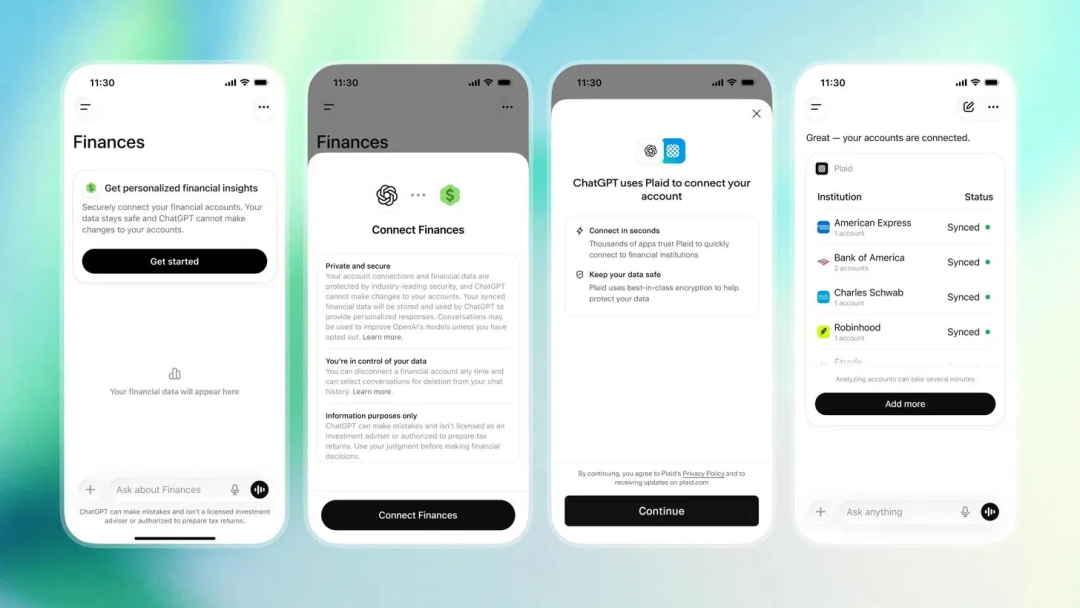
ChatGPT personal finance function connection process: initiated from the Finances entrance on the sidebar, authorized by Plaid, American Express, Charles Schwab, Robinhood and other accounts are completed simultaneously one by one.
ChatGPT will then guide you to complete account authorization through Plaid, and the synchronization will be completed in a few minutes.
The first reaction of many people when seeing this may be: OpenAI is directly connected to the bank? Not so.
It also needs to go through a key middle layer: Plaid (financial data connection service).
Users will complete login verification according to Plaid/bank authorization process; in scenarios where bank usernames and passwords are required, Plaid said it will not share these login credentials with applications such as OpenAI.
In other words, OpenAI gets structured financial data and cannot get your bank password.
Through Plaid, financial institutions covered by this personal financial management feature include Schwab, Fidelity, Chase, Robinhood, American Express, Capital One, etc.
After synchronization is completed, you will see a dashboard: portfolio performance, consumption categories, subscription items, and upcoming bills.
Then you can ask questions directly, and the questions can be very specific: "Can I buy a house in Chicago within 5 years?" "What subscriptions do I have that I can cancel?" "What's wrong with my consumption structure?"
ChatGPT answers based on your real account data rather than giving a set of general templates.
Currently, this feature is open to Pro users in the United States and supports web and iOS.
OpenAI’s plan is to first accumulate early feedback and then expand to Plus users, with the ultimate goal of being available to everyone.
OpenAI locks itself in "read-only mode"
Boundaries deserve more attention than functionality.
In this Plaid account connection preview, OpenAI limits permissions to "read-only".
ChatGPT can access the account balance, transaction records, investment positions, and debt liabilities, but it cannot view the complete account, change any account information, transfer funds, place orders, or perform investment operations.
In other words, it knows how much money you have, but it can't touch a cent.
This design is not caused by technical limitations, the main reason is safety and controllability considerations.
In highly sensitive scenarios, "read-only" is the fastest way to build trust. The first step is to allow AI to read data and provide financial management advice; after trust is established, the second step is to "help you operate".
In terms of data protection mechanism, OpenAI has also launched supporting measures:
After the account is disconnected, the synchronized financial data will be deleted from the OpenAI system within 30 days; temporary conversations will not be connected to the financial account.
In addition, ChatGPT will also extract "financial memories" from your description, such as "I am saving money to buy a car" and "How much money do I owe XX". These memories can be viewed and deleted separately on the financial page.
GPT-5.5 model is the confidence to dare to do finance
In terms of the base model, the dialogue to connect financial accounts calls GPT-5.5 Thinking by default, and Pro users can call the higher-level GPT-5.5 Pro.
OpenAI specially conducted a set of internal personal finance benchmark tests for this purpose, inviting more than 50 professionals from mainstream financial institutions to jointly design assessment dimensions. The score is a weighted combination of response quality and accuracy.
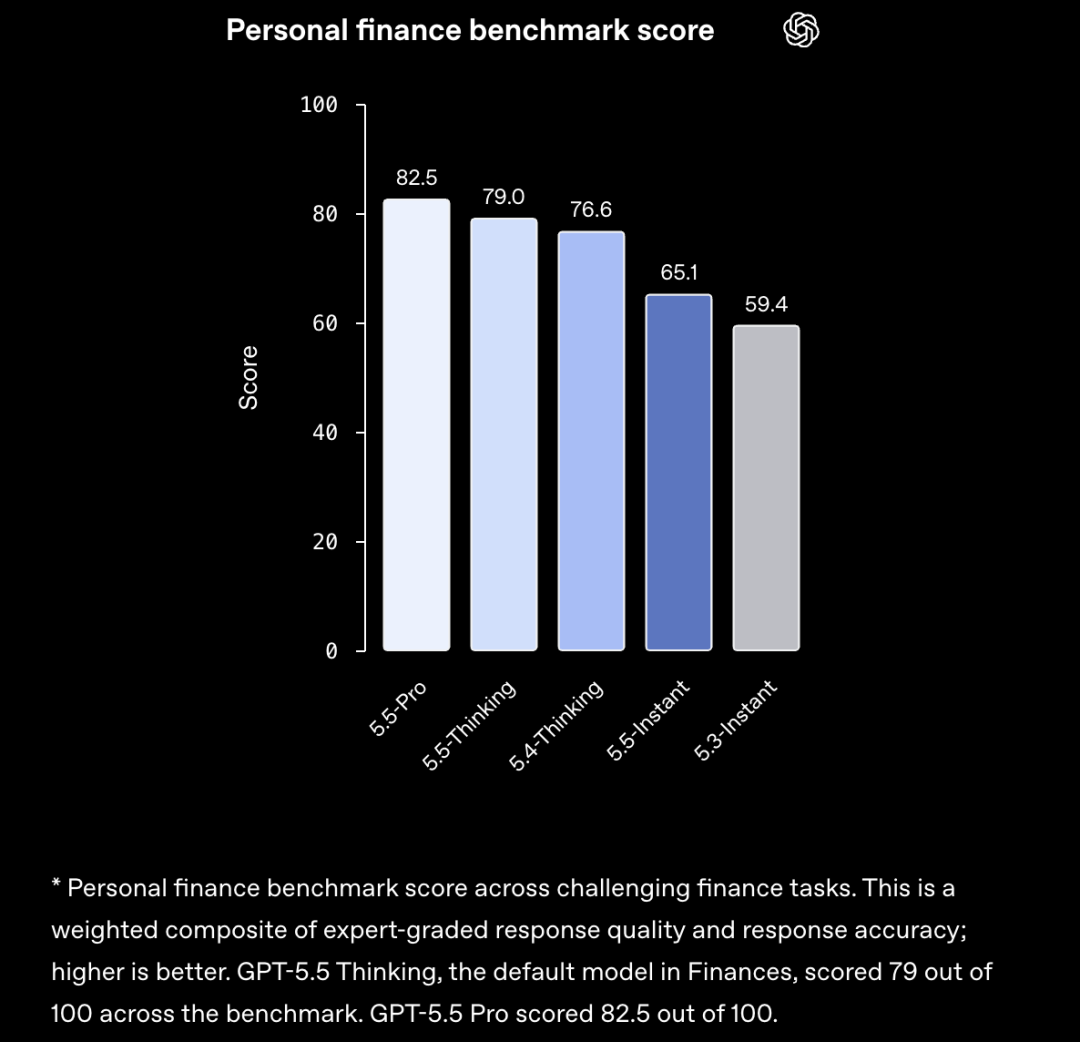
OpenAI internal personal finance benchmark test: GPT-5.5 Pro topped the list with 82.5 points, GPT-5.5 Thinking, which is called by default, scored 79 points, and the Instant model of the same series scored 59.4 points.
In OpenAI's internal personal finance benchmark test, GPT-5.5 Thinking scored 79 points out of 100, and GPT-5.5 Pro scored 82.5 points.
Horizontal comparison: GPT-5.4 Thinking only scored 76.6 points, GPT-5.5 Instant and 5.3 Instant scored 65.1 and 59.4 points respectively.
This time, the personal finance function defaults to Thinking instead of Instant. The main reason is multi-variable contextual reasoning:
It is necessary to clearly calculate income, expenses, balances, debts, goals, and timing, and to clarify assumptions and what information is needed when uncertain. This is the strength of Thinking models.
What’s more noteworthy is that GPT-5.5 is becoming a universal base for OpenAI verticalization.
For health scenarios and financial scenarios, two highly sensitive industries, OpenAI did not make specialized fine-tuned versions, but directly used the general flagship model.
From question and answer entrance to data entrance
Financial management is just the entrance, data is the purpose.
On the surface, it is a product launch of an “AI personal financial assistant”. But OpenAI’s ambitions go far beyond financial management.
The logic of OpenAI is: from general question and answer, to highly sensitive vertical data scenarios, to action closed loop.
According to TechCrunch, just about a month before this feature was released, OpenAI acquired the team of personal finance startup Hiro.
Hiro is a personal finance start-up company that previously focused on helping users with personalized budget planning and consumption behavior analysis. This set of capabilities was directly integrated into the experience design of ChatGPT’s financial management function.
Cooperation with Intuit is also progressing. According to a joint announcement by both parties, in the future users can directly complete the tax impact estimation of stock sales and the approval probability calculation of credit card applications in ChatGPT, and then jump to Intuit to complete the operation.
After being connected to Intuit, ChatGPT's financial advice will extend from "analysis" to "execution". Users will not just listen to the AI saying "how should you file a tax return", but can directly complete the tax estimate in the conversation, and then jump to TurboTax to submit the declaration with one click.
This is the closed loop that OpenAI wants to build: the "question and answer portal" first lets you ask questions, the "data portal" allows it to see your true situation, and finally the "action portal" allows it to execute it for you.
The commercial value of these three levels is not of the same order of magnitude at all.
"Q&A" can be copied by any competitor. "Read account + help with execution", the moat is much thicker.
More than 200 million users ask ChatGPT for financial questions every month. In the past, these 200 million questions were not supported by data.
Now, the subset of users willing to connect their accounts begins to provide real financial data as context for the conversation. Once this flywheel starts spinning, the depth of personalization will be unimaginable for general-purpose AI.
Of course, the core issue is: in the end everything depends on user data. Currently, this feature is only available to US Pro users, with a monthly subscription fee of $200.
OpenAI’s plan is to first collect feedback from this group of users, improve it and expand it to Plus users, with the ultimate goal of being available to everyone.
When an AI can see all of your income and expenses and know how much you spend on where and how every month, will your probability of telling the truth to it be higher than to a human financial advisor?
When faced with human financial advisors, many people will embellish their consumption habits; but when faced with AI, people may be more honest.
If this is the case, AI can see your financial problems more clearly, and it is not just a matter of efficiency.