NVIDIA today announced the launch of second-generation Ray Reconstruction technology as part of the DLSS 4.5 feature set. Ray reconstruction was first introduced with DLSS 3.5 in 2023, aiming to solve key image quality issues such as distortion of ray tracing shadows and reflections and inaccurate details when DLSS 2 super-resolution is turned on. By introducing a dedicated AI reconstruction module into the rendering pipeline, this function can replace traditional temporal and spatial filters and better restore the details and lighting effects brought by ray tracing.
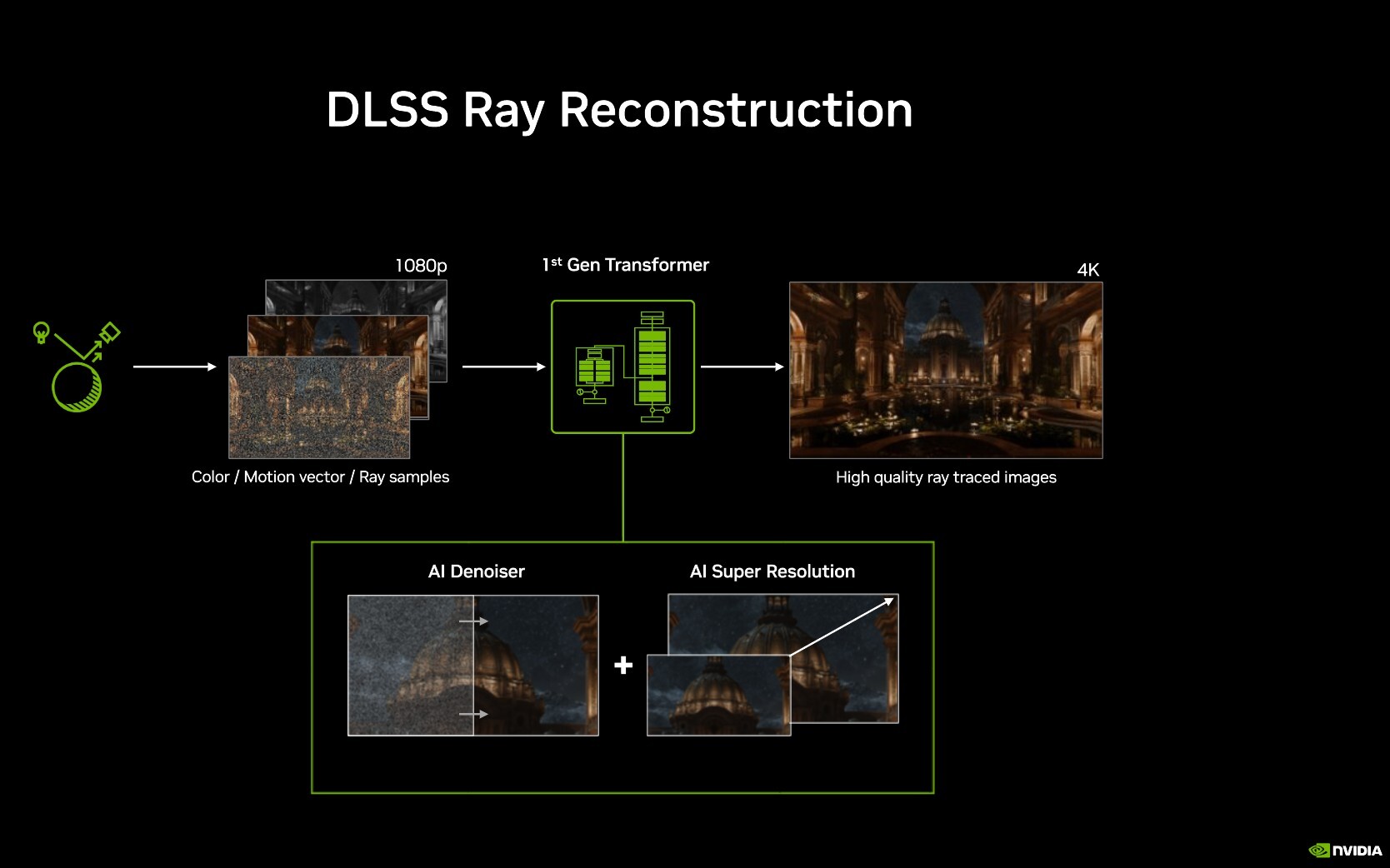
In 2025, NVIDIA will upgrade its early convolutional neural network (CNN)-based light reconstruction AI model to the new Transformer architecture, which will further improve its understanding of complex scene details and temporal consistency. Subsequently, NVIDIA released the DLSS 4.5 feature set containing the fourth-generation Transformer model in the same year. These models were trained on larger data sets, but the light reconstruction module itself was not updated simultaneously at that time. In other words, in the previous DLSS 4.5, parts such as super-resolution have adopted the latest generation Transformer model, while light reconstruction still uses the implementation of the previous version.
The second-generation light reconstruction technology released this time marks the completion and improvement of the DLSS 4.5 feature set. The new version of light reconstruction uses the second-generation Transformer model, and on the basis of significantly expanding the amount of training data, it conducts targeted training on various complex lighting, materials and scenes. Nvidia says this will result in more precise shadow contours, more natural reflection performance, and more stable temporal consistency, thereby reducing common image quality problems such as flickering, noise, and ghosting.
In addition to the new generation AI model, DLSS 4.5 ray reconstruction also integrates a more efficient AI denoiser to achieve cleaner ray tracing images with lower noise processing costs. The new denoiser combines stronger spatial awareness with a deeper understanding of the spatial relationships between different pixels, object boundaries and lighting changes, helping to improve overall lighting accuracy and local detail performance. In scenes with highly reflective materials, complex shadow overlapping, and multiple light sources, the new version of light reconstruction is expected to significantly reduce artifacts and improve visual stability.
With the second generation of light reconstruction officially added to DLSS 4.5, NVIDIA's overall DLSS function line is also continuing to evolve towards a unified AI rendering framework based on Transformer. From the early CNN model to today's Transformer model, functions such as light reconstruction and super-resolution gradually rely on the same type of deep learning architecture and larger-scale training data, making the synergy between different modules better. For game developers, this means higher-quality ray tracing output and more stable graphics with less manual tuning when using the latest DLSS version.