ChatGPT developer OpenAI filed confidentially for a U.S. initial public offering (IPO) on Monday, joining rival Anthropic in its push into the stock market to feed investors investing in the artificial intelligence boom. OpenAI did not disclose the size or terms of the offering, but reports suggest the artificial intelligence giant plans to seek a valuation of up to $1 trillion in an initial public offering that could come as early as September.
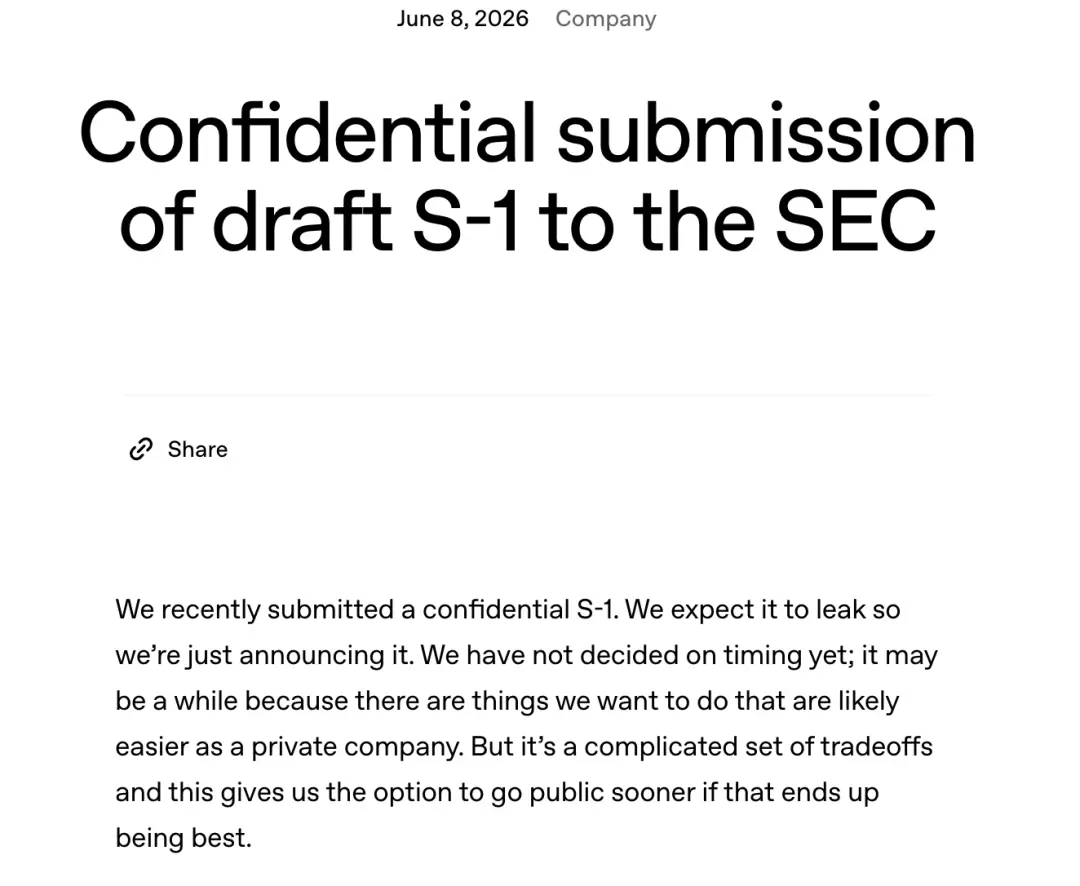
If the valuation is reached as scheduled, OpenAI will kick off the successive listings of three trillion-dollar valuation companies, which is also seen as the most critical test of investors' interest in high-growth technology stocks in the past decade.
Elon Musk's SpaceX took the lead in launching the IPO process. If successfully completed, it will be the largest IPO in history. The company plans to raise US$75 billion at a valuation of US$1.75 trillion.
In prediction markets where traders place bets on the outcome of future events, most participants had expected OpenAI to file for an IPO before Anthropic.
Artificial Intelligence Era
The IPOs of Anthropic and OpenAI will mark a transformative period for the technology industry and global markets, with artificial intelligence quickly becoming a core investment theme of this decade.
OpenAI said earlier this year it was raising $110 billion from heavyweight investors including SoftBank 9984.T , Amazon AMZN.O and Nvidia NVDA.O at a valuation of $840 billion.
At that time, the company also disclosed that ChatGPT had more than 900 million weekly active users and more than 50 million consumer subscribers.
The IPO filing comes after OpenAI renegotiated a partnership with one of its early investors, Microsoft MSFT.O , allowing the AI pioneer to forge new partnerships with the likes of Amazon and Alphabet Inc's GOOGL.O Google.
The Windows system maker's early-stage investments totaling $13 billion since 2019 have paved the way for OpenAI's meteoric rise and fueled growth in the software giant's Azure cloud computing business.
In March, OpenAI said its monthly revenue had reached $2 billion, growing at about four times the rate of companies defining the internet and mobile era, including Alphabet and MetaMETA.O.
By comparison, its quarterly revenue at the end of 2024 will be about $1 billion.
Challengers are gaining momentum
However, the industry that OpenAI pioneered has quickly become fiercely competitive, with rivals including Anthropic vying to challenge its dominance, and investors paying close attention to whether the artificial intelligence industry's meteoric rise can be sustained.
Anthropic has emerged as one of its biggest competitors. Its ClaudeAI has seen a surge in demand for its ability to assist software developers with programming tasks. Some companies have even deployed its top model, Mythos, to mine vulnerabilities in code.
The company behind the popular programming assistant ClaudeCode confidentially filed for a U.S. initial public offering (IPO) on Monday, weeks after completing a funding round that raised $65 billion and valued it at $965 billion.
While these blockbuster IPOs could inject new impetus into the U.S. IPO market, some bankers warn they could also siphon funds that would otherwise go to smaller deals.
Altman and Musk
OpenAI was founded in 2015 as a research-oriented nonprofit, but formed a for-profit branch four years later to help cover the ballooning costs of developing AI systems.
Its unique structure for nonprofits to control for-profit entities came under intense scrutiny in late 2023, when CEO Sam Altman was briefly ousted but returned to the job days after employee protests.
In December 2024, OpenAI unveiled plans to overhaul its structure by establishing a public benefit corporation, saying the move would help it raise more funds while easing restrictions imposed by its non-profit parent company.
OpenAI's reform plan quickly became controversial, with early backer and billionaire Elon Musk sharply criticizing it. He later sued OpenAI, accusing Altman and other executives of turning the non-profit organization into a vehicle for personal gain.
In May this year, a U.S. jury ruled in a lawsuit filed by Musk that the AI company was not liable to the world's richest man for allegedly deviating from its original intention of benefiting mankind.
The unanimous ruling removes a major unresolved issue facing the IPO, and analysts said it removes a major legal hurdle that public market investors typically worry about.