The British "Guardian" reported that the world's first underwater data center driven by offshore wind power was officially put into operation offshore Shanghai recently, and China has once again taken new steps in addressing the energy consumption challenges brought by artificial intelligence. This facility, called the "Shanghai Lingang Submarine Data Center Demonstration Project", started trial operation in May this year. It has a total designed capacity of 24 MW and was jointly constructed by Hailan Cloud Technology and China Communications Construction Group.

The data center is located about 10 kilometers offshore from Shanghai, sunk about 10 meters below the water surface, and is powered by nearby offshore wind farms. According to public information from the Chinese government, the overall energy consumption of this underwater data center is more than one-fifth lower than that of a land-based data center of the same size. This is not only due to the fact that it is powered by renewable energy, but also because it takes advantage of the natural cooling effect of seawater, significantly reducing the need for cooling electricity.
In traditional land-based data centers, in order to prevent servers from overheating, a large number of cooling systems are usually required to support them. The power consumption in the cooling link accounts for 25% to 40% of the overall power consumption, and it also consumes a large amount of fresh water resources. As the demand for artificial intelligence computing power surges, data centers are regarded as the "physical backbone of AI", and their water and electricity consumption issues have increasingly attracted outside attention. The United Nations University Institute for Water, Environment and Health recently warned that by 2030, the water footprint of global data centers may reach 9.3 trillion liters, which is equivalent to meeting the domestic water needs of 1.3 billion residents in sub-Saharan Africa for a year. Against this background, moving data centers into the sea is expected to reduce dependence on terrestrial freshwater resources.
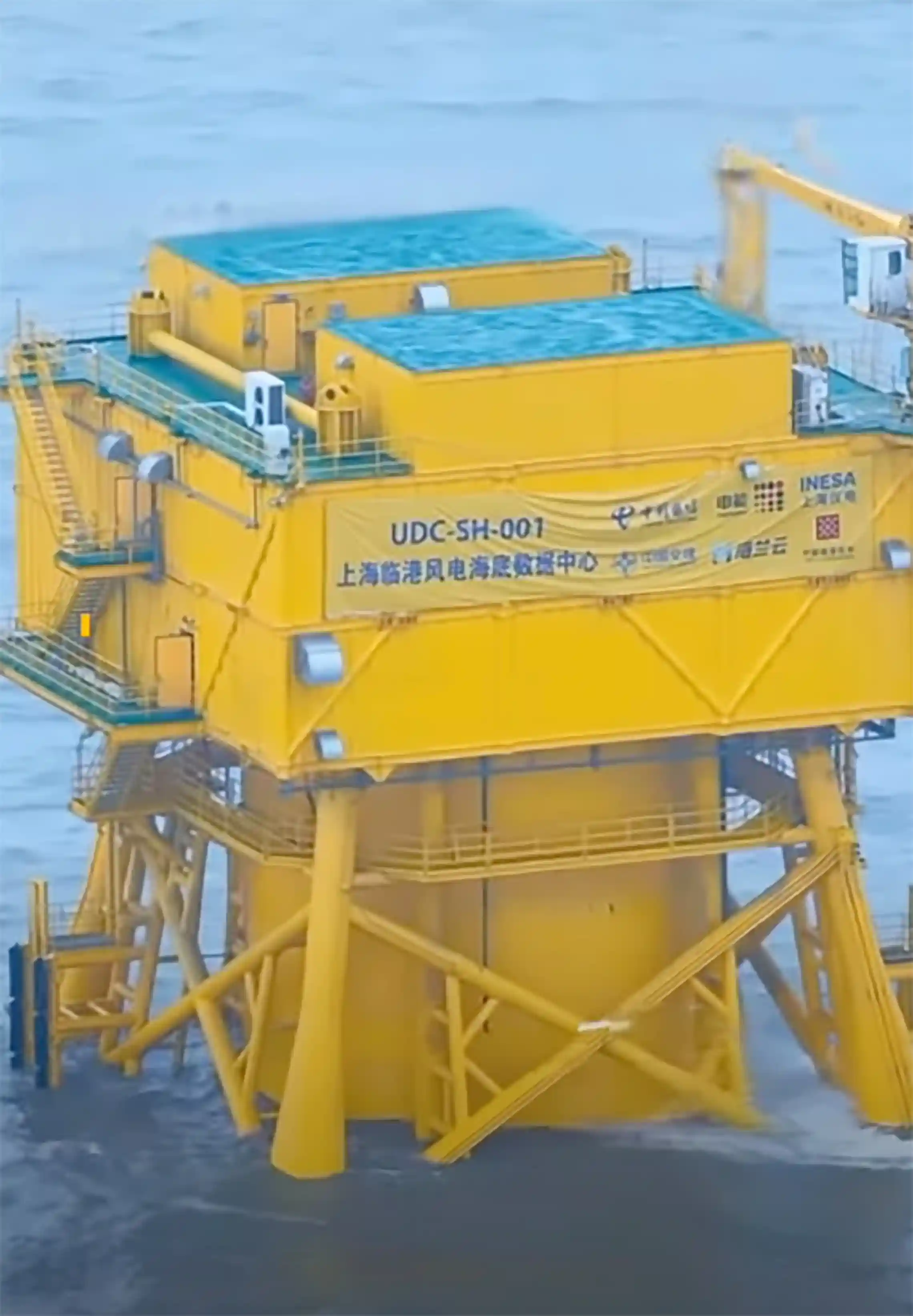
The report pointed out that Hailan Cloud Technology has put into operation the world's first commercial underwater data center project in Hainan, a tropical island in southern China, as early as 2023. However, this Shanghai project is the first case where energy is provided by offshore wind farms. The wind farm is located off the coast of Lingang in the east of Shanghai. The wind turbines can be seen on the shore with the naked eye. The Lingang New Area where it is located is Shanghai's high-tech and free trade pilot zone and is also the location of the Tesla Gigafactory.
Building data centers underwater is not the first of its kind in China. As early as 2018, Microsoft deployed an underwater data center test project in the waters near the Orkney Islands in Scotland, and announced positive test results two years later, but subsequent progress has been relatively slow. Dr. Dong Hanjiang, a scholar at the Hong Kong Polytechnic University, said that Microsoft was one step ahead in the proof of concept of technology, while China promoted the commercialization of the project faster due to the combined effect of market demand, industrial capabilities, ocean engineering experience and policy support.
China has made the development of artificial intelligence one of the key pillars of its economic and social development strategy. Last year, China released its Artificial Intelligence Action Plan, which calls for accelerating the construction of data center infrastructure and pledges to significantly increase the proportion of clean energy provided for AI infrastructure by 2030. According to Chinese government information, the total investment in the Shanghai Lingang Underwater Data Center project is approximately 1.6 billion yuan (approximately 177 million pounds).
At the same time, experts also remind that underwater data centers may have a certain impact on the marine ecosystem. For example, the construction and operation process may disturb seabed sediments or cause local seawater temperatures to rise, which requires continuous monitoring and evaluation. Professor Rick Stafford, a marine biologist at Bournemouth University in the UK, said that underwater data centers are generally a "good idea worth trying". Although using seawater cooling will bring about a certain temperature increase in local areas, the scope of the impact is expected to be limited and controllable.