The Nasdaq exchange confirmed on Friday that SpaceX will be included in the tech-heavy Nasdaq 100 index on July 7, paving the way for Elon Musk's rocket and artificial intelligence giant to attract passive investment. Typically, inclusion in an index drives up stock prices as exchange-traded funds (ETFs) designed to replicate the index's performance buy shares of newly added companies.
To make the Nasdaq 100 more attractive to companies seeking to list in the U.S., Nasdaq, along with other index providers FTSE Russell and MSCI, has loosened inclusion criteria to include requirements such as profitability, the number of days a company has been listed and the number of shares available for trading.
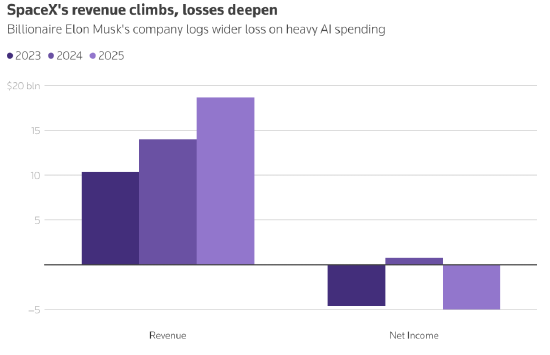
SpaceX was listed on Nasdaq on June 12. Over the past three years, its performance has fluctuated between large losses and small profits. Last year, the company reported a net loss of $4.9 billion.
OpenAI and Anthropic, developers of large language models (LLMs), are also expected to file for initial public offerings (IPOs) this year or next, with valuation targets likely to exceed $1 trillion.
Investors gain broader exposure by buying mutual funds and ETFs that track the Nasdaq 100, such as Invesco's QQQ and QQQM.
JPMorgan Chase estimates that SpaceX’s inclusion in the Nasdaq 100 index could bring $4.3 billion in passive capital inflows.
"Obviously, there's a lot of demand, which is why they're accelerating the process of including it in the index," said Michael Field, chief equity market strategist at Morningstar. "A lot of people will be happy about that. But some fund managers are not so happy, including the skeptical ones, and we are among them. We think the stock is overvalued."
S&P Global SPGI.N said this month it would not change the admission requirements for SpaceX into its major indexes, including Wall Street benchmarks S&P 500 .SPX and .INX, and would wait at least 12 months before considering the matter.