Anthropic stuffs some of its "flagship capabilities" into the default model for free users. In the early morning of July 1st, Beijing time, Claude Sonnet 5 was officially unveiled. It can independently plan tasks, call browsers and terminals, write code, check errors, and run complex workflows... In the official words of Anthropic, this is the Sonnet model that is currently "the most agent-like".Its performance is already close to that of Opus 4.8, but the price has dropped a notch.
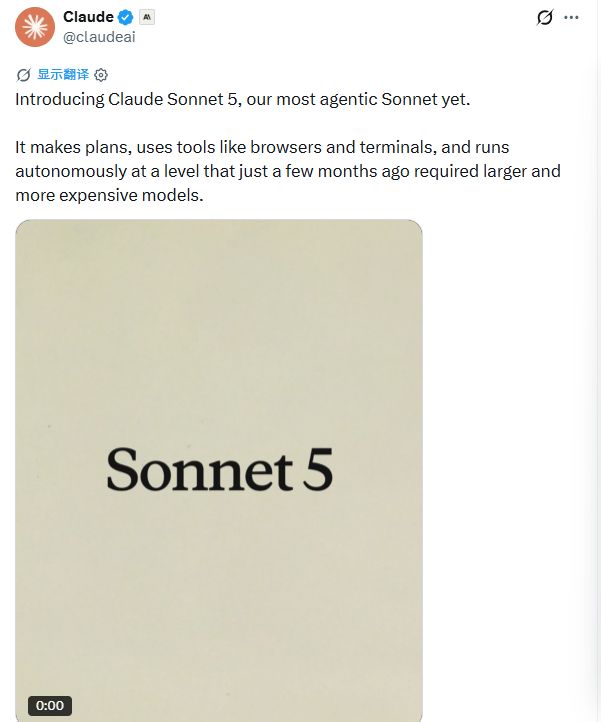
It does sound delicious.
During the release period, the input and output Token prices of Sonnet 5 (per million) are only US$2 and US$10 respectively; even if normality returns to normal at the end of August, the input and output Token prices will be US$3 and US$15 respectively. Compared with the standard pricing of Opus 4.8 (input $5/output $25), Sonnet 5 is equivalent to a direct discount of 40%, and even lower to 40% off during the initial launch period.
But if you only focus on the benchmarks and price wars, you’re underestimating Anthropic’s ambitions.
This is more like an extreme stress test conducted by this Silicon Valley unicorn on the eve of its IPO: When a near-flagship-level model is cheap enough to be used as a daily productivity tool, will corporate customers still lock it in a "pilot project"? Do they dare to truly integrate AI into core business processes?
This answer not only determines how popular Sonnet 5 can be sold, but also determines whether Anthropic's grand story that points to a trillion-dollar valuation can raise real money in the capital market.
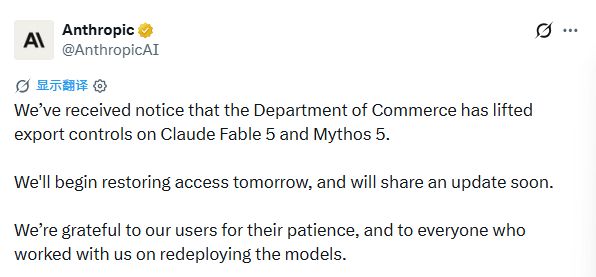
At the same time, Anthropic announced through an official document that the U.S. Department of Commerce has lifted export controls on Claude Fable 5 and Mythos 5, and access to the two models will be restored tomorrow.
01Four months, from payment barrier to public benchmark: intelligent agents are no longer noble
If you have never used the top-end Opus before, you may not understand the impact Sonnet 5 brings this time.
Turn the time back to February this year. At that time, if you wanted AI to not only answer questions in the chat box, but to operate the browser, open the terminal, and execute complex multi-step workflows on its own, you would probably have to spend money to buy the most expensive model.
That is the privilege of the minority, supported by corporate budgets, and is something that ordinary users cannot get involved with.
Now when you open Claude, the free default model already has this capability.
AI product expert Aakash Gupta shared a set of shocking comparisons after his experience. He pulled out the data and said that on the SWE-bench Pro, a hard-core test of agent coding, Sonnet 5 scored 63.2%, while the flagship Opus 4.8 scored 69.2%, catching up to more than 90% of the flagship level.
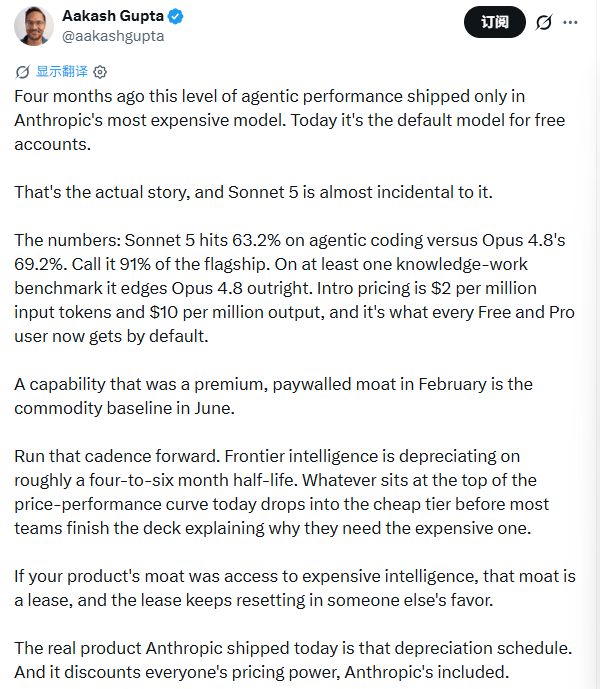
On another knowledge work benchmark GDPval-AA v2, Sonnet 5 scored 1618 points, even directly surpassing Opus 4.8's 1615 points. His feelings are very direct;What was a high-end paywall just four months ago is now standard for everyone.
Gupta also reminds everyone that no matter what advantage you currently hold on the price-performance curve, that moat is essentially just a short-term lease that is constantly being reset.What Anthropic really announced today may be this greatly shortened depreciation timetable.The depreciation cycle of cutting-edge intelligence is only about four to six months, and most teams have already fallen into the cheap tier before most teams even finish the presentation explaining why the expensive version is needed.
Another X user @Shawnife also expressed similar sentiments on social media.
He feels that releases like Sonnet 5 are becoming easily underrated, not because the improvements aren't important, but because AI advancements now feel so frequent that jumps in power are starting to seem normal. For him, what stands out is not just that Sonnet has gotten better;Rather, the line between "everyday models" and "cutting-edge capabilities" is continually thinning.
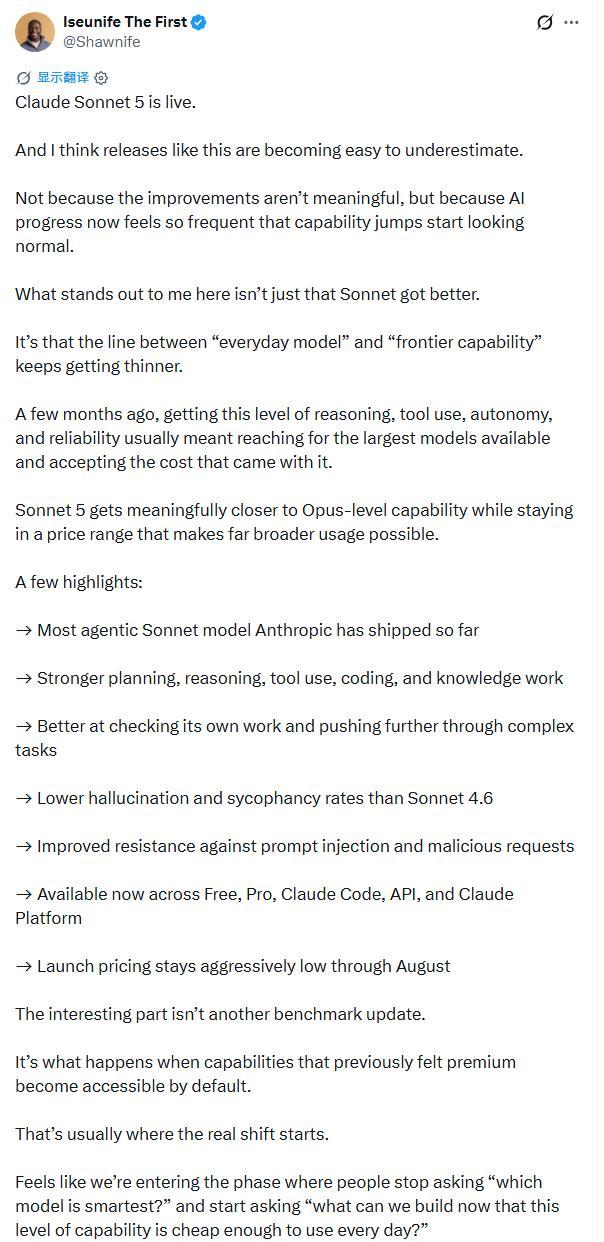
A few months ago, achieving this level of reasoning, tool usage, autonomy, and reliability often meant picking up the largest model available at the time and accepting the high cost that came with it. Now Sonnet 5 is significantly approaching Opus-level capabilities while maintaining the price range, which will make wider use possible.
@Shawnife concluded,It feels like we're entering a stage where people stop asking "which model is the smartest" and start asking "what can we build now that this level of power is cheap enough to use every day".That's often where the real transformation begins.
02 Not just "be smarter", but learn to "get the job done"
For ordinary users, the feeling that the model has become smarter is often vague, but developers have a very keen sense of smell.
The biggest feature of this Sonnet 5 upgrade is not that it can chat better, but that it has become extremely "reliable" and is especially good at handling the kind of dirty work that would get stuck halfway before.
This "unbreakable" quality is the key for companies to dare to turn experimental projects into production deployments.The biggest obstacle in pushing AI from pilot to production line is never the individual score of a certain dazzling skill, but whether it can maintain stability in the chaotic and unpredictable real workflow. A guide who gets lost after reaching the sixty-fourth step of the eighty-step road is not as useful as an honest map.
Let’s look at the objective data first.
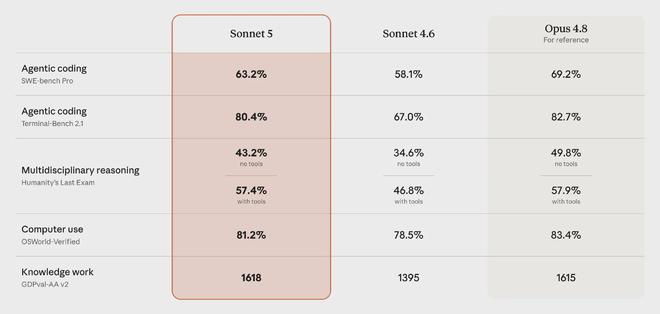
In the proxy coding test SWE-bench Pro, Sonnet 5 got 63.2%, and the previous generation Sonnet 4.6 got 58.1%. This jump brought Sonnet 5 close to Opus 4.8’s 69.2%.
In another coding evaluation, Terminal-Bench 2.1, which emphasizes more on actual combat, the gap narrowed even further, with Sonnet 5 reaching 80.4% and Opus 4.8 reaching 82.7%, almost tied.
In terms of multi-disciplinary reasoning, using the final human test as a benchmark, Sonnet 5 scored 57.4% with the help of tools, which is basically the same as Opus 4.8's 57.9%.
In the OSWorld-Verified evaluation, which simulates real computer operations, Sonnet 5 scored 81.2%, a substantial improvement over the previous generation's 78.5%.
These figures collectively point to the fact that Sonnet 5 is not a patchwork of the previous generation, it jumps directly into a performance range that highly overlaps with the flagship model.
Let’s look at subjective experience.
Sualeh Asif, the co-founder of the AI code editor Cursor, used it to run his daily work and found that this new model can stick to the established plan, follow the development specifications, and finally deliver a clear series of multi-step code changes at a comfortable cost, just like a truly reliable engineer with stable output.
Daniel Shepard, a senior engineer at the automation platform Zapier, gave it a task that previous models often failed to do: automatically update the company's complicated Salesforce account hierarchy and send out a rigorously formatted release announcement. Previous models usually got stuck halfway through,But Sonnet 5 completes the entire workflow from start to finish. This ability to reliably complete the entire process completely changes the economics of automation.
Podcast host Ben Davis’ experience brings out another level of feeling. His first reaction was that the benchmark test performance of this thing was actually very poor, and it was especially inefficient in terms of reasoning. It was not a fast model. Even though the price was reduced, it was not a cheap model due to inefficiency issues.
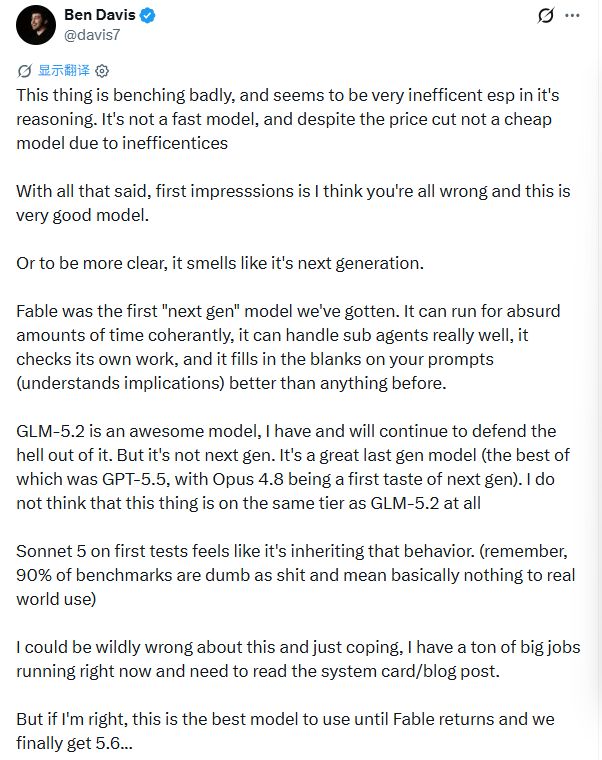
But when the topic changed, he said that his first impression was that he felt that everyone else was wrong. This was a very good model. The expression he used was that Sonnet5 smelled like "next generation".
He explained that Fable is the first "next generation" model everyone has gotten.The characteristics of this model are not high score, but the ability to run continuously for ridiculously long times, the ability to handle subagents well, the ability to check its own work, and the ability to fill in the gaps in your prompts and truly understand the meaning of your words better than any previous model.
Sonnet 5 inherited this flavor from its first test, checking its own output and proactively checking for errors without being explicitly asked to do so. However, he also admitted that, like most Claude models, it sometimes preaches too much, answers questions you didn't ask, and easily goes off topic. Fortunately, when you point it out, it won't argue with you for too long, but will simply admit your mistake and get back on track.
So his conclusion is,Until Fable truly comes back, this may be the best model out there.
Finally, let’s look at actual business practice. The test results of Box CEO Aaron Levie provide more solid evidence for these previous feelings.
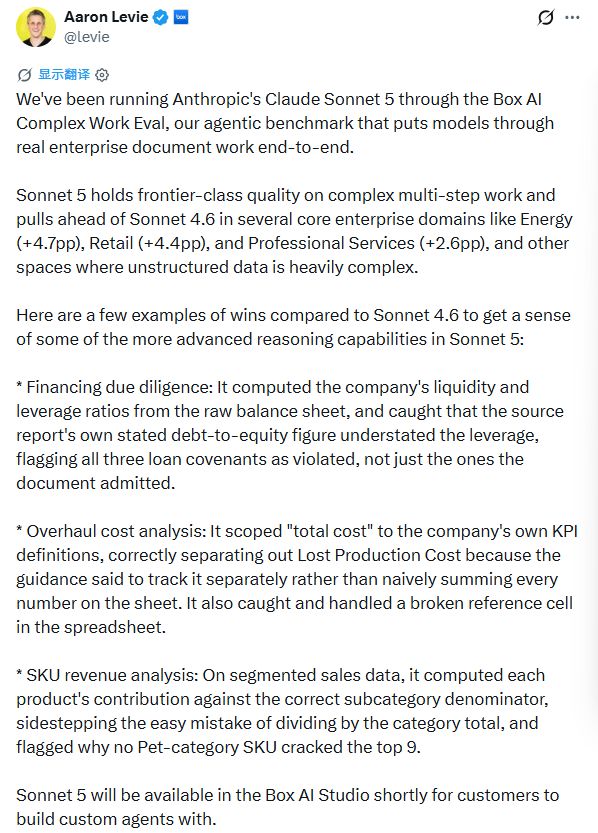
Box has a self-developed AI complex work evaluation system internally, which specifically allows the model to gnaw on real corporate documents end-to-end. He threw the Sonnet 5 in and rolled around, and the results were quite amazing. In several lucrative high-complexity sectors, such as the energy industry, Sonnet 5 leads by 4.7 percentage points over its predecessor, retail by 4.4 percentage points, and professional services by 2.6 percentage points.
Levi also shared several specific practical cases. When doing due diligence on financing, Sonnet 5 calculated the company's liquidity and leverage ratio from the original balance sheet, and even found out the understated debt-to-equity ratio in the source report, and marked all three loans as violations, not just the ones admitted by the document itself.
When analyzing overhaul costs, other models may mindlessly add up every number in the table, but it cleverly limits it to the company's own defined KPI framework, cleanly stripping out the production loss costs that should be tracked separately, and also follows the clues to find a damaged reference cell in the spreadsheet.
When doing SKU revenue analysis, it does not fall into the common pitfall of dividing by the sum. Instead, it accurately calculates the contribution of each product to the denominator of the correct subcategory, and can even explain why a certain product category did not make it into the top nine of the rankings.
Levy feels that in areas where unstructured data is highly complex, Sonnet 5 has indeed demonstrated its ability to carry the production banner.He confirmed that this model will soon be available to customers in Box AI Studio to build the company's own personalized intelligence.
03 The ledger in the tokenizer: cheaper, but not necessarily saving money
For corporate customers, this ability to stably process complex documents is exactly the reason why they are willing to pay. But the prerequisite for being willing to pay is that the bill must be within the budget.
On the surface, it seems that the cost of Sonnet 5 has dropped a lot, and you can buy a smartphone that is close to Opus at the special price of only US$2 and US$10. However, after finishing the test, many people turned around and reminded everyone to pay attention to "avoid pitfalls."
Simon Willison, a researcher who specializes in AI details, has a habit. Every time a new model is released, he will go directly to the "new features" section of the developer documentation, because there usually is more practical information hidden there than the official announcement. This time he really dug out a technical detail that needed to be weighed carefully.
Sonnet 5 has a new version of the word segmenter, and the way it processes text has changed. The direct consequence of this is that for the same input text, the current token consumption is nearly 30% more than that of the old model Sonnet 4.6.
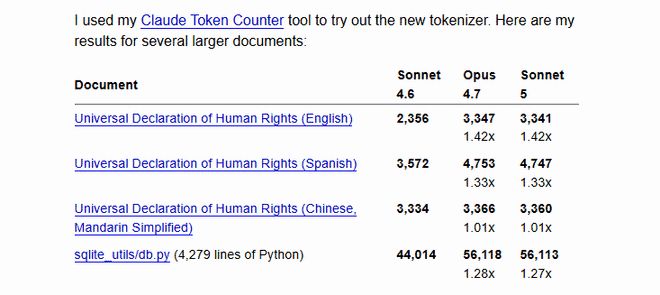
He did an actual measurement using a publicly available Claude Token counting tool, and the results were quite intuitive. He used the full text of the English version of the Universal Declaration of Human Rights for testing. On the old model Sonnet 4.6, only 2356 tokens were consumed. By Sonnet 5, it directly expanded to 3341 tokens, an increase of 1.42 times. Switching to the Spanish version, the number of tokens increased from 3572 to 4747, an increase of 1.33 times.
The most brutal thing was to test a Python code file with more than 4,000 lines. The token increased sharply from 44014 to 56113, an increase of 1.27 times. The only thing that relieved him was Simplified Chinese. The token consumption of Chinese text on the two models was basically the same, with only a slight 1.01 times fluctuation, which was almost negligible.
This finding means that for developers who rely heavily on English processing or run a lot of Python code, the per-task cost of the model may not be as good as advertised.
Anthropic actually admitted this in the footnotes of the official document. They explained that the purpose of setting preferential pricing is to keep the transition period roughly cost-neutral.In other words, part of the few dollars of room for price reduction is used to hedge against token inflation.
This hidden variable caused some developers who had originally applauded the price reduction to calm down instantly and began to recalculate their calculations based on their typical workloads.
04 There was a huge quarrel on social networks: some people shouted that it smells great, and some people called for a refund.
At any time a model is released, there isn’t just one voice on social media. In the first few hours after Sonnet 5 went live, feedback on the X platform was quickly divided.
Some people feel that this update is sincere, while others express their disappointment unceremoniously.
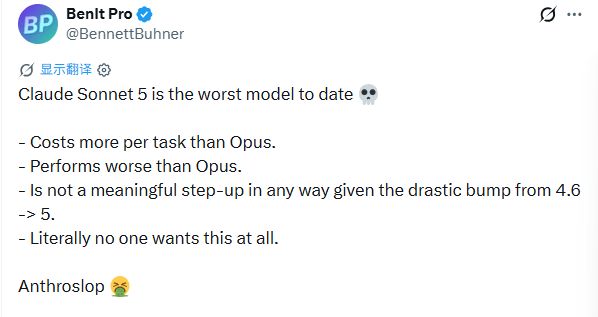
X user @BennettBuhner’s complaint was quite pointed. He directly said that the Sonnet 5 is the worst model so far. His reason is that the actual consumption cost of each task is higher than using Opus, but the performance is worse than Opus, and the jump from a version number as large as 4.6 to 5 is not a meaningful improvement in any aspect. He vented his dissatisfaction by using a coined word, Anthroslop, with obvious irony.
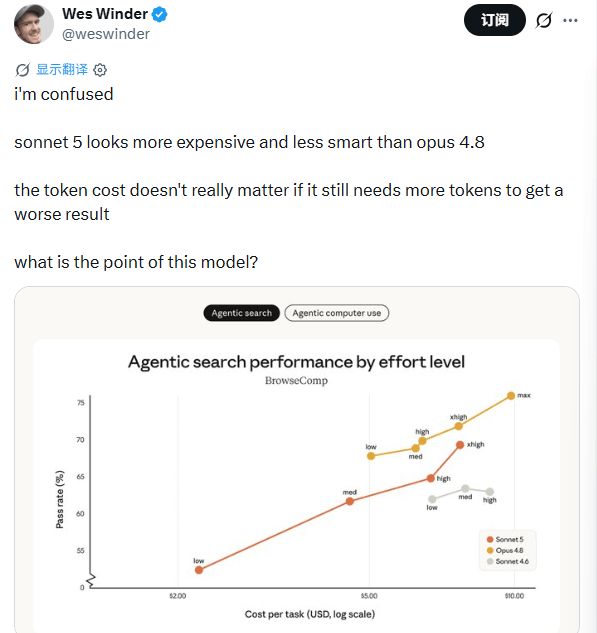
X user @weswinder also expressed similar confusion. His logic is straightforward. The Sonnet 5 looks more expensive than the Opus 4.8, and it's not as smart.If more tokens are needed to obtain worse results, then the so-called unit price advantage per token is actually meaningless.He asked directly, what is the significance of this model?
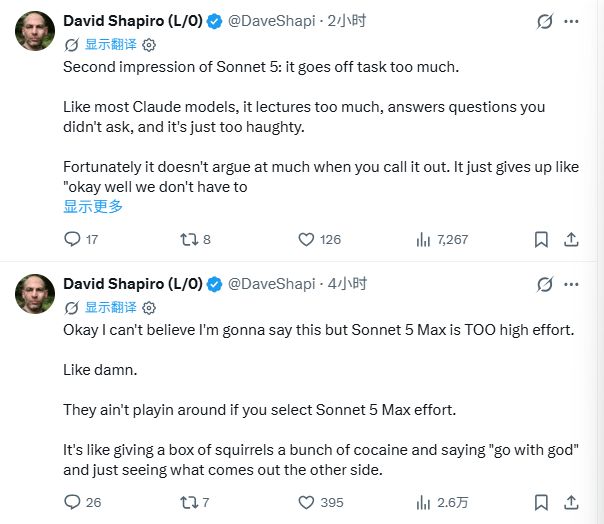
Another X user, @DaveShapi, had a roller coaster experience. His first reaction was shock. In his own words, he couldn't believe he was saying this, but the Max effort mode of Sonnet 5 was too strenuous. He described it as feeling like feeding a box of squirrels a bunch of cocaine, then saying "God bless you" and waiting to see what comes out the other side.
He then complained that Sonnet 5 went off topic too easily, was preachy like most Claudes, would answer questions you didn't ask, and was overall too arrogant. Fortunately, there is an advantage. When you point out its mistakes, it will not argue with you for too long. It will simply admit its mistakes and ask what's wrong. We don't have to worry about it. He asked helplessly, why should I pay for this?
But apart from the voices of dissatisfaction, some people also gave completely different judgments. X user @kimmonismus’s comments brought a more strategic level of scrutiny.
The evaluation result he got was that Sonnet 5 was indeed better than the previous generation, which everyone would have expected, but it was weaker than Opus 4.8 in all evaluations. What he especially doesn't understand is that since there is no jump in performance, why does the version number jump directly from 4.6 to 5 instead of calling it 4.8 or a similar number. Usually a big version number jump means a major leap in capabilities, but this time it obviously doesn't.
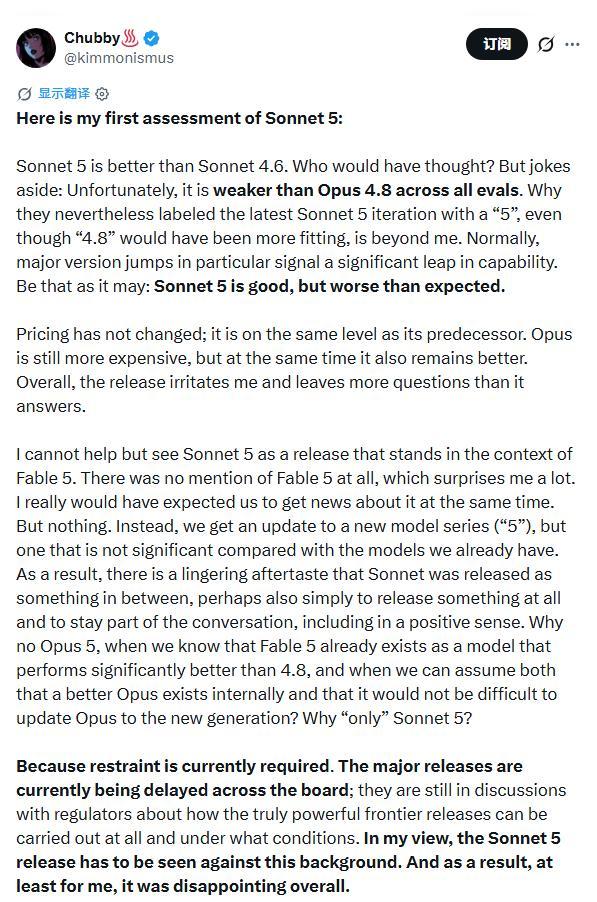
@kimmonismus said that overall the release left him confused and raised more questions than it answered. He couldn't help but examine Sonnet 5 in the context of Fable 5. Since everyone already knew that there was a Fable 5 with significantly stronger performance inside, and also knew that it could be assumed that there was a better Opus inside, why did they hold back for a long time and only release a Sonnet 5 that was neither good nor bad?
He speculated that this was likely due to the current need for restraint. The real highlight is that because regulatory communications are still being delayed across the board, Anthropic needs to release something now to keep itself in the conversation and not forget it, including maintaining those positive voices.In his opinion, the release of Sonnet 5 can probably only be understood in this context, leaving an aftertaste of some sort of transitional in-betweenness that, at least for him personally, is generally disappointing.
In the face of these criticisms, many people have spoken out for Anthropic.
Some people think that comparing Sonnet with Opus itself shows that Sonnet has leapfrogged the market. Mid-range products are being compared with flagship models, which just proves that the performance has squeezed into the first echelon. Others pointed out that Free users can now buy models of this level for free, so there is nothing to complain about.
This kind of controversy itself shows that Sonnet 5 is walking on a delicate balance point. It is still far away from being amazing, but it is far away from failure.The real test is not the word-of-mouth on the day of release, but how many developers will actually migrate their daily workflow to this model in the next few weeks, and whether those who have migrated will nod or frown when they receive the bill at the end of the month.
05The danger of being "sealed" and restraint on the eve of IPO
As a star company that is sprinting towards a trillion-dollar valuation, Anthropic is extremely tight on security. This time in the system card of Sonnet 5, the security assessment occupies a large space and many details are revealed.
Let’s talk about the areas of progress first. Compared with the previous generation Sonnet 4.6, Sonnet 5 has real improvements in multiple dimensions.
It exhibits lower rates of hallucinations and obsequious behavior, is better at rejecting malicious requests, and is more resistant to hint injection attacks in agent scenarios. The official has conducted a full set of automated behavioral audits, and the test scope covers a series of inappropriate behaviors such as cooperation, abuse, and deception. The overall inappropriate behavior score of Sonnet 5 is lower than that of the previous generation, which means it is safer.
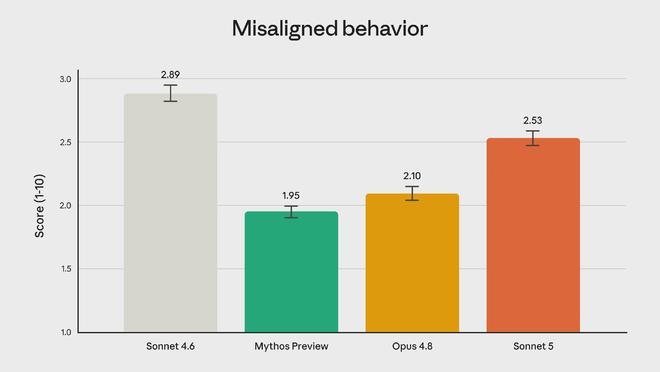
But to be honest, it's not the safest one.The system card clearly states that compared to the more capable Opus 4.8 and the Claude Mythos Preview that specifically focuses on network security, Sonnet 5 showed a slightly higher rate of misconduct in the same evaluation.This statement is very cautious, but it is enough to illustrate the problem. Stronger models actually do better in some security dimensions.
The most intuitive comparison comes from an exploit test developed in collaboration with Mozilla.
The task was for the model to write usable software exploits for the Firefox 147 browser. The report card of Sonnet 5 is very clean. There are no usable vulnerabilities at all, and the success rate is zero. Its partial success rate is 13.2%, slightly higher than the 8.8% of the previous generation Sonnet 4.6, but both numbers are worth mentioning in front of Opus 4.8. Opus 4.8 produced 68.8% of the available exploits, and Mythos 5 was as high as 88.4%.
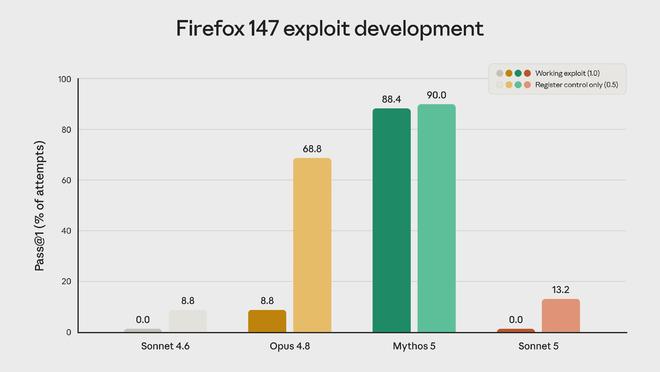
In other words, although Sonnet 5's versatility has soared, there is still a gap between it and its two older brothers in terms of network security skills that require extremely destructive power.
To prevent it from being too clever and causing chaos, Anthropic's approach is to directly enable network security protection by default. This system can detect and block dangerous network usage behaviors in real time. Whenever the model attempts to touch the dangerous area, the protective shield will pop up.
Officials explained that the strictness of this set of protection measures is the same as that on Opus 4.7 and 4.8. Because they judged that the overall network security risk level of Sonnet 5 is low, they did not take more stringent measures like restricting Fable 5.
For those organizations with special needs that require less protection for cybersecurity research, Anthropic offers a "Cyber Verification Program" channel. Organizations that have already joined the program will automatically receive the same access rights on Sonnet5 and do not need to reapply. In general, the official recommendation is that those who are serious about network security work use Opus4.8.
06 What role does Sonnet 5 play in the IPO narrative?
Anthropic is rushing to go public, and its valuation has been pushed to nearly one trillion US dollars. Pushing Sonnet 5 on this node is more like a strategic move than just a routine update.
Looking at its financing trajectory in the past six months, it is indeed fast. In February this year, Anthropic completed US$30 billion in financing at a valuation of US$380 billion. At that time, annualized revenue reached US$14 billion, growing more than tenfold each year in the past three years. By late May, it had completed another US$65 billion in Series H financing, its valuation jumped directly to US$965 billion, and its annual revenue had soared to more than US$47 billion.
But this growth rate also brings an inevitable scrutiny. Gil Luria, director of technology research at analyst firm D.A. Davidson, poured cold water on it, cautioning that while Anthropic does appear to be ahead in terms of cutting-edge models,But most of the current usage comes from trials and experiments, which may not be sustainable.Transforming developers’ curiosity-seeking trials into production-level dependencies with long-term contracts is the most critical obstacle facing AI laboratories.
Looking at Sonnet 5’s pricing strategy in this context, the logic becomes clear. Enterprise customers who are trying expensive Opus-class models may find that the Sonnet 5 offers good enough production quality at a price point that finance departments are willing to approve at scale.If this thing goes through, it could accelerate the industry's transition from experimentation to deployment, which is a key step for Anthropic to justify its valuation.
There is another sign that is easily ignored. Just one day before the launch of Sonnet 5, California Governor Gavin Newsom announced a partnership to provide Claude to all state agencies at a 50% discount, along with free workforce training.This means Anthropic will receive ongoing, recurring revenue.
Kate Jensen, Anthropic's head of the Americas, said it's about keeping Claude available for those who keep California running. This agreement has also extended to various cities and counties in California. It does not represent a one-time sale, but the kind of deep binding that allows the income base to penetrate the developer community and penetrate into the public service system. For corporate customers, this ability to stably process complex documents is exactly the reason why they are willing to pay.
07Competitive landscape and valuation pressure
The timing of the release of Sonnet 5 also coincides with the most competitive window in the entire industry.
OpenAI completed US$122 billion in financing at a valuation of US$852 billion in March and is also preparing for its own IPO. After the merger of Elon Musk's SpaceX and xAI, the IPO price was US$135 per share, with a valuation of US$1.77 trillion. Google, Meta and a slew of well-funded Asian AI startups are all vying for the same enterprise market.
This is a money-burning arms race in which no one dares to stop and take a breath.
PitchBook analyst Harrison Rolfes said something very real about this. What he means is, don’t just look at superficial numbers such as valuation and revenue. Those can all be piled up by burning money.The really important number is the gross profit margin, which is how much money is left after deducting direct costs such as computing power and electricity bills for every dollar the company earns. This number has never been seen by the outside world until now. If the gross profit margin is ugly, no matter how high the revenue is, it will only make money at a loss.
Therefore, the listing of this wave of AI companies in 2026 will either become the most successful capital feast since the Internet bubble, or it will become a negative teaching material for investors in the public market to remember how expensive it is to just listen to the story without looking at the books.
The subtext of this sentence is that Wall Street will not be easily impressed by the rapid growth of revenue. They will peel off the financial reports layer by layer to see how much computing power is burned behind each dollar of revenue. Gross profit margin is the key indicator to test whether an AI company is a technological miracle or a capital black hole. Public markets are brutal.
Conclusion
The ball is now out.The real test of Sonnet 5 will not be in the benchmark chart on the day of release, but in the billing and retention rates in the following months.Have developers really migrated their daily workflow? When they receive their bill at the end of the month, do they nod or frown? These are the only ones that count.
Breaking it down, there are three variables that will determine the answer.
The first is the reliability of the agent.Benchmark testing tests the capability ceiling, but the production environment tests long-term stability. After thousands of developers start running in their own chaotic and unpredictable scenarios, whether Sonnet 5 will fall off the chain is more important than how high the score it runs in the laboratory.
The second one is the bill variable hidden in the tokenizer.If corporate customers don’t do cost calculations based on their business scenarios and just look at the advertised unit price of each token and think it’s cheap, then when the discount period ends, the real bill may be shocking.
The third variable is more interesting.Assuming Sonnet 5 is really successful, developers migrate on a large scale, and enterprise customers also insert it into the production process, what will happen next?
Opus's position will become awkward. If Sonnet can already provide sufficient performance at a much lower cost in most scenarios, who would be willing to spend more than twice the money to call Opus?At that time, Anthropic may be counterattacked by its own success. The better Sonnet sells, the more sales of Opus will be squeezed, and Opus is the product line with higher gross profit.
Either take the initiative to lower prices and compress profit margins, or watch customers flow from high-priced products to low-priced products. Neither path is easy to follow.
Anthropic’s bet this time is right in the middle of the two endings.
It came up with a model whose performance is close to that of flagships, but the price can be rolled out on a large scale. It wants to prove one thing: cutting-edge capabilities can not only stay at the most expensive flagship level, but can also become infrastructure that enterprises can use every day and make money at the same time.
When Anthropic actually comes to the public market, investors will give an answer: Can this "close to flagship, price drop" route support a story close to a trillion dollars.