Electra, a start-up American aircraft manufacturer, recently released a concept model of a next-generation mainline passenger aircraft for 2050. This hybrid solution can carry more than a hundred passengers. It improves efficiency while reducing emissions through electrification, advanced aerodynamic layout and integrated body and power design. The project is part of NASA's Advanced Aircraft Concepts for Environmental Sustainability (AACES 2050) program, which aims to explore feasible paths for a new generation of environmentally friendly passenger aircraft while being compatible with existing airport infrastructure.
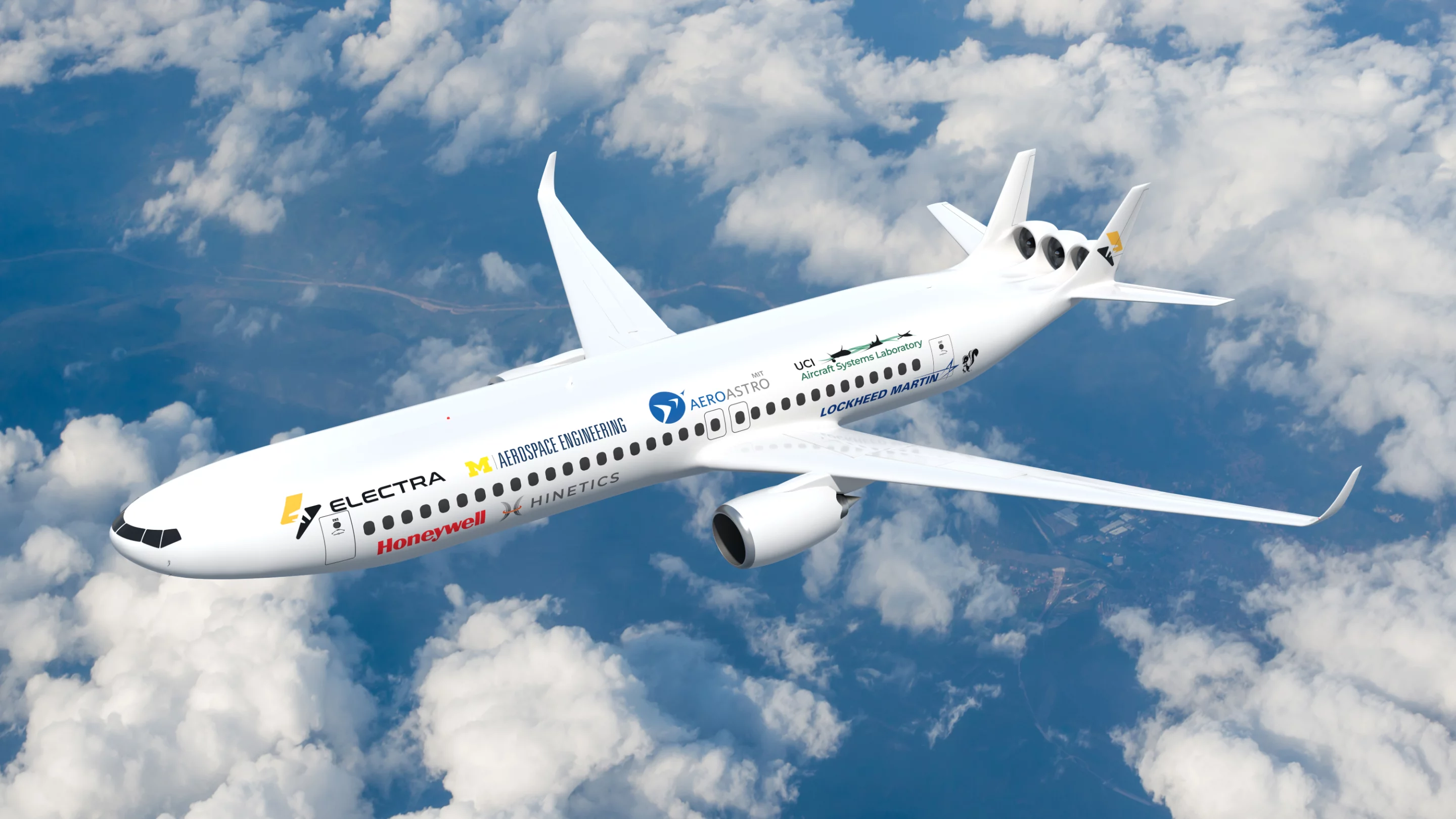
Different from the idea of "plug-in" electric motors on the traditional airframe, Electra attempts to start from the overall airframe structure and propulsion system, and deeply couple the aerodynamic design and propulsion layout to simultaneously improve fuel economy and environmental performance. This concept aircraft is based on the D8 "green airliner" research plan previously proposed by MIT. Its most significant appearance feature is the so-called "double-bubble" fuselage: two cylindrical fuselage sections are fused together in parallel, similar to a modern interpretation of the structure of the Boeing 377 Stratocruiser in the 1940s that was "transversely" 90 degrees.
Electra pointed out that the "double-bubble" fuselage is not only to increase the cabin space without increasing the fuselage length, but more importantly, to allow the fuselage itself to bear a large amount of lift, making the overall layout close to some form of wing-body fusion design. By allowing the fuselage to participate in lift generation, the structural burden on the wing can be significantly reduced, thereby reducing the size of the wing and bringing about dual gains in drag and weight.
The real "ingenuity" is reflected in its hybrid propulsion system. Under the wings, the design retains two turbofan engines, which are responsible for providing most of the thrust and powering the electrical system in the airframe via integrated megawatt generators. At the rear of the fuselage, three fans driven by electric motors are arranged. These fans are embedded in the rear section of the fuselage and form an integrated turbine-electric hybrid propulsion architecture with the front turbofan power generation system.
From an intuitive perspective, this layout seems a bit unnecessary: since the turbofan can directly generate thrust, why do we need to generate electricity first and then drive the electric fan, adding multiple energy conversion losses in the middle? The answer given by Electra lies in the aerodynamic design - the key to this system is to use the boundary layer airflow on the surface of the aircraft to regain energy that would otherwise be wasted in the wake of the aircraft.
In this plan, the underwing turbofan is suspended under the wing through the nacelle pylon, deliberately away from the boundary layer on the surface of the aircraft body, to inhale free-flow air that is consistent with the aircraft's flight speed and has a relatively uniform flow field, thereby maintaining "clean" air intake conditions in the traditional sense. At the same time, a layer of thicker, lower-velocity boundary layer airflow will form on the surface of the fuselage. This low-energy airflow develops backward along the fuselage. If it is allowed to fall off naturally, it will form a turbulent wake at the tail, dragging down the overall aerodynamic efficiency of the aircraft.
Electra's AACES 2050 concept aircraft has three electric fans directly embedded into the fuselage structure at the tail, allowing them to actively inhale this low-energy boundary layer airflow and re-energize it before the flow completely escapes to form a wake. Through this "tail re-acceleration" process, the energy that would have been lost in the form of wake vortices can be partially recovered, the body's wake can be "contracted", and the resistance is significantly reduced, thus improving the overall propulsion efficiency, reducing fuel consumption and emissions, and allowing the use of smaller and lighter engine configurations.
Electra emphasized that this idea is quite elegant in theory, but it still faces multiple challenges in engineering practice, including the safety and efficiency of long-distance transmission of megawatt-level power within the body, thermal management of motors and power electronics, and possible noise issues caused by electric fans at the tail. Whether these key technologies can be engineered under cost and reliability constraints is a difficult problem that must be gradually overcome in the next ten years or so.
Dr. Parker Vascik, director of product strategy at Electra, said the value of electrification is that it allows designers to place propulsion units in locations where engines could not previously be placed, thereby gaining greater freedom and benefits at the overall layout level. He pointed out that the goal of this concept is not only to be highly efficient on paper, but to propose "a solution that can actually be built, certified for airworthiness and put into use" while maintaining compatibility with existing airline operating models and airport infrastructure.