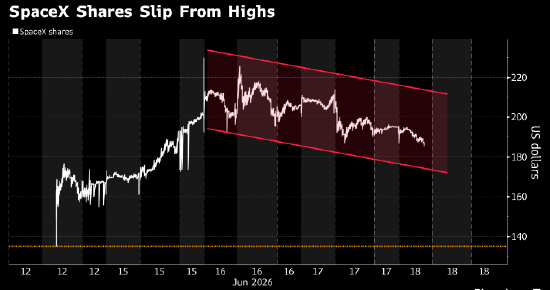
SpaceX's stock price action proves that even the largest initial public offering (IPO) in history is not immune to the share price fluctuations common after large companies go public. Shares of Musk's rocket, satellite and artificial intelligence company fell for a second day in a row, falling as much as 10% on Thursday after falling nearly 5% on Wednesday. However, SpaceX is still expected to achieve a gain of about 28% from its IPO price of $135 in its first full week of trading.
Michael Monaghan, a partner and portfolio manager at Founder Funds in Dallas, said stock prices are likely to remain volatile as investors weigh expectations for high future revenue growth against a unclear path to achieving it. The institution owns SpaceX stock.
"The reason why we feel very comfortable holding this stock is that we expect it to achieve $200 billion in revenue by 2030," he said, adding that there are higher forecasts in the market. "But you need a rocket, literally and figuratively, to make that kind of revenue."
Vanda Research data shows that retail investors, who had been net buyers in the first few days of SpaceX's listing, retreated on Wednesday, with net inflows nearly flat for most of the time, and only a small net purchase of $2.3 million was recorded at the close. That sentiment seemed to carry over into Thursday. In the first 10 minutes after the market opened, retail investors sold a net $3.5 million, then the flow stabilized and switched back to net buying.