A latest national survey released by the Pew Research Center shows that American society has formed a relatively clear regulatory consensus on the issue of social media use by minors: nearly 60% of American adults support banning people under the age of 16 from using social media platforms. This result reflects that social debates surrounding the mental health of minors, online safety, and platform responsibilities are gradually transforming into practical support for more stringent policy tools.
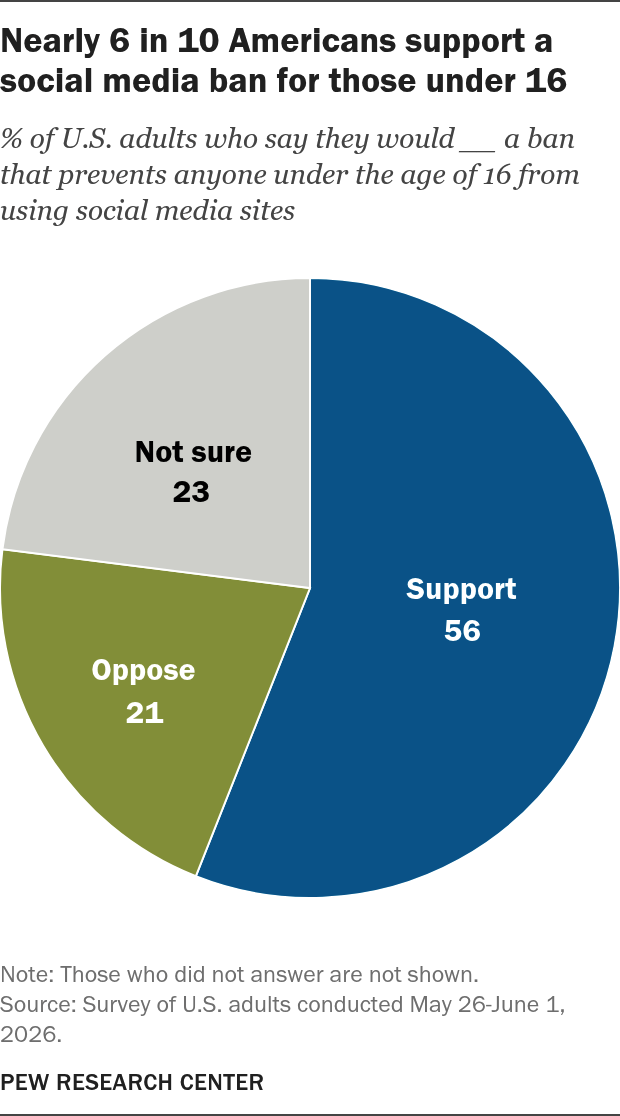
According to survey data, about 56% of American adults support the implementation of a social media ban for teenagers under the age of 16, only about 21% clearly oppose it, and about 23% of the respondents are uncertain. The survey was conducted by the Pew Research Center from May 26 to June 1, 2026, covering nearly 10,000 American adults and is certain to be representative. Compared with previous polls on issues such as "limiting the duration of social media use by minors" and "age verification," this data shows that the American public has also shown a majority support trend for direct "age bans."
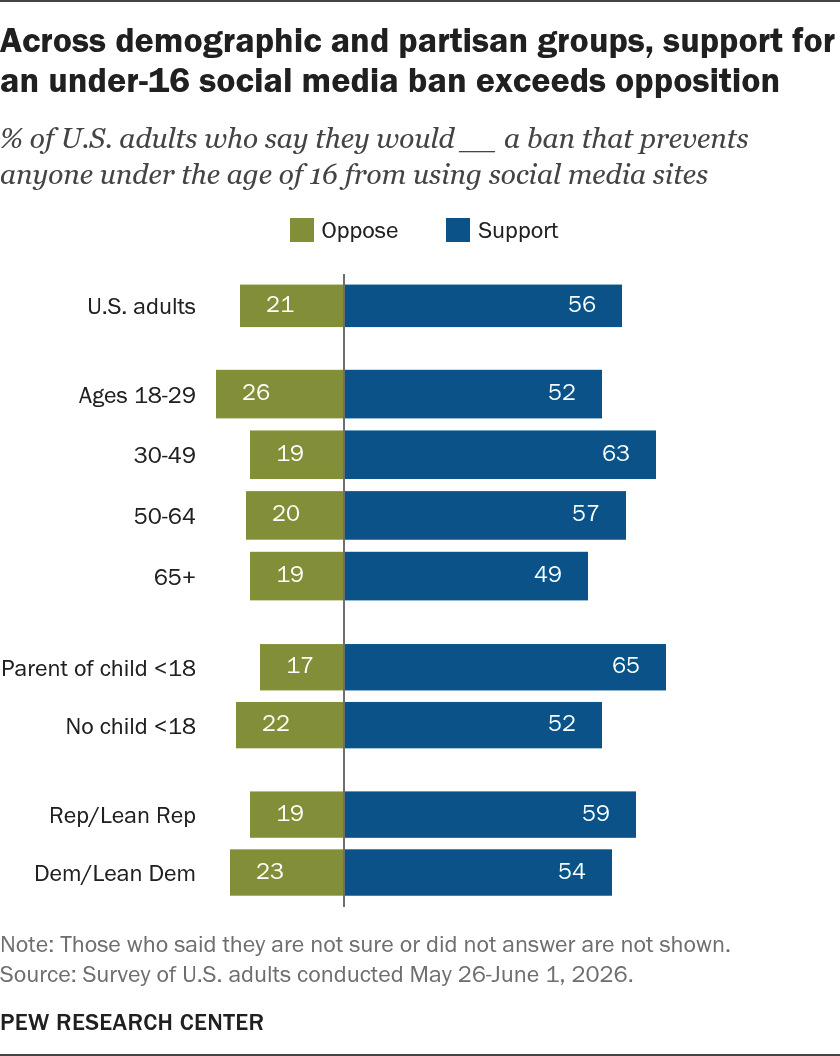
Among different age groups, young and middle-aged respondents are particularly supportive of the ban. The survey shows that about 63% of adults aged 30 to 49 support banning the use of social media by people under the age of 16, and about 57% of those aged 50 to 64 support it. In contrast, people aged 65 and above are relatively cautious about the ban, with only about half in favor. Analysts pointed out that this may be related to differences in social media usage habits, risk perceptions and tolerance of government intervention among different generations.
Whether you are a parent or not is also one of the important factors affecting attitudes. The survey shows that among parents with minor children under the age of 18, about 65% support the establishment of a social media ban for people under the age of 16, while only about 17% are explicitly opposed. Even among adults without children, about 52% support the ban and about 22% oppose it. This shows that the use of social media by minors is no longer just a “parental issue”, but is regarded as a broader issue involving public health and social governance.
It is worth noting that public opinion around social media regulation takes on a cross-party character. Pew's survey results show that about 59% of Republican supporters and about 54% of Democratic supporters support banning the use of social media by people under the age of 16, and the support ratios of the two parties are similar. Among those who clearly oppose the ban, about 19% are Republican supporters and about 23% are Democratic supporters. In the current highly polarized political environment, this relatively consistent attitude shows that the online safety and mental health of minors is becoming one of the few public issues that can transcend partisan differences.
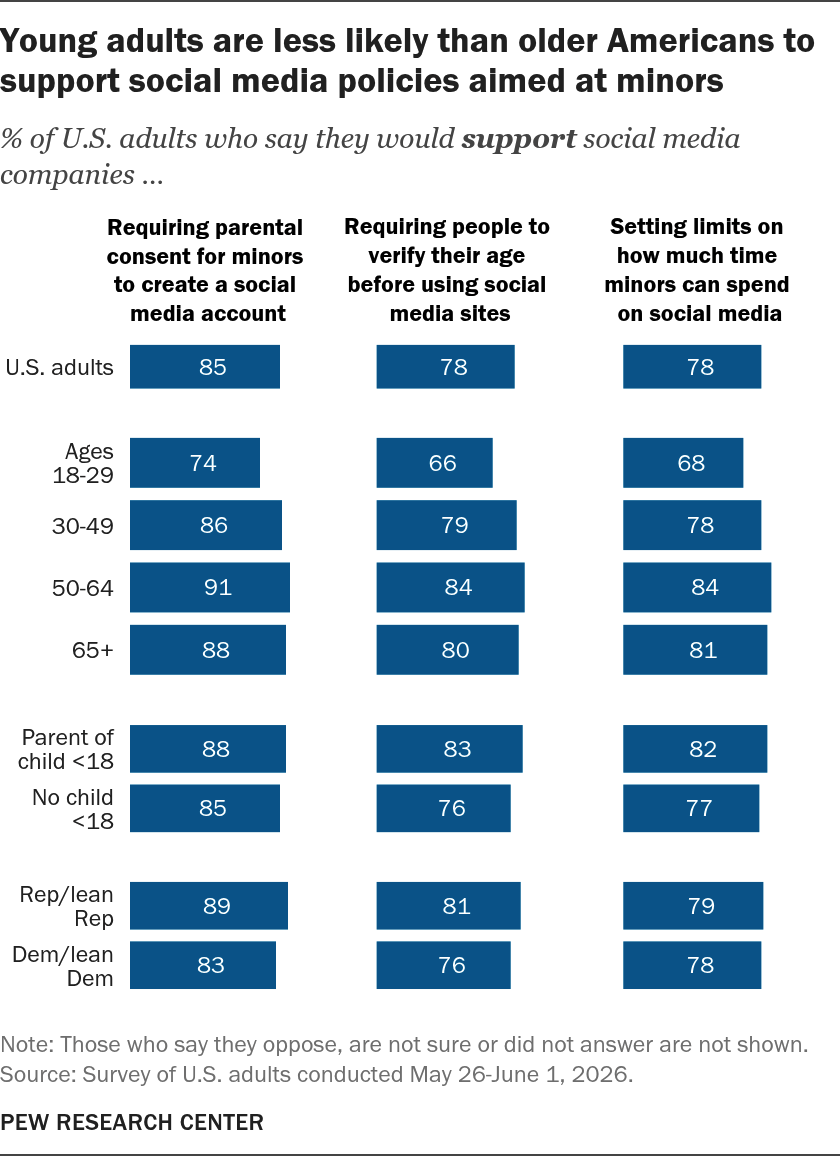
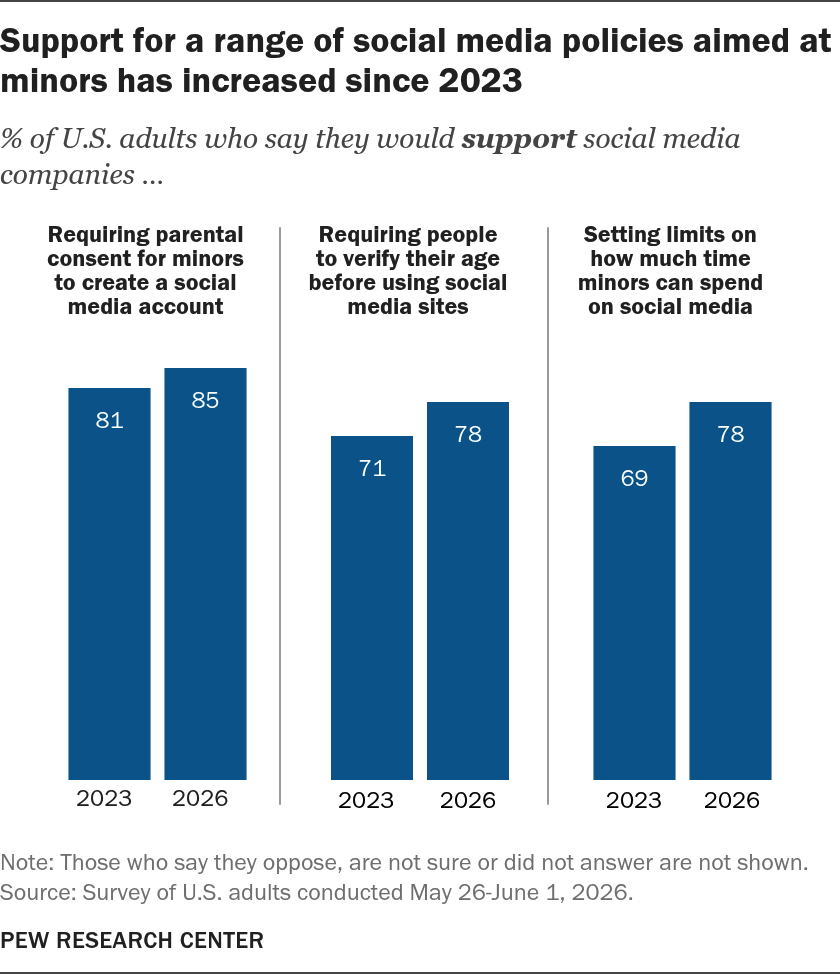
In addition to "direct bans", the American public also shows a higher level of support for a series of auxiliary regulatory measures. Surveys show that about 85% of adults support requiring minors to obtain parental consent when creating social media accounts. In addition, about 78% of the respondents believe that users should be required to complete reliable age verification before using social media, and technical and institutional measures should be taken to prevent minors from bypassing age restrictions. Regarding measures to limit the daily social media use time of minors, support is also as high as about 78%, which is further increased from the 69% support rate in the relevant survey in 2023.
At the international level, many countries have successively promoted similar legislative attempts. Previously, Australia passed a law that will ban children under 16 from using social media starting in 2024; Denmark plans to implement a platform ban for users under 15 years old, and British regulators have also publicly stated that they will consider age restrictions or duration restrictions. A global survey shows that about 65% of respondents support banning children under the age of 14 from using social media, highlighting that the issue of minors’ online safety has become a common issue in international public policy.
However, experts also caution that imposing social media bans on minors is not a "zero-risk" solution. Multiple studies and policy assessments have pointed out that there is currently insufficient evidence to show that a comprehensive ban can significantly improve the mental health of adolescents. Instead, it may cause a series of supporting issues such as implementation difficulty, privacy protection, freedom of speech and access to educational resources. Some scholars believe that in order to build a safer digital environment, rather than relying solely on age bans, it is better to strengthen the binding force in terms of platform responsibility, algorithm design, and content review systems.
Overall, the latest Pew Research Center survey reflects that American society is undergoing structural changes in its attitude towards minors’ use of social media: from “reminders and guidance” to gradually supporting stronger institutional restrictions. Under the background that public opinion has provided "authorization" for policy tightening, in the future, U.S. federal and state-level legislative bodies and regulatory authorities may introduce more specific policy combinations in terms of age restrictions, parental consent, time management, age verification, etc. How to strike a balance between protecting the physical and mental health of adolescents and safeguarding their right to participate in the digital age will become the core focus of the subsequent policy debate.