Eastern Time in April 2019, the Event Horizon Telescope (EHT) collaboration team released the first black hole image in human history for the first time, clearly presenting a celestial body that has never been directly observed before. Now, a multinational team of astronomers has obtained "the most detailed X-ray view yet" of the plasma jet of the same supermassive black hole M87*, using NASA's Chandra X-ray Observatory.
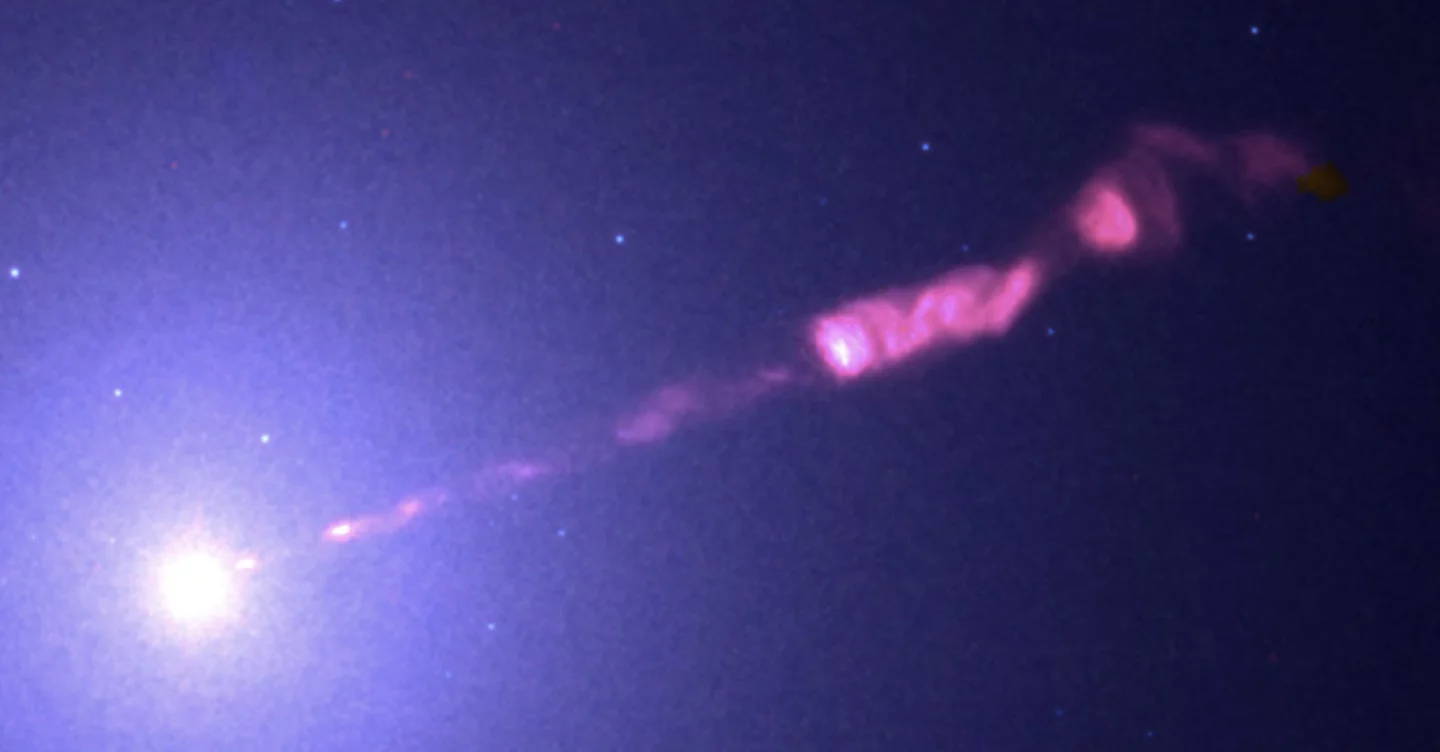
According to the latest paper published on the preprint platform arXiv, researchers detailed how they used long-term observation data from the Chandra Telescope to track the evolution of this huge cosmic jet on a scale of more than ten years, highlighting the observatory's unique ability to study changes in grand cosmic structures over time. M87* is located in the Virgo galaxy cluster about 55 million light-years away from the Earth. The surrounding material is captured by the strong gravity of the black hole and forms a hot accretion disk. Under the influence of the black hole's rotation and magnetic field, it generates high-energy jets that extend for thousands of light-years.
The standard model of astronomy holds that when a supermassive black hole devours surrounding gas and dust, the disk of material will form a high-temperature, rotating accretion disk around the black hole. The black hole's powerful gravity and high-speed rotation jointly distort the surrounding magnetic field, coiling it into beams at the two poles. These coiled magnetic fields seem to become "particle accelerators", constantly emitting high-energy particle jets outside the galaxy. NASA data shows that the jet of M87* is more than 3,000 light-years long, rushing into the depths of the universe at a relativistic speed close to the speed of light, and releasing radiation covering a variety of wavebands from radio to X-rays.
This research was led by Camille Poitras, a doctoral student at the School of Science and Engineering at Université Laval in Canada. The team used advanced X-ray image processing technology to synthesize and reconstruct multiple M87* jet observation data acquired by Chandra between 2012 and 2025. Traditionally, X-ray imaging has been combined with radio, optical and infrared observations to study the different structures of black hole jets. Radio telescopes are good at resolving larger, more extended structures in jets, while X-rays are more sensitive to the hottest, most energetic parts of jets. However, due to resolution limitations, X-ray images have long been difficult to clearly "split" the complex detailed structures in the jet.
In the latest work, the Chandra team performed a so-called "deconvolution" process on the images, which significantly improved the image resolution, allowing the detail accuracy presented in the X-ray view to approach that of images from optical and infrared telescopes, while retaining the sensitivity of X-rays to high-energy structures. This means that the processed Chandra images can take into account both structural resolution and high-energy information in the same field of view, providing a more powerful tool for studying the particle acceleration mechanism inside the jet. By overlaying and analyzing observations over more than ten years, the research team was able to meticulously depict the evolution of the M87* jet on a timeline, revealing the trajectory of its internal structure on a ten-year scale.
"We have been able to see jets changing before, but never at this level of detail in X-ray wavelengths," Poitras said. She points out that through deconvolution techniques, structures that used to be jumbled together in X-ray images can now be resolved, allowing scientists to more clearly track the relative motion and changes of different components in the jet over more than a decade. Such long-term, fine-scale time series observations provide key clues to understanding how black hole jets transport energy from near the event horizon to the galaxy scale.
M87* was chosen as the target for EHT's first black hole imaging in 2019, in part because it is an "active" supermassive black hole with a bright accretion disk and significant relativistic jets. In contrast, the current environment of the black hole Sagittarius A* at the center of our galaxy is relatively "barren" and lacks sufficient gas and dust material, so it is in a relatively "quiet" state overall. The high level of activity of M87* not only makes it an ideal observation object for the Event Horizon Telescope, but also provides the Chandra team with an excellent sample to study the dynamic evolution of the jet.
Analysis shows that the latest X-ray view of M87*'s jet appears to be more "dynamic" than previously appreciated. Within this huge jet of energy, some structures appear almost stationary, while others exhibit the visual equivalent of moving at five times the speed of light. The researchers emphasized that this does not mean that matter really exceeds the speed of light, but it stems from an observational artifact called "superluminal motion." When the material in the jet moves at nearly the speed of light in a direction nearly toward the Earth, observers will see the projection of the jet on the sky background appear to be moving faster than the speed of light due to light path and time delay effects.
This superluminal visual effect provides astronomers with a unique window into the interaction of high-energy particles in jets with magnetic fields on relatively short time scales. Gerrit Schellenberger, an astrophysicist at the Harvard-Smithsonian Center for Astrophysics and co-author of the paper, said this work demonstrates Chandra's continued power in tracking extreme cosmic phenomena over long time scales and helps to deepen our understanding of how energy released near supermassive black holes is transported along jets and ultimately deposited into the environment of the galaxy in which it resides. This type of research is not only related to the physical process of the black hole itself, but also closely related to the formation and evolution of galaxies.
The research team noted that the reprocessed, high-detail images of Chandra will help explore how particles inside the jet are accelerated to extreme energy levels. From certain observation angles, these high-energy particles and their radiation performance even seem to be "tearing apart the laws of physics," constantly challenging our existing understanding of physical processes under extreme conditions. Relevant results have been publicly released on the arXiv preprint platform, and the Chandra X-ray Observatory has also released a media note simultaneously for the scientific research community and the public to learn more about this work.