An international research team led by the University of Vienna recently used machine learning technology to conduct a new analysis of the mysterious gamma-ray glow that has existed for a long time in the center of the Milky Way. The results show that dark matter is still an important candidate source of this signal and cannot be ruled out. Relevant research was completed in collaboration between the University of Vienna and the Lawrence Berkeley National Laboratory in the United States, and was published in Physical Review Letters.
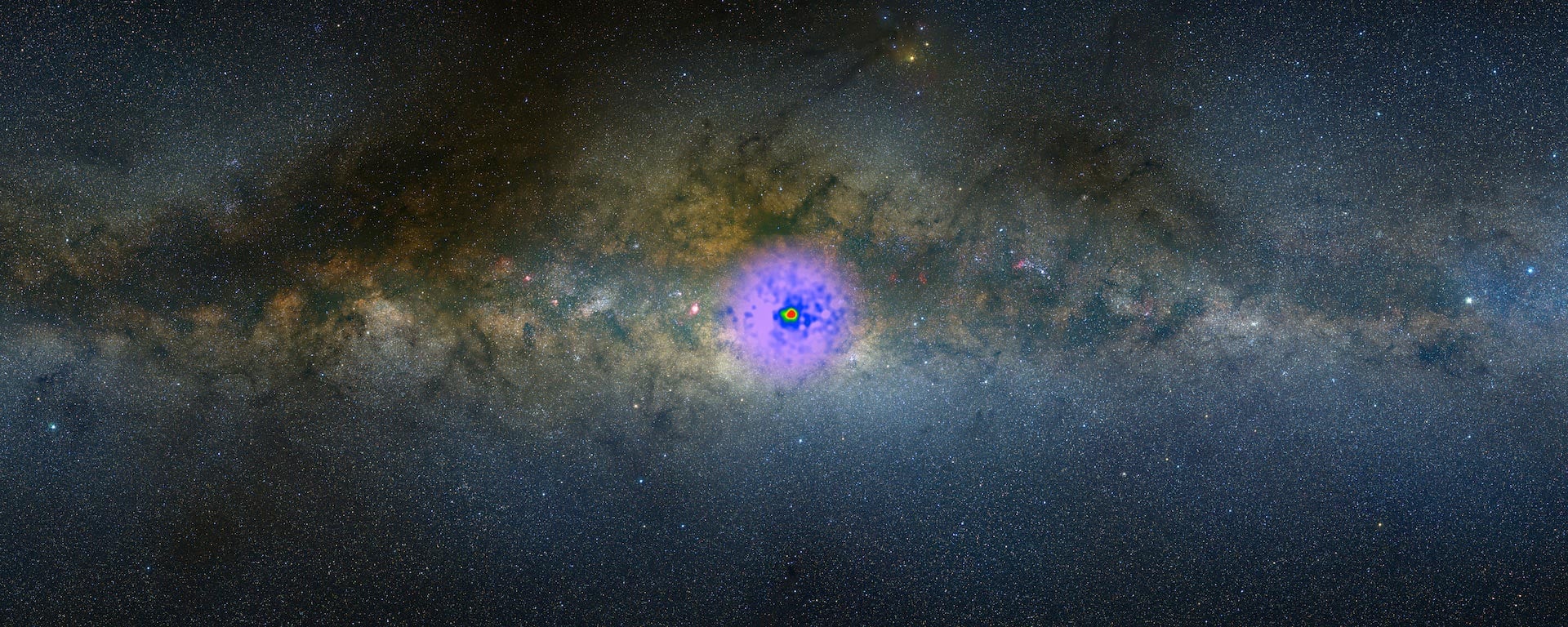
This gamma-ray glow, called "Galactic Center Excess" (GCE), is a weak spherical radiation distributed near the center of the Milky Way and extending for thousands of light-years. Since its discovery, its cause has been a topic of endless debate in the astrophysics community. The existing mainstream explanations include two major directions: one is the gamma ray signal generated by self-annihilation dark matter, and the other is from a large group of rapidly rotating neutron stars such as millisecond pulsars that have not been individually resolved. However, years of observation and analysis have never been able to provide conclusive answers to these two scenarios.
The difficulty, the researchers pointed out, is that the galactic center is one of the most complex, bright, and crowded regions in the entire gamma-ray sky. Various radiation sources overlap with each other, making parsing the nature of the signal particularly tricky. In the past, statistical analysis generally favored a "point source" explanation, which is to say that these excess radiation mainly come from numerous dense objects that are brighter but cannot be resolved individually. However, such studies generally only used information on the spatial distribution of photons in the sky.
To make up for this shortcoming, the new research team built a machine learning model and trained it with more than one million sets of simulated gamma ray observation data, allowing it to simultaneously analyze the spatial distribution and energy spectrum information of photons under the same framework. This is the first time that the key information of photon energy has been systematically incorporated into machine learning statistical analysis on the issue of excess radiation at the galactic center, which will help to more comprehensively compare different scenarios such as dark matter and millisecond pulsars.
After adding energy spectrum information, the analysis results changed significantly. Earlier research believed that if the signal source is a point source group, they should be relatively bright, but they are limited by the instrument resolution and have not been identified one by one. The latest results show that if these point sources are indeed millisecond pulsars, they must be much dimmer than previously assumed, so that their statistical characteristics are almost indistinguishable from the diffuse radiation produced by dark matter annihilation.
Specific estimates show that to completely explain the observed excess radiation with millisecond pulsars, their number would need to accumulate to at least about 35,000 near the center of the Milky Way, far exceeding the assumption of only hundreds to thousands of sources in some early studies. This result weakens the statement that "traditional point source groups alone can explain all signals" to a certain extent.
Team members say the new analysis does not prove that dark matter must be the true cause of the gamma glow, but it weakens one of the main objections to the dark matter proposal. In a machine learning framework that incorporates photon energy distribution, it is too early to completely rule out the possibility of contribution from dark matter annihilation. According to scientists, the origin of excess radiation at the center of the Milky Way remains one of the longest-debated open questions in contemporary astrophysics, and this work shows that dark matter is still a convincing "suspect" behind this cosmic mystery.