A new study from Osaka Public University brings a revolutionary breakthrough to the field of thermal engineering. An international research team led by Professor Koichi Okamoto and Associate Professor Shunsuke Murai of the School of Engineering have successfully developed a new programmable smart material.The technology breaks the laws of physics that have long limited the control of thermal energy, allowing engineers to manipulate and store heat with unprecedented precision in the same way a microchip controls electrical current. This breakthrough result has been recently published in the well-known academic journal "Laser & Photonics Reviews".
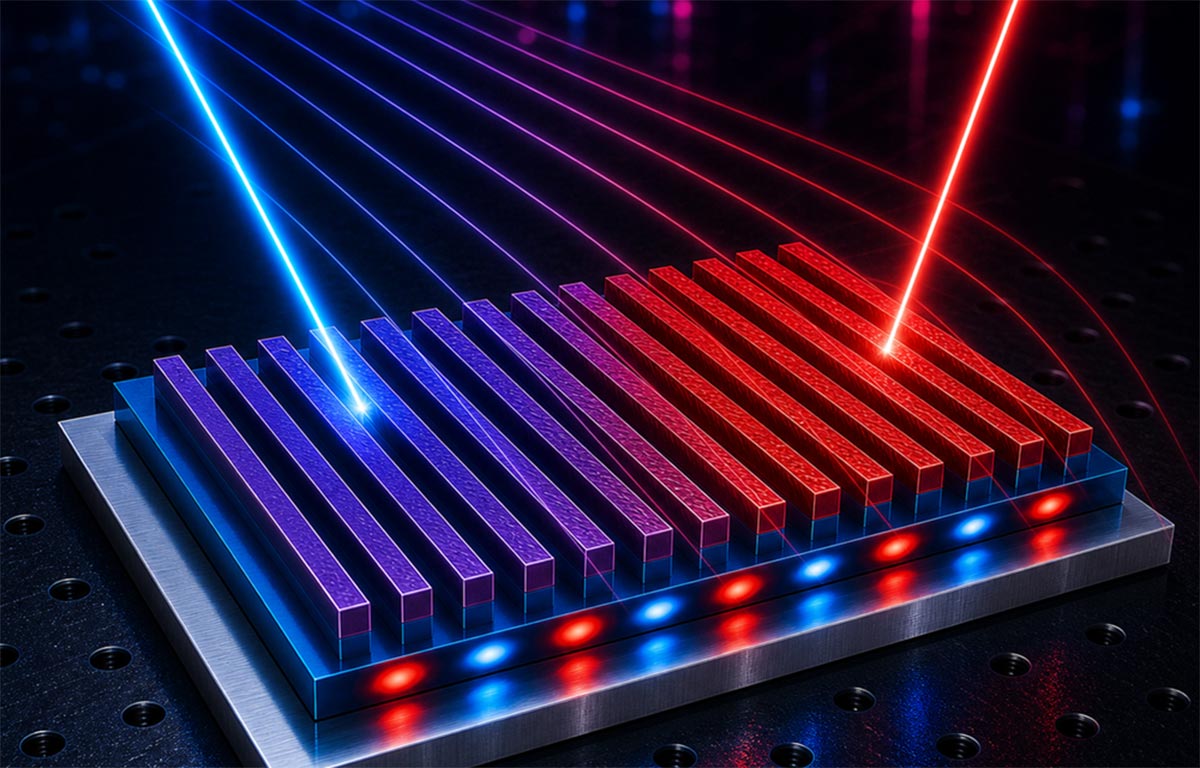
In traditional physics, the flow of heat has always followed the strict principle of "interchangeability" (ie, the law of reciprocity). This means that a material that efficiently absorbs heat in a specific direction and wavelength will release it in the same way, a property that has long limited scientists' ability to independently control heat absorption and emission. In order to break this traditional physical bond, the research team cleverly combined a "magneto-optical material" that changes the interaction characteristics of light under a magnetic field with a "phase change material" called GST, and successfully created a new device that can freely control the direction of thermal radiation.
What is even more groundbreaking is that the device can not only turn this directional radiation behavior on or off at will, but can also continue to maintain its set state after cutting off the power supply. This means that heat can be "programmed" and stored like data in a microchip.
The researchers noted that the system achieved a huge performance jump compared to previous designs. Traditional similar devices can only barely work when light is incident at very challenging and steep angles, at which point the efficiency of absorbing and emitting heat is greatly reduced. The new device completely solves this pain point and can show significant anisotropic response even at a quasi-sinusoidal angle where light is incident almost vertically. In addition, previous designs also had defects such as unstable switching status and loss of memory when powered off. However, the new device provides more reliable switching performance and can perfectly preserve its storage status without continuous power supply.
This innovative achievement shows a broad imagination in terms of application prospects. The research team stated that their ultimate goal is to develop miniaturized devices that can actively control thermal radiation. In the future, they are expected to not only enable smarter infrared sensors and more efficient energy conversion systems, but also promote the development of next-generation photonic storage technology - allowing future computer chips to use light and heat instead of traditional charges to store massive amounts of information. The successful implementation of this technology marks a solid step forward for mankind in the fields of thermal energy management and next-generation photonic computing.